
Key Takeaways
In an Asset Sale Your Company Is the Seller, and the Exemption Drops Out. The $1,275,000 lifetime exemption only works when you, as an individual, sell qualifying shares.
The Same $3 Million Can Leave You $230,000 to $415,000 Apart. An asset sale pays two tolls, one in the company and one when the money reaches you. The gap depends on your facts.
Your Company Has to Pass a Three-Part Health Check. Idle cash is the usual reason a profitable company fails it.
A Big Exempt Sale Can Still Bring Minimum Tax. On the $3 million example the second calculator adds roughly $185,000 in the sale year.
Most of the Bill Is Due April 30 of the Year After You Sell. For a 2026 sale that’s April 30, 2027, minimum tax included.
A single sentence in your business sale contract can cost you $230,000 to $415,000 more in tax on a $3 million deal.
When a buyer hands you a letter of intent, the short outline of the deal you both sign before the lawyers start, there is one line halfway down page one you can’t afford to skim past. “Purchaser will acquire substantially all of the assets of the Business.”
That line means the buyer wants your company’s stuff (equipment, customer lists, inventory) rather than your company’s shares. That one distinction switches off the biggest tax break most Canadian business owners are counting on, the lifetime capital gains exemption (LCGE).
For 2026, the LCGE shelters up to $1,275,000 of your profit from regular tax. But it only works if you, as an individual, sell qualifying shares.
Here’s how the two deals compare.
| Share sale (they buy your shares) | Asset sale (they buy your company’s assets) | |
|---|---|---|
| Who is selling? | You, personally | Your corporation |
| The $1,275,000 exemption | Applies, if your shares qualify | Does not apply |
| How many times is it taxed? | Once | Twice, first in the corporation, then again when you take the cash out |
The House Analogy
Think of your business as a fully furnished house.
If you sell the shares, you’re selling the whole house with everything in it. You hand over the keys, take the money, claim your exemption if your shares qualify, and walk away.
If you sell the assets, the buyer is only paying for the furniture. Your corporation is left as an empty house holding a pile of cash. Because the corporation sold the assets, it pays corporate tax on the profit. Then, to get most of that money out of the empty house and into your personal bank account, you pay yourself a dividend, and that triggers a second round of personal tax.
The $1,275,000 exemption can’t protect you from either of them.
Here’s what people usually miss.
- If a holding company owns your shares, it can’t use the exemption either.
- Spare cash piling up in the company can disqualify your shares, and that test looks back two years.
- Minimum tax, a second calculator the tax rules run on your year, can add six figures in the year you sell.
- In an asset sale, the split of the price between equipment, goodwill and a non-compete changes the bill.
- Selling to family or staff, or carrying a US passport, brings rules of its own.
On This Page
- Who Pays the Tax When a Business Is Sold in Canada?
- How Much Tax Is Due When You Sell Your Company’s Shares?
- Do Your Shares Qualify for the Lifetime Capital Gains Exemption?
- What Tax Does Your Company Pay When It Sells Its Assets?
- Share Sale or Asset Sale, What Does the Same Price Leave You?
- Can You Spread the Tax on a Business Sale Over Several Years?
- What If You Sell Your Business to Your Children or Your Employees?
- What Changes for US Citizens and People Leaving Canada?
- When Is the Tax on a Business Sale Due?
- 7 Common Traps When Selling a Business
- Frequently Asked Questions About Tax on Selling a Business
- What Should You Settle Before You Sign the Letter of Intent?
Who Pays the Tax When a Business Is Sold in Canada?
Whoever Owns What the Buyer Takes Is the One Who Pays.
1. In a Share Sale, You Are the Seller
You Report the Profit on Your Own Tax Return.
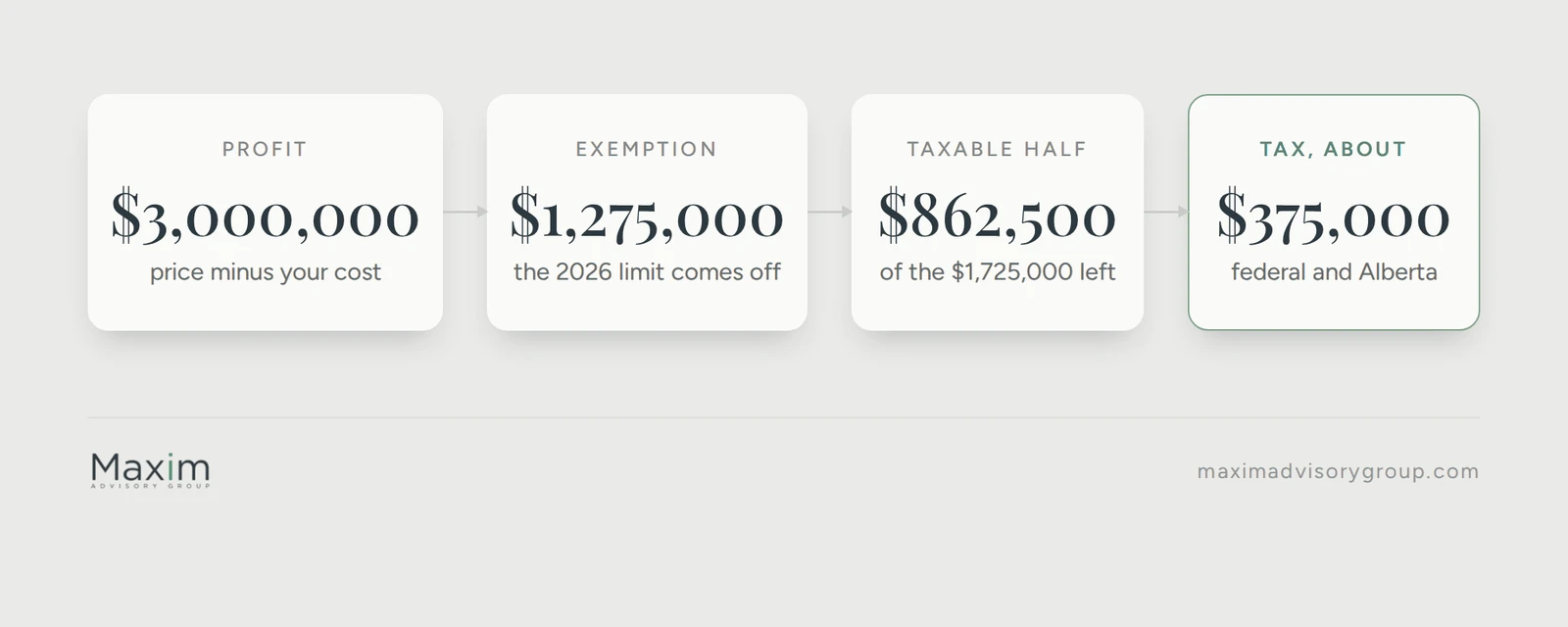
Your profit, the price minus what your shares cost, is called a capital gain. For most founders that cost is a few dollars. Half of that gain goes into your income for the year you sell. This is the only kind of sale the lifetime exemption can cover.
2. In an Asset Sale, Your Company Is the Seller
The Money Passes Two Toll Booths Before It Reaches You.
Think of the road from the buyer to your bank account as having two toll booths.
The first booth is the company’s tax. Your company gets the price and pays tax on each thing it sold. On equipment, some of the depreciation it deducted in earlier years comes back as income when the sale price is more than the value left for tax. Goodwill, what the buyer pays for your name and customer list, is mostly taxed as a capital gain.
The second booth is yours. Whatever is left after the company’s tax sits in the company. To get it into your hands, the company usually pays you a dividend, and you pay tax on that.
So the same dollar can be taxed twice. Part of the money can pass the second booth for free. And when the company pays you taxable dividends, some of the first toll comes back to it. Neither happens on its own.
How Much Tax Is Due When You Sell Your Company’s Shares?
Take Off the Exemption, Tax Half of What’s Left, Then Check Minimum Tax.
Now say the buyer rewrites the letter and takes your shares after all. How big is the tax bill? Smaller than you might fear, because the government taxes just half of any profit, and the exemption comes off first. Assume you have no other income that year and your shares qualify.
1. Is Only Half Your Profit Still Taxed?
Yes. Ottawa Dropped the Move to Two-Thirds in March 2025.
The share of a profit that gets taxed is called the inclusion rate. In 2024 the federal budget proposed raising it to two-thirds on the part of an individual’s profit above $250,000 a year. The government put it off to 2026, then cancelled it on March 21, 2025. The Income Tax Act still taxes one half.
If someone ran your numbers in 2024 using two-thirds, those numbers are out of date.
2. How Much Does the Exemption Cover in 2026?
$1,275,000 of Profit, and Two Things Can Hold Part of It Back for the Year.
The exemption rose to $1,250,000 for sales after June 24, 2024, and for 2026 indexing for inflation makes it $1,275,000. It’s a lifetime limit, so whatever you used on an earlier sale comes off what’s left.
Two things can hold part of it back in the year you sell…
- Investment costs that ran ahead of investment income. If the interest you paid on money borrowed to invest, and similar costs, has run ahead of your investment income since 1988, the gap is called a cumulative net investment loss, or CNIL.
- A business investment loss you claim the same year, meaning a loss on shares of, or a loan to, a small private company.
Your accountant takes both off on Form T657, the form that works out your claim.
So a history of borrowing to invest, or a recent loss on a small company, can shrink the tax-free part of this year’s sale, and the room it holds back can still be used in a later year.
3. Can Minimum Tax Still Catch You on an Exempt Sale?
Yes. It Counts All the Profit the Exemption Misses, and 30% of the Part It Covers.
Think of minimum tax as a second calculator. The tax rules run your year through your normal calculator and through this stricter one, which allows fewer breaks. You pay whichever number is higher. Its formal name is alternative minimum tax, or AMT.
The second calculator counts every dollar of profit the exemption doesn’t cover, plus 30% of the part it does. It takes off the first $181,440 in 2026, then taxes the rest at 20.5%. Here are the two calculators side by side on the share sale, federal tax only.
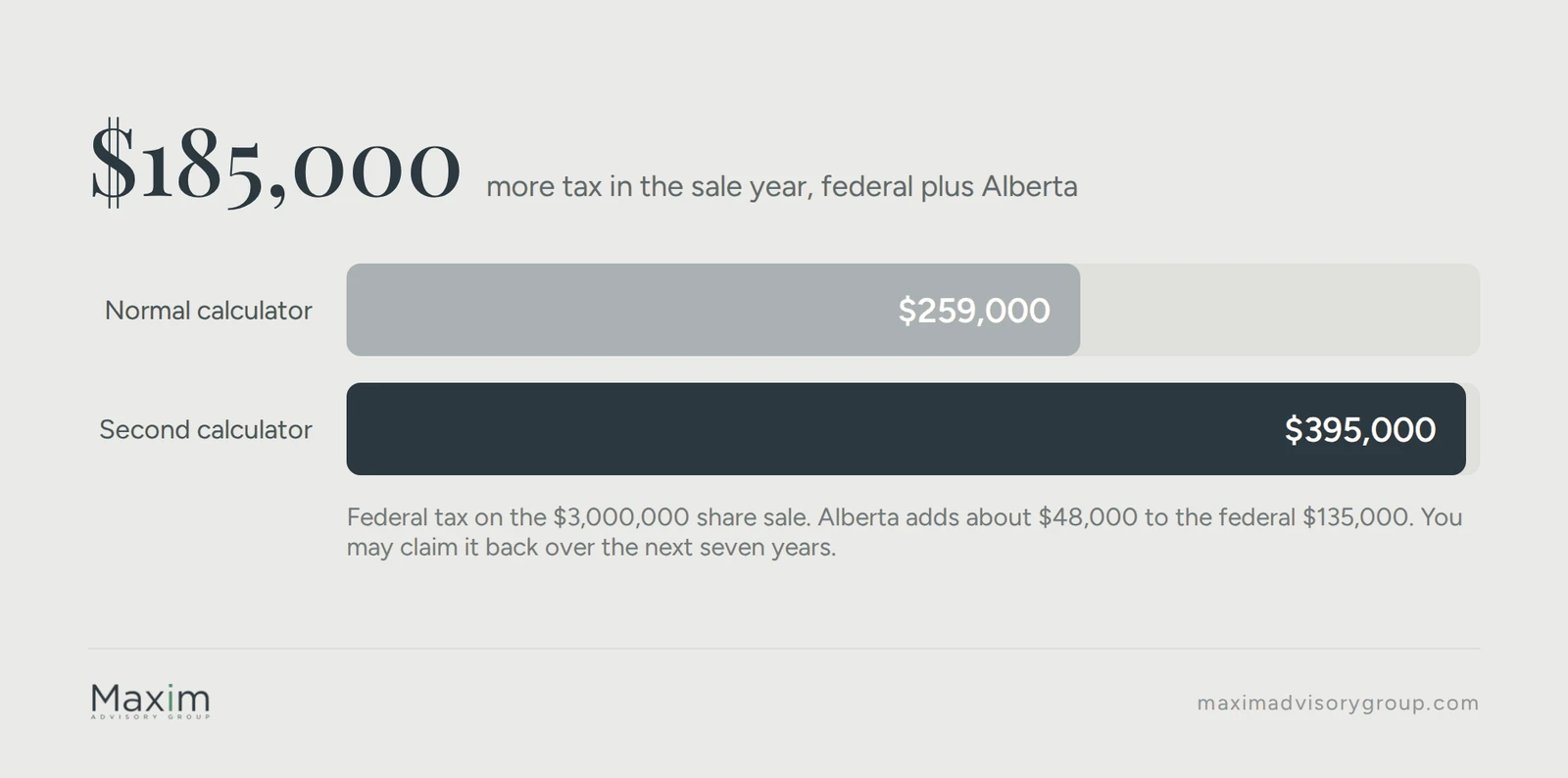 Personal credits and other income change these figures.
The second calculator comes out about $135,000 higher. Alberta adds 35% of that difference, about $48,000. So the sale year costs roughly $185,000 more than the normal bill.
That extra works as a prepayment, but it won’t come back on its own. In any of the next seven years when your normal calculator comes out above the second one, you can get part of it back. After a sale, with less income coming in, those years can be scarce.
4. Will the Sale Cost You Your OAS Pension?
For That Year It Can, Because the Exemption Doesn’t Shrink the Income the Clawback Looks At.
If you collect OAS, the exemption won’t protect it. The clawback reads your net income before the exemption comes off, so a $3 million sale repays that year’s pension in full and shrinks your payments for the following July to June. Our OAS clawback guide covers the timing, and Form T1213(OAS) can cut that second hit.
Do Your Shares Qualify for the Lifetime Capital Gains Exemption?
Your Company Needs to Pass a Three-Part Health Check, One Part on Sale Day and Two Looking Back Two Years.
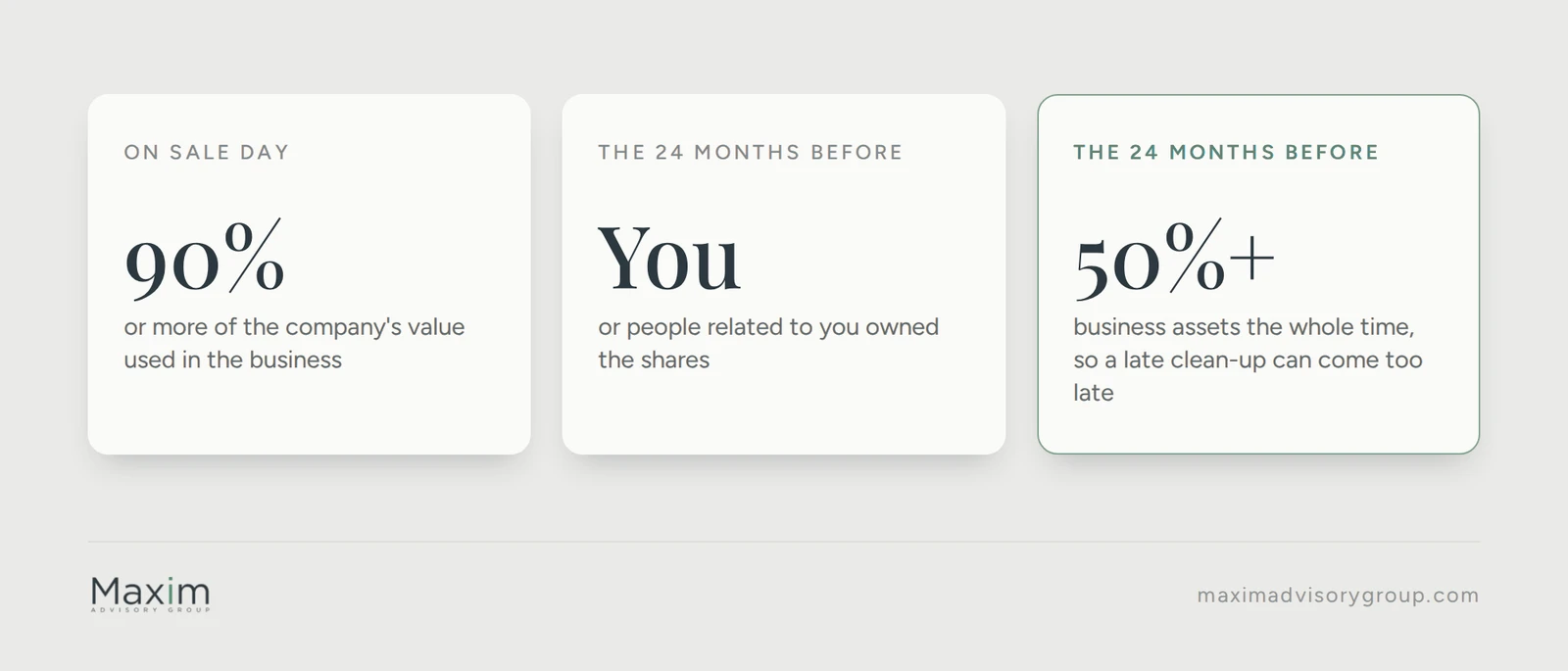
Even when the buyer takes your shares, the exemption isn’t automatic. Your company must pass a three-part health check first. In tax terms, the shares have to be qualified small business corporation shares, meaning shares in a private Canadian company that passes all three parts. Fail one part and none of the profit on that sale is tax-free.
Test 1. Are at Least 90% of the Company’s Assets Working in the Business on Sale Day?
Idle Cash Is the Usual Reason a Healthy Company Fails.
On sale day, the CRA looks at what your company owns. It wants “all or most (90% or more)” of what those assets are worth to be used in a business the company runs mainly in Canada. “Worth” here means fair market value, what the assets would sell for between strangers. Cash the business doesn’t need, and investments, don’t count.
The company must also be a Canadian-controlled private corporation on sale day, and for the two years before it (see Test 3). That’s a private company that people outside Canada and public companies don’t control.
If, for example, $600,000 of your company’s $3 million in assets is cash it doesn’t need, only 80% is working, so the shares fail on sale day.
Test 2. Did Anyone Besides You or a Close Relative Own the Shares in the Last Two Years?
New Shares Start Out With an Outsider’s History.
For the 24 months before the sale, the shares must have belonged only to you, or to people and partnerships related to you. Related is a legal term with a tighter circle than family. It covers your spouse, your children, grandchildren, parents and grandparents, your brothers and sisters, the same relatives of your spouse, your relatives’ spouses, and companies any of you control. A cousin, or your brother’s daughter, isn’t related.
New shares are the catch. Shares your company issues in that window count as if an outsider held them right up to their issue date, so their two-year clock starts from zero. There are three exceptions…
- shares issued in exchange for other shares
- shares issued for all or substantially all of an active business’s assets
- a stock dividend, which is a dividend paid in new shares instead of cash
If your company issued new shares in the last two years, for a reorganization or a new investor, have them checked against this part.
Test 3. Were More Than Half the Company’s Assets Working in the Business for the Whole Two Years Before?
This Part Looks Back, So a Late Clean-Up Can Come Too Late.
For the whole 24 months, the company generally has to have been a Canadian-controlled private corporation, with more than half its asset value used in the business. If a non-resident or a public company controlled it at any point in that window, get that checked before you count on the exemption. With 20% idle cash the whole time, your company passes this part.
Clearing the $600,000 out before the sale, a step advisors call purification, then gets it through all three. Paid out to you, though, that cash is a taxable dividend.
Now say idle cash hit 60% of the company’s assets at one point last year. Clearing it out today fixes Test 1. Test 3 keeps failing until two full years pass with business assets above half.
If your company owns shares of other companies, each layer faces a tougher version of these tests. Have a structure like that checked well before a buyer appears.
What Tax Does Your Company Pay When It Sells Its Assets?
Each Thing Your Company Sells Is Taxed Its Own Way, So How the Price Is Split Sets the Bill.
Somewhere in an asset purchase agreement is a schedule that splits the price. So much for equipment, so much for inventory, so much for goodwill, and a line for the non-compete. Your company pays a different toll on each line, and the buyer usually wants a different split from you.
1. Why Does Equipment Bring Back Tax Your Company Already Saved?
Depreciation Comes Back as Income When Equipment Sells for More Than Its Value Left for Tax.
Every year your company owned its equipment, the government let it deduct part of the cost. That deduction is called depreciation, and it lowered the company’s tax along the way. If a piece of equipment then sells for more than its value left for tax, the government takes that break back. The difference, up to what the equipment cost, is called recapture, and it goes back into the company’s income. Take one delivery truck.
| One truck | Amount |
|---|---|
| What the company paid | $100,000 |
| Value left for tax | $40,000 |
| Sale price | $70,000 |
| Recapture, added to the company’s income | $30,000 |
The truck held its value better than the write-offs assumed, so $30,000 of those write-offs comes back. It’s taxed in full as business income, with none of the half-off a capital gain gets.
2. How Is Goodwill Taxed When Your Company Sells It?
Half the Profit Pays the First Toll, and the Other Half Can Skip the Second.
Goodwill is what the buyer pays for your name and your customer list. Since 2017 it has had its own depreciation pool. When goodwill you built yourself is sold, the price above its tax cost is a capital gain.
At the first booth, the company pays tax on half of that gain as investment income, at about 46.7% in 2026 for a Canadian-controlled private corporation. When it later pays you taxable dividends, the government hands part of that tax back to the company. This is called the dividend refund.
The other half, the untaxed part, goes into the capital dividend account, a running total of money that can pass the second booth for free. The company pays it to you tax-free by filing Form T2054 when it pays the dividend.
3. Can You and the Buyer Split the Price However You Like?
Only Within Reason, and the Non-Compete Line Is Fully Taxable Unless You Both Elect.
The Income Tax Act replaces any split that isn’t reasonable with one that is, whatever the agreement says. That includes the price of the non-compete, your promise not to compete with the buyer.
A payment for agreeing not to compete is fully taxable unless the seller and the buyer jointly choose to treat it as part of the goodwill price. In an asset sale your company is the seller, so your company makes that choice with the buyer. It’s a letter both sign, because the CRA has never published a form for it.
The buyer may want you to sign a non-compete personally too. If you’re paid separately for it, that money is ordinary income to you. If you get nothing for it, and it’s part of the written deal under which your company gets the price, you and the buyer can jointly elect so that none of the price counts as paid for your promise.
4. Does GST Apply When Your Company Sells Its Assets?
Not If the Buyer Takes Nearly the Whole Business and You Both Elect.
Usually not, if the buyer takes 90% or more of what’s needed to run the business and you both sign the election on Form GST44. Without it, GST or HST applies to the taxable assets in the sale.
Share Sale or Asset Sale, What Does the Same Price Leave You?
Follow the Same $3 Million to Your Bank Account Both Ways.
So what does that line on page one cost you? Quite a lot, because the asset sale pays two tolls and gets no exemption.
Here’s the same $3 million followed all the way to your bank account both ways. In the asset sale, $300,000 of the price goes to equipment with $200,000 of value left for tax, so $100,000 is recapture, and $2,700,000 goes to goodwill.
The taxable dividend is the cash left after the company’s tax and the tax-free payout, plus the refund that paying it brings back.
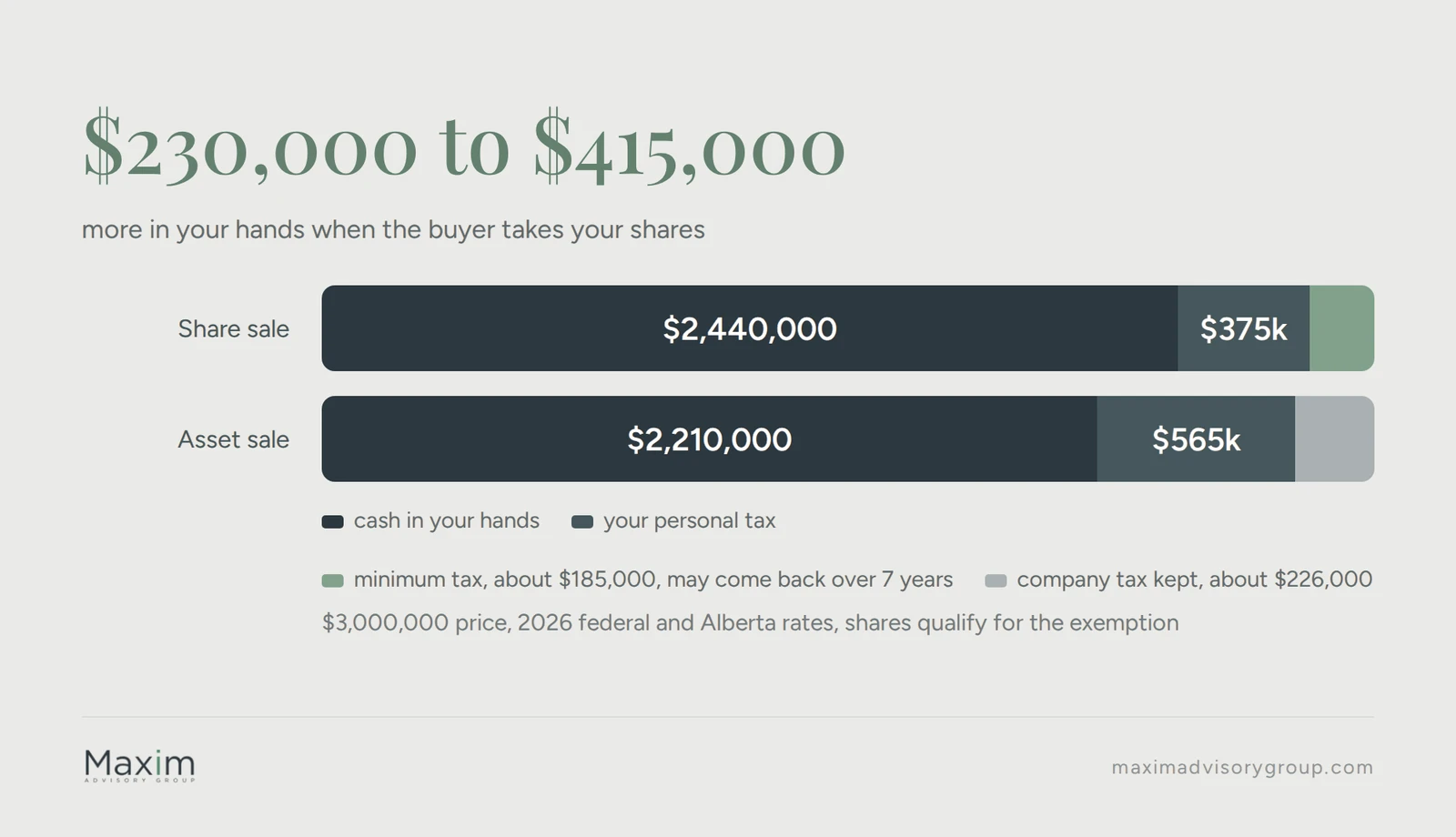
Assumes you own the shares yourself, they qualify, the sale is your only income that year, and the company pays everything out in the sale year. 2026 federal and Alberta rates, before personal credits.
On these figures, the share sale leaves you between $230,000 and $415,000 more. The low end assumes you never get the minimum tax back. The high end assumes you get all of it back.
The exemption shelters $1,275,000 of profit in the share sale and nothing in the asset sale. And the asset sale pays two tolls, once in the company and again on the dividend at your top rate.
Two things in the asset column can move. If you’re not a US citizen, the company can pay you over several years and put off personal tax on what it keeps. And a different split between equipment and goodwill changes the recapture line.
The Difference Is a Negotiating Number.
A buyer asking for assets is asking you to give up part of that difference. In return, they get a fresh cost to depreciate and none of the old company’s history. Ask for some of it back in the price before you sign.
Can You Spread the Tax on a Business Sale Over Several Years?
If the Buyer Pays Over Time, the Tax Can Follow, Up to a Point.
1. What Happens to the Tax If the Buyer Pays You in Instalments?
The Tax Can Trail the Payments for Five Years at Most, or Ten for a Child or an Employee Trust.
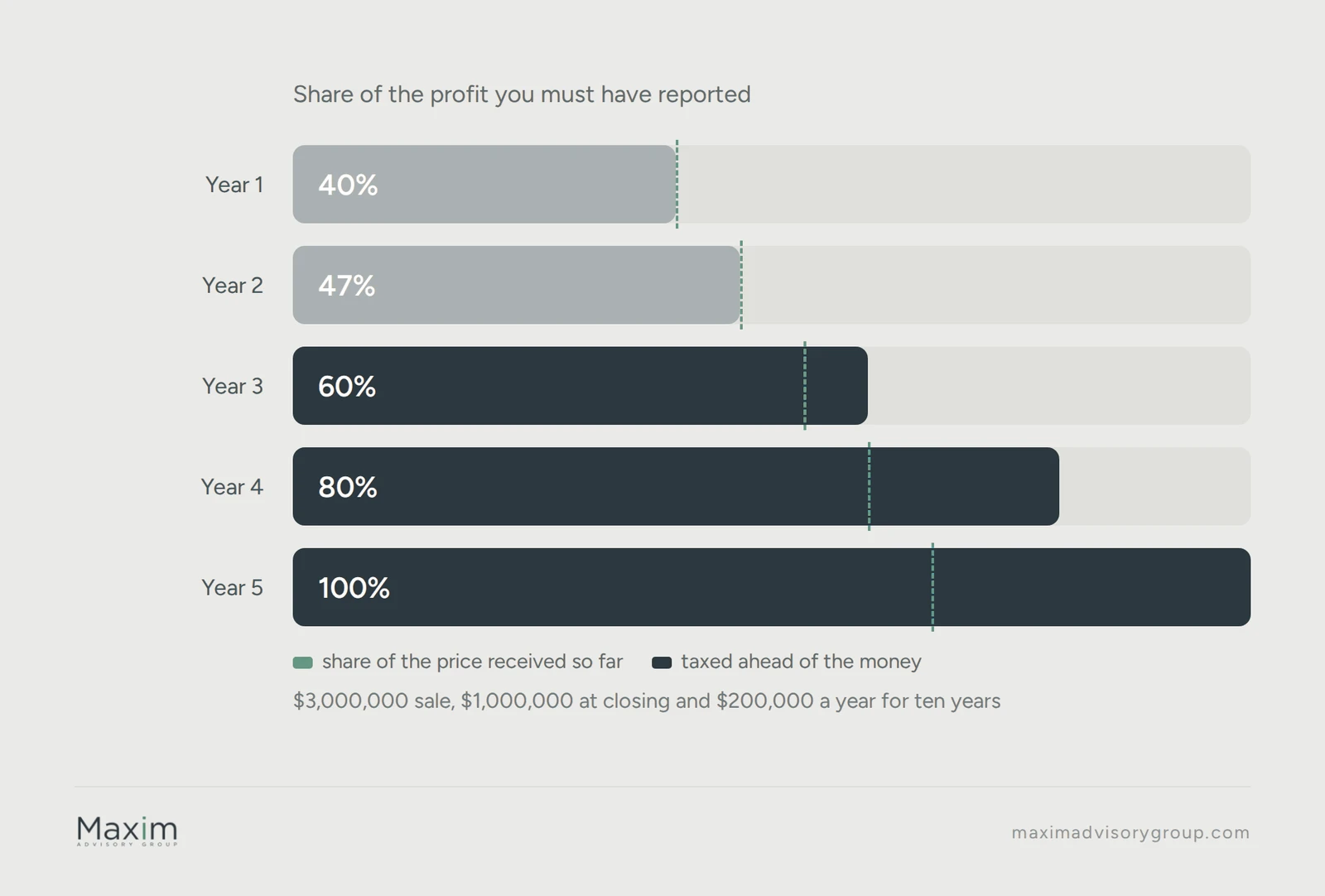
If the buyer pays over time, a capital gains reserve lets the tax trail the payments, but at least a fifth of the profit has to be reported each year. A sale of qualifying shares to your child or an employee ownership trust gets ten years instead. On a $3 million sale, with $1 million at closing and $200,000 a year for ten years, you’re paying tax on money you haven’t received from year 3.
2. How Is an Earn-Out Taxed?
The CRA’s Method Works for Shares Only, and Only on Six Conditions.
An earn-out is part of the price that depends on how the business does after you sell. On a share sale, the CRA lets you subtract each payment from your cost as it becomes certain, but only if the deal meets the six conditions in Interpretation Bulletin IT-426R, including an arm’s-length buyer and a five-year limit. In an asset sale, an earn-out tied to revenue can be taxed in full as income.
What If You Sell Your Business to Your Children or Your Employees?
A Sale to Your Child’s Company Can Keep the Exemption, and a Sale to Your Staff Can Shelter Up to $10 Million.
Not every buyer is a stranger. Sometimes the people who want the business are your kids, or the team that runs it with you. Either way, both cases have their own rules.
Your child will often buy through a company of their own, so the business’s future profits can pay for the shares. For years, selling to a relative’s company could turn your profit into a dividend, with no exemption and a higher rate. Selling the same shares to a stranger’s company carried no such penalty.
That changed for sales from January 1, 2024. Your profit now stays a capital gain, with the exemption available, if the handover passes one of two tests. The quick version is finished within 36 months. The slow version runs over five to ten years. Either way, you give up control of the company at the sale, and you and your child file a joint election on Form T2066.
Handing the business to your kids no longer has to cost you the exemption. You give up control at the sale, and the handover has to meet every condition of one of the two routes, including your child staying active in the business and you stepping out of managing it.
Selling to your employees. An employee ownership trust is a trust that holds the company’s shares for its staff. On a qualifying sale to one, up to $10,000,000 of profit can be exempt. That’s a separate exemption from your lifetime one. The $10 million is available once per business and shared among the owners who claim it, and the second calculator leaves that exempt profit out entirely. When it was introduced, it only covered sales from 2024 to the end of 2026. Legislation passed in June 2026 made it permanent, and it also covers sales to a worker co-op.
Four of its conditions stand out.
- A professional corporation can’t use it. That’s a company practising a regulated profession such as medicine, law or accounting.
- The shares need the same two-year history as for the lifetime exemption.
- You or your spouse must have worked in the business regularly and substantially for at least two years before the sale.
- At least three-quarters of the trust’s beneficiaries must live in Canada.
What Changes for US Citizens and People Leaving Canada?
The Exemption Only Works on Your Canadian Return, and Only While You Count as a Canadian Resident.
1. What If You’re American and Live in Canada?
The US Taxes the Profit on Its Own Terms, Exemption or Not.
If you’re a US citizen, passport or not, the sale goes on two tax returns. The US taxes the income of its citizens wherever they live. A clause in the Canada–US tax treaty, the saving clause, lets it keep doing that, and the Canadian exemption plays no part in the US math.
Normally the US stops the same profit being taxed twice by letting Canadian tax count against the US bill. That’s called a foreign tax credit. On the $1,275,000 the exemption covers, Canada collects little or no tax, so there’s little for the US to credit. The 3.8% US net investment income tax can also apply to the whole gain, and Canadian tax generally can’t offset it. That slice is where a US citizen’s US bill tends to show up.
Two more US rules can reach further.
- If you own 10% or more of a Canadian company that Americans control, a US rule can treat your profit on its shares as a dividend, up to the company’s past earnings.
- If the company sells its assets instead, its profit can show up as US income for you that same year, even while the money stays in the company. That rule, for foreign companies Americans control, was called GILTI until 2025 and is now called net CFC tested income.
As a US citizen, have the US side worked out before you pick shares or assets. Either choice can bring US tax that the Canadian numbers on this page don’t show.
2. What If You Move Away From Canada, or Already Have?
Residency Is Tested Over the Year You Sell.
The exemption is for someone resident in Canada all year. You also count as resident all year if you lived in Canada at some point that year, and for the entire year before or the entire year after.
Leaving is itself taxed, because Canada treats much of what you own as sold on your departure day. Departure tax in Canada explains it, and cross-border guidance maps out everything else a move involves.
Once you’ve left, Canada can still tax your profit on private company shares if Canadian real estate, resource or timber property made up more than half their value at any point in the last five years. Those shares are taxable Canadian property, assets Canada taxes even when the owner lives elsewhere.
In that case the CRA must hear from you within 10 days, on Form T2062. Without a clearance certificate, the CRA’s confirmation that the tax on the sale is paid or covered, the buyer holds back 25% of the price. The Canada–US tax treaty explains which country taxes the profit, and non-resident tax in Canada covers your other Canadian income after you leave.
Moving and selling within a few years of each other need planning together, because each one changes the tax on the other.
When Is the Tax on a Business Sale Due?
For a Sale in 2026, Most of the Bill Is Due on April 30, 2027.
Your 2026 return is due by April 30, 2027. If you or your spouse ran a business of your own outside a company, the return can wait until June 15, but the tax is still due April 30, minimum tax included.
Set the money aside at closing. A sale in January gives you fifteen months with a large tax bill sitting in your bank account, which is long enough to forget it is spoken for.
A sale year can also trigger quarterly instalments for the next two years, and the CRA’s reminders will base them on the sale year. If your income drops back, pay on your own estimate using the current-year option instead.
Here’s how the dates line up on a 2026 sale.
| When | What |
|---|---|
| April 30, 2027 | Your 2026 tax, including any minimum tax and any OAS repayment |
| September 15 and December 15, 2027 | Instalments, which the CRA’s August reminder bases on 2026, the sale year |
| July 2027 to June 2028 | OAS held back from your pension, based on your 2026 income |
| 2 or 3 months after the company’s year-end | The company’s tax on an asset sale. Two months, or three for a Canadian-controlled private corporation that claimed the small business deduction, the lower rate on its first $500,000 of business income, and whose taxable income the year before was within that limit |
| 6 months after the company’s year-end | The company’s return |
7 Common Traps When Selling a Business
Assuming the exemption follows your shares into a holding company. Only an individual can claim it, never a company. When a holding company sells the operating company, there’s no exemption to claim. Selling the holding company’s shares instead can work, but the health check then reaches through both companies, and that takes planning well before any offer.
Missing the cash that builds up in the company year after year. Idle cash grows quietly in a profitable company, so check it against the 90% and more-than-half tests every year, long before a buyer calls.
Treating the non-compete as a detail for the lawyers. Settle its price, and the joint election that keeps it from being fully taxed, before the purchase agreement is final.
Assuming the exemption keeps minimum tax away. The second calculator can add a six-figure bill in the sale year, due April 30 with the rest, even if you recover it later.
Treating a pre-sale dividend to your holding company as automatically tax-free. A dividend larger than the company’s “safe income”, roughly its after-tax earnings that belong to your shares, can be taxed as a capital gain. Work out safe income before the dividend is paid.
Assuming the buyer has filed the GST election. The buyer files Form GST44, but your company is the one that would otherwise have needed to collect the GST, so ask to see it filed.
Missing that an earn-out has to be written to fit the CRA’s six conditions. Ask for terms that meet all six, or price in the risk that the payments are taxed another way.
Frequently Asked Questions About Tax on Selling a Business
Short Answers to What Sellers Ask First.
How Much Does the Exemption Take Off Your Taxable Income in 2026?
Up to $637,500. The exemption covers $1,275,000 of profit. Only half of any profit is taxed, so the deduction on your return is half that, $637,500. Your accountant works it out on Form T657, and anything you claimed on an earlier sale comes off the limit.
Can Your Spouse Claim Their Own Exemption?
Yes, if they own qualifying shares themselves. Each individual gets their own limit. If the shares came from you, though, the tax rules can count their profit as yours. You avoid that if the transfer met specific conditions, such as selling them the shares at fair market value with the right election, or lending them the money at the CRA’s prescribed interest rate and collecting the interest every year.
What Happened to the Canadian Entrepreneurs’ Incentive?
It has not become law. Budget 2025 signaled the government isn’t going ahead with it, and nothing was ever legislated, so don’t plan a sale around it.
Is the Employee Ownership Trust Exemption Ending in 2026?
No. Legislation passed in June 2026 made it permanent. Some CRA pages still show the old 2026 end date.
What Should You Settle Before You Sign the Letter of Intent?
The Letter Sets Shares or Assets, and Changing That Later Means Reopening the Deal.
The letter of intent decides whether the buyer takes your shares or your company’s assets. The lawyers then draft everything else around that choice. Three things are worth settling before you sign it.
| Settle before you sign | Why it cannot wait |
|---|---|
| Shares or assets, and a price for each | On this page’s example the gap is $230,000 to $415,000 |
| Whether your shares meet all three tests, today and across the last two years | Idle cash is the usual reason a profitable company fails |
| How an asset price splits between equipment, goodwill and the non-compete | Each line is taxed differently, and the buyer will have its own split |
If your shares would have failed at any point in those two years, the fix runs on a 24-month clock.
That clock started before the buyer called.
We start with the structure, meaning who owns what, what the company holds, and what the three tests say on today’s numbers. The review is paid. If your shares already pass, it’s a short meeting.