

Key Takeaways
A Holdco Shares Your Company’s Low-Rate Bucket. Above $50,000 of investment income, every $1 shrinks the $500,000 bucket by $5, whichever company holds the investments.
Your Company Already Gives You the Tax Deferral. $100,000 left in an Alberta company keeps $89,000 to invest, against $52,000 paid out as top-bracket salary. A holdco only picks which vault the money waits in.
The Vault Keeps Some Creditors Out. The CRA and a bankruptcy court can still reach some of what’s inside.
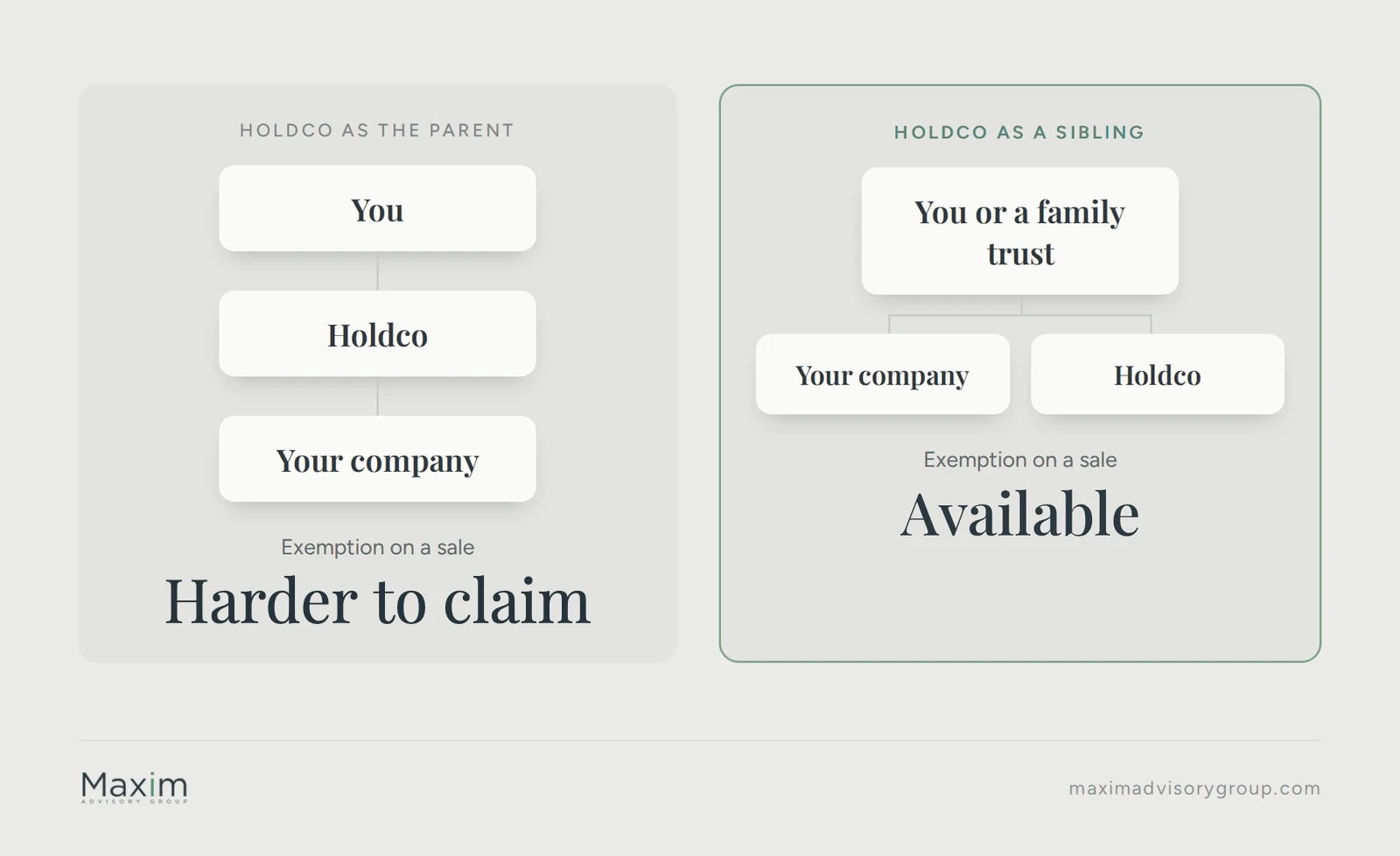
Parent or Sibling Decides the Exemption on a Sale. As the parent, a holdco makes the $1,275,000 exemption much harder to use. As a sibling, you or a family trust’s beneficiaries can generally still claim it directly.
An Alberta Health or Accounting Professional Corporation Can’t Have a Holdco as a Shareholder. Voting shares must belong to licensed members of the profession.
Could a holding company benefit you? Let’s look at a classic “suffering from success” scenario.
Imagine it’s March, and your year-end statements just arrived. Your business had a fantastic year. Even better, you’ve been responsibly parking your after-tax profits in a corporate investment account, which has grown to a healthy $1.8 million over the last eight years.
Then, your accountant points to a frustrating line item. Your company owes about $12,000 more in corporate tax this year than it would have for the exact same amount of work a few years ago.
Why? Because your investments are doing too well, and they are messing with your tax rate.
Here is a simplified look at where that surprise $12,000 tax bill comes from.
| This year | |
|---|---|
| Investment income last year ($1.8 million at 5%) | $90,000 |
| Amount over the $50,000 threshold | $40,000 |
| Cut to the $500,000 low-rate limit ($5 for every $1 over) | $200,000 |
| Business income from the company’s work | $400,000 |
| Income now taxed at 23% instead of 11% | $100,000 |
| Extra corporate tax (12% of $100,000) | about $12,000 |
Here’s what this means in plain English. Normally, the government gives your company a break. In Alberta, for example, the first $500,000 of active business income it earns each year (shared with any related companies) gets a very friendly “small business rate” of just 11%. Anything the company makes above that line gets taxed at 23%.
But there’s a problem. If your company makes more than $50,000 in passive investment income, the government starts shrinking your $500,000 low-tax bucket. In this scenario, your investments shrank your bucket so much that $100,000 of your hard-earned business income spilled over into the expensive 23% bracket. Your investments essentially ate your small business tax break.
Where a Holding Company Comes In
This is where your accountant will likely suggest setting up a holding company. Think of it as a parent company that owns the shares of your main operating business. It acts as a separate vault to hold the extra money your day-to-day business doesn’t need to operate.
While moving your investments into this new holding company won’t magically refund the $12,000 you just lost, it’s where a plan for your extra money usually starts. It keeps the money further from the business’s creditors and sets the company up for a sale.
Here’s what people usually miss.
- Your company and a holding company count as one for that $500,000 bucket, so moving the investments doesn’t refill it.
- The tax you put off by leaving money in a company comes from the company you already have. A holding company adds none.
- Even inside the vault, some of the money stays within reach of the CRA and a bankruptcy court.
- Set up as the parent of your business, it can cost you a tax-free amount on a sale worth up to about $300,000 of tax (half of $1,275,000, taxed at about 48%).
- Family members who own its shares pay the top tax rate on their dividends unless they fit an exception.
We’ll walk through each one.
On This Page
- What is a holding company?
- How does money get into a holdco?
- Does it lower your tax?
- Will it save your small business rate?
- Does it protect you from creditors?
- Selling the business
- Can you pay your family through it?
- Can an Alberta physician or dentist use one?
- How do you set one up?
- What does it cost to run?
- Leaving Canada, and US shareholders
- Is it worth it for your company?
- Forms and deadlines
- Mistakes that are easy to make
- Short answers
- What to bring to your next year-end meeting
What Is a Holding Company in Canada?
It Owns Your Company and Keeps What the Business Doesn’t Need.
A holding company in Canada, or holdco, is a company that sells nothing and does no work of its own. Its job is to own things. It owns shares of your business (the pieces of ownership), and often investments or real estate too.
Your business, the one that does the work and sends the invoices, is called the operating company, or opco.
The opco earns the money, and the holdco keeps it. The holdco is the parent and the vault, and the opco is the shop.
How Does Money Get From Your Company Into a Holding Company?
It Moves Up as a Dividend, and Usually Arrives Tax-Free.
Money moves from the shop to the vault as a dividend, which is a payout of company profit to whoever owns the shares. Here, that owner is the holdco.
A dividend from one Canadian company to another normally arrives tax-free, because the company receiving it can deduct it from its income. So if your company sends $300,000 of spare after-tax profit up to the holdco, the holdco usually owes nothing on it that year.
However, there are two rules you might want to consider.
The first is a tax the holdco gets back later. Sometimes the vault pays a deposit on the way in. The tax law calls it Part IV tax. It comes up usually in two scenarios…
- Your opco earned investment income of its own, and got some of that tax refunded when it paid the dividend. The holdco then owes a matching amount. This only happens when the holdco controls the opco, or owns more than 10% of both its votes and its value. The law calls those “connected” companies.
- The holdco collects dividends from companies it isn’t connected to, such as public companies it invests in. Those are taxed at 38⅓% when they arrive.
Either way, the holdco gets the deposit back when it pays dividends out to you.
The second is a limit on dividends that shrink a gain. A large dividend makes the opco’s shares worth less. That shrinks the profit you’d be taxed on if you ever sold them. So section 55(2) can treat part of that kind of dividend as a capital gain, which is the taxable profit on selling something for more than it cost. It can apply even in a year with no sale planned.
The safest amount to move is the after-tax profit the opco has kept over the years, which accountants call safe income. Move much more than that, and part of the dividend can be taxed as if you’d sold something.
Does a Holding Company Lower Your Tax?
Mostly It Changes When You Pay, and the Company You Already Have Does That.
The tax break you feel this year comes from leaving money inside a company instead of paying it to yourself. Your opco already gives you that, with or without a holdco.
Let’s just say that you have $100,000 your company earns this year and doesn’t need. Here’s what’s left of it each way, at 2026 federal and Alberta rates.
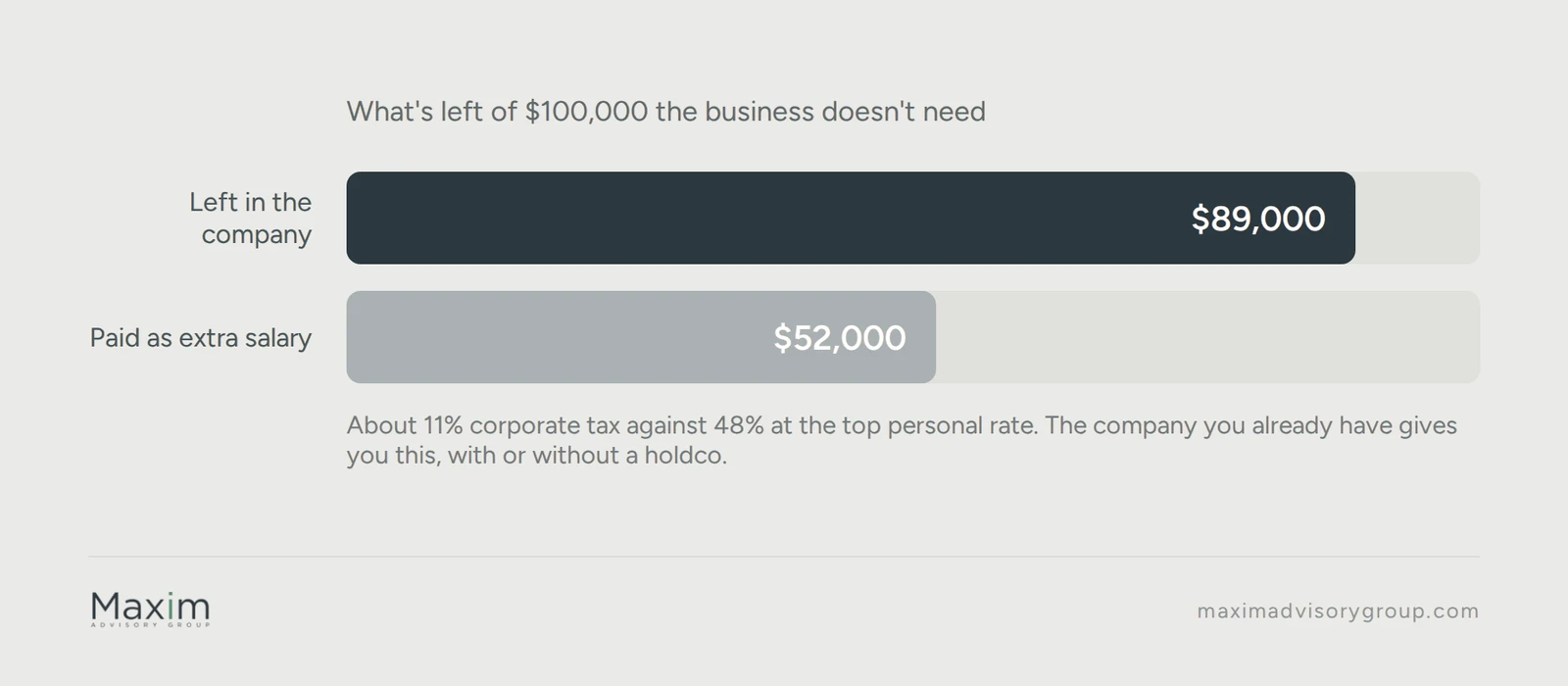
That $37,000 difference isn’t a saving. It’s mostly tax you’ll pay later, when the money leaves the company as a dividend. What you get is the years it spends invested in between.
What Happens to Investment Income Inside a Company
Once the money is invested, the shop’s low rate stops applying. Interest, rent, foreign income and the taxable half of capital gains are taxed at about 46⅔% inside an Alberta company, which is 38⅔% federal plus 8% Alberta. That’s close to the top rate you’d pay personally.
Part of it comes back later. Here’s $10,000 of interest earned in the holdco.
| $10,000 of interest in the holdco | |
|---|---|
| Tax when it’s earned (about 46⅔%) | about $4,700 |
| Refunded once the holdco pays you about $8,000 of taxable dividends | about $3,100 |
| Tax the company keeps | about $1,600 |
The refund is there so investment income costs about the same whether you earn it yourself or through a company. In Alberta it ends up slightly higher, once the dividend is taxed in your hands.
Capital gains open one of the few tax-free doors out of the vault. Tax applies to just half of any capital gain. The untaxed half goes into a running total called the capital dividend account, and the holdco can pay that amount to you tax-free. To do it, the holdco files an election form, Form T2054, by the day the dividend is paid or becomes payable, whichever comes first. Confirm the balance before you pay, because a capital dividend bigger than the account gets hit with a 60% tax on the excess.
Will a Holding Company Save Your Small Business Rate?
No. Your Company and Its Holdco Share One Bucket.
The tempting idea is that a holdco comes with a second $500,000 bucket of its own. The tax rules give the two companies one. A holdco and the opco it controls are associated companies, meaning companies under common control, so the rules add up their investment income and give them a single $500,000 bucket to share. Moving the investments from the shop to the vault leaves the bucket just as small as it was.
Accountants call the shrinking the passive income grind. It starts once the companies’ investment income passes $50,000 a year, and at $150,000 the bucket is empty.
Find your company’s row.
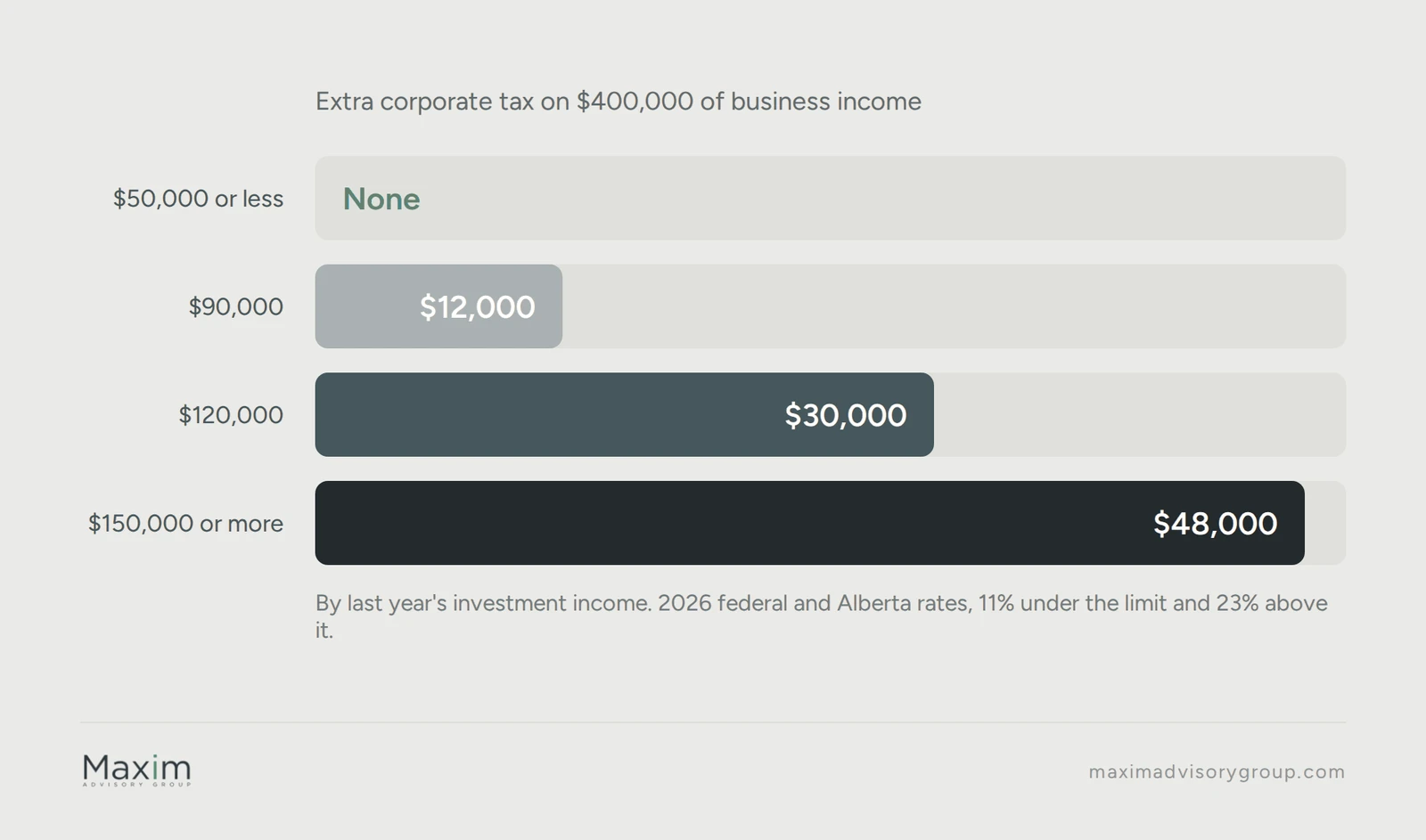
At 2026 federal and Alberta rates, with $400,000 of business income.
In other words, every extra $10,000 the portfolio earns above $50,000 costs your company about $6,000 of extra corporate tax, as long as the business earns more than what’s left in the bucket.
Keep these three things in mind…
- The bucket is set by last year’s investment income, so this year’s bill reflects how the portfolio did a year ago.
- Alberta shrinks its share of the bucket the same way, so income that spills over pays the full 12-point gap between 11% and 23%.
- Some of the cost comes back later. Income taxed at 23% lets the company pay eligible dividends, which are taxed at a lower personal rate than other dividends.
What you can control is timing. A gain only counts once you sell, and when you sell is a choice you make each year.
Does a Holding Company Protect Your Money From Creditors?
It Does Protect Some of It, From Some Creditors.
If someone sues the shop, they can go after everything the shop owns. A claim over a leaking roof on a job your company finished can empty the whole $1.8 million in its investment account. Scary, but true.
Once surplus moves up to the holdco as a dividend, it belongs to a different company. The vault isn’t part of the shop, so most claims against the shop touch only what’s still in the shop.
A few things can still reach the vault, though.
- A personal guarantee, which is your own promise to pay the company’s debt if it can’t. If you signed one for the opco’s line of credit, it follows you wherever the money sits.
- Money moved to dodge creditors. If money moves up while the business can’t pay its debts, or knows it soon won’t be able to, and the point is to keep it from creditors, a court can void the transfer.
- The opco’s unpaid tax. If the opco later owes tax for that year or an earlier one, the CRA can in some cases collect it from the holdco, up to the amount moved.
- A bankruptcy, where a court can order dividends paid while the opco couldn’t pay its debts to be repaid.
The vault keeps out the shop’s everyday creditors best when the money goes in early and regularly, while the business is healthy. We handle the tax side and work with your lawyer on the legal side.
What Happens to a Holding Company When You Sell Your Business?
Where the Holdco Is Decides Whether You Keep the Exemption.
When you sell shares in a qualifying small business, the first $1,275,000 of profit in 2026 can be free of regular tax. That’s the lifetime capital gains exemption. The profit, or capital gain, is what you sell the shares for minus what they cost you.
To qualify, your shares have to clear three hurdles…
- On the day you sell, at least 90% of the company’s value sits in things used in the business.
- Throughout the previous two years, that share stayed above half.
- Nobody but you or a person related to you owned the shares in that time.
Your company fails the first test today. Its $1.8 million of investments sits next to a business worth about $2 million, so only about half of what it owns is business.
A shop stuffed with investments doesn’t count as a small business for the exemption. Moving the surplus out well ahead of a sale fixes that, and it’s called purifying the company. The holdco is the usual place for the surplus to go.
Parent or Sibling? Where the Holdco Sits Matters
The holdco can also sit beside your company like a sibling, with you or a family trust (a trust that holds shares for your family) owning your company directly. On a sale, the difference is the whole exemption.
| Holdco as the parent (above) | Holdco as a sibling (beside) | |
|---|---|---|
| Who owns your company | The holdco | You, or a family trust |
| How surplus reaches the holdco | Dividends on the shares it owns | Through the trust, or through its own class of shares in your company |
| Who sells your company’s shares | The holdco | You, or the trust |
| Exemption on the sale | Harder to claim. Only people can claim it | Available to you, or to the trust’s beneficiaries |
Selling the holdco’s own shares can sometimes still work, but then both companies have to pass the tests, and investments sitting in the vault make that much harder. It takes planning well ahead of a sale.
If a sale is possible, the holdco usually belongs beside your company, as its sibling.
There’s a catch in the word “regular”. The exemption only removes regular tax. Minimum tax, a second calculation that allows fewer deductions, still counts 30% of the exempt profit. Any minimum tax you pay can be credited against your regular tax in any of the following seven years.
The limit on dividends that shrink a gain bites hardest just before a sale. Suppose your company has kept $500,000 of after-tax profit over the years, but is worth $2.5 million, mostly goodwill (the value of its name and client list). Just before the sale, it declares a $1.2 million dividend to the holdco to shrink the profit on the shares, often paid with a promissory note (a written promise to pay later). Section 55(2) then splits it.
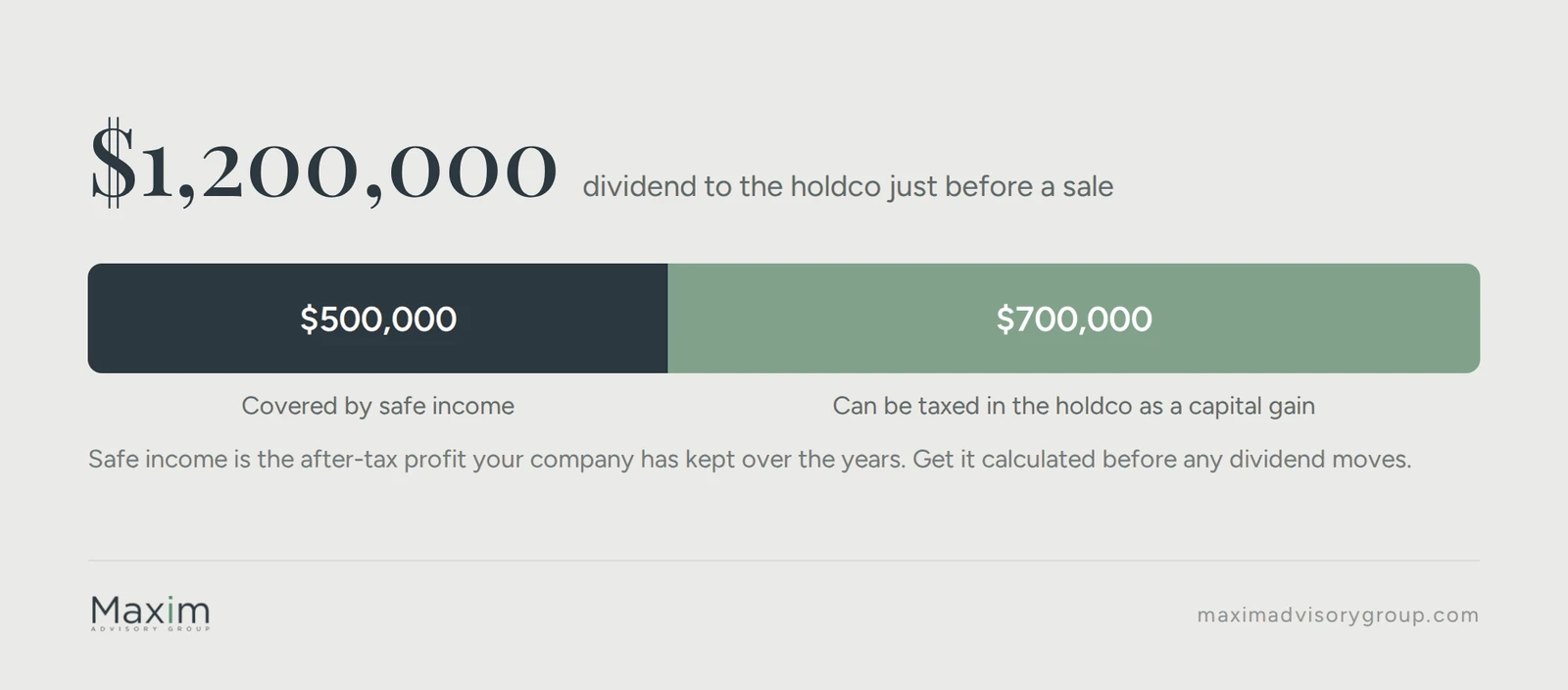
If a sale is coming, get the safe income calculated before any dividend moves.
Can You Pay Your Family Through a Holding Company in Canada?
Only Through an Exception, Because the Default Is the Top Tax Rate.
It used to be much simpler. You gave your spouse or adult children some holdco shares, paid them dividends, and the income was taxed at their lower rates. Since 2018, a rule called the tax on split income, or TOSI, taxes those dividends at the top personal rate unless an exception applies.
So if your spouse has no other income and receives a $50,000 dividend, it’s taxed as if every dollar sat on top of a high income.
The three exceptions owners use most are…
- Your spouse, from the year you turn 65. Dividends to your spouse are generally treated as if they were paid to you.
- Real work in the business. An adult family member who works in it regularly and substantially qualifies. The rules count an average of 20 hours a week, this year or in any five earlier years, as enough.
- Owning a real stake, which the rules call excluded shares. The family member has to be 25 or older and own at least 10% of both the votes and the value. The company can’t be a professional corporation, and less than 90% of its business income can come from services. Almost all its income also has to come from something other than a related family business.
A holdco that lives on dividends from the family business fails that last test. For a holdco, the age-65 rule and real work in the business are usually the exceptions that fit.
Can a Physician or Dentist in Alberta Use a Holding Company?
Not as an Owner of the Professional Corporation.
A professional corporation is the company a doctor, dentist or other regulated professional practises through. Alberta limits who can own one.
Voting shares are the shares that come with a say in how the company is run. In Alberta, every voting share must belong to a member of the college, which is the body that licenses the profession. Non-voting shares can go only to those members, or to a member’s spouse or common-law partner, their child, or a trust for the member’s minor children. A holding company isn’t on that list.
The College of Physicians & Surgeons of Alberta reads the rule the same way. The rule covers every profession under the Health Professions Act, and chartered professional accountants face a matching rule under their own Act.
So a doctor’s, dentist’s or accountant’s professional corporation in Alberta can’t have a holdco among its shareholders at all, so a parent holdco is off the table. The investments stay in the shop, the shrinking bucket applies to it directly, and the “owning a real stake” exception for family dividends isn’t open to it.
How Do You Set Up a Holding Company in Canada?
The Company Is Easy to Create. Moving Your Shares Into It Is Where the Tax Sits.
Creating the holdco is an ordinary incorporation, federally or in Alberta. If the holdco will be the parent, the tricky part is getting your company’s shares into it.
Say your company’s shares cost you $10 when you started it, and the company is now worth about $3.8 million, counting the business and the $1.8 million portfolio. There are two ways to put those shares under the holdco.
| Sell them to the holdco for cash or a note | Swap them for new holdco shares | |
|---|---|---|
| What you receive | Cash, or a promissory note (a written promise to pay you later) | Holdco shares |
| Tax now | Almost the whole $3.8 million is taxed as a dividend, at a higher rate than a capital gain | None, if you elect your $10 cost |
| When tax arises | This year | When the holdco shares are sold, when you die, or when you leave Canada |
The swap is called a section 85 rollover. It’s a transfer you can make without paying tax at the time. You and the holdco agree on the price the shares move at, usually what they first cost you, and the tax waits.
Keep in mind these three things…
- The value has to hold up. The swap rests on what the shares are worth, and the CRA can disagree.
- Form T2057, the rollover’s election form, has a deadline. It’s due by the earliest filing deadline of anyone involved, for the year of the transfer. The CRA accepts it up to three years late, with a penalty of up to $100 a month, capped at $8,000.
- The share terms are hard to change later. Which classes of shares the holdco issues, and who owns them, decide who can receive dividends and when. Changing them means another reorganization.
One More Rule If Family Will Own Shares
If your spouse or a child under 18 will own holdco shares, directly or through a family trust, the corporate attribution rule can apply. It’s there to stop owners shifting investment income to family through a company. When it applies, you’re taxed each year on a set amount of interest, at a rate the CRA sets called the prescribed rate, even though nobody paid you that interest.
The rule generally switches off while the holdco’s assets are almost all business assets, or shares of a company that passes the same test itself. A holdco that keeps an investment portfolio fails it, and so does a company like yours with a large portfolio of its own. A family trust can also be set up so the rule doesn’t bite. Have it reviewed before anyone is issued shares.
What Does a Holding Company Cost to Run?
A Second Company Means a Second Set of Everything, Every Year.
The vault comes with its own paperwork.
- its own books, and its own bank and investment accounts
- a minute book, which is the record of its decisions and shareholders, plus an annual return to the corporate registry
- a corporate tax return, the T2, every year, even in a year it earns nothing
- T5 slips, the tax slips for dividends, for anything it pays you
Ask whoever will keep its books to quote the annual fee before you set it up. That fee comes back every year.
The vault has to be worth more to you than it costs to keep. For a company that only keeps $30,000 a year, for example, it often won’t.
What Happens to Your Holding Company If You Leave Canada?
The Companies Stay Canadian, and Leaving Counts as Selling Your Shares.
Your shop and your vault don’t move when you do. A company incorporated in Canada after April 26, 1965 stays resident here wherever its owner lives.
You get taxed on the way out. When you give up Canadian residency, it counts as selling your shares, and much of your other property, at what they would fetch that day. That’s the departure tax. For your company, it means a gain of nearly $3.8 million on shares that cost you $10.
What Changes Once You’ve Gone
- Dividends. Canada holds back 25% of each dividend the holdco pays you, or 15% under the Canada-US tax treaty if you’re a US resident.
- The company’s status. Once non-residents control it, it stops being a Canadian-controlled private corporation, the status behind the small business rate. The low-rate bucket is gone, and its shares no longer qualify for the exemption on a sale.
- Its investment income is taxed at the general corporate rate, with no refund when the holdco pays dividends.
Our non-resident tax guide and Canada-US treaty page pick up from here, and cross-border guidance is where the whole move gets planned.
What If You or a Family Member Who Owns Shares Is a US Citizen?
Then the Holdco Is a US Tax Matter Too, Even If You Have Never Lived There.
People with a US green card count the same way. Which US rules apply depends on how much of the company US owners hold.
| Who holds the company | What the IRS calls it | What it means for you |
|---|---|---|
| US persons who each own 10% or more, together holding more than half | A controlled foreign corporation, meaning a foreign company controlled by US owners | Form 5471 every year. The IRS can also tax your share of the company’s income each year, even if nothing is paid out. Since 2026 that generally includes most of its business income too, because Alberta’s 11% small business rate is too low to get out from under the US rules. |
| Otherwise, if it mostly holds investments | Usually a passive foreign investment company, the US label for a foreign company that mostly holds investments | Form 8621 every year, and a harsh default tax on gains and payouts |
A holdco built only for Canadian rules can leave a US tax bill with nothing Canadian to credit against it. Get the US side modeled before anyone is issued shares.
Is a Holding Company Worth It for Your Company?
It’s Worth It Through Claims and a Sale, and Only Then.
Remember the $12,000 from the March example? A holdco won’t bring it back. What shrinks it in future years is less investment income across your companies. That means a smaller portfolio, a mix that pays out less each year, or gains taken less often.
A holdco is great in two other ways.
- Distance from claims. If your business could face claims, from work that goes wrong to disputes with suppliers, moving surplus into the vault each year while the business is healthy keeps it further from the next one.
- A cleaner sale. If you might sell in the next few years, set the holdco up as a sibling and start purifying at least two years ahead.
A holdco usually isn’t worth it in these cases.
- You spend most of what the business earns, so there’s little to put in the vault.
- A sale is close and the company is already clean. Reorganizing inside the two-year window can create new problems.
- You expect to leave Canada within a few years.
- What you want is estate or family planning, which a will and a trust can handle for less.
Which Forms and Deadlines Apply to a Holding Company?
Six Canadian Filings, Plus Two US Forms If a Shareholder Is a US Person.
These are the filings a holdco and its owners run into most.
| Form or filing | What it’s for | When it’s due |
|---|---|---|
| T2057 | Telling the CRA about the share swap that puts your company under the holdco | The earliest filing deadline of anyone involved, for the year of the swap |
| T2 return | Each company’s yearly tax return | Six months after year-end |
| Corporate tax balance | Paying any tax the company owes | Two or three months after year-end |
| T5 slips | Reporting dividends paid to shareholders | The last day of February after the calendar year |
| T2054 | Making a capital dividend tax-free | The day the dividend is paid or becomes payable, whichever comes first |
| T1135 | Reporting foreign investments, such as US shares, that cost more than $100,000 in total | The company’s T2 deadline |
| Form 5471 (US) | Reporting a controlled foreign corporation | With each US shareholder’s return |
| Form 8621 (US) | Reporting a passive foreign investment company | With each US shareholder’s return |
Two Months or Three?
The tax balance is due 2 months after year-end, or 3 months for a company that qualifies. To qualify, the company must have used the small business rate this year or last. Its associated companies’ combined taxable income last year must also have stayed within their combined bucket, after any shrinking.
Say your company’s bucket was already cut to $300,000 last year too. Its taxable income last year, about $490,000 from its work and its investments, was well over that, so it doesn’t qualify and pays in 2 months. A holdco that earns only investment income doesn’t use the small business rate, so it usually pays in 2 months too.
Which Holding Company Mistakes Are Easiest to Make?
Each One Starts From an Assumption That Sounds Reasonable.
- Assuming the vault gets its own bucket. Add up both companies’ investment income before you move anything. That combined number is the one that shrinks your low-rate bucket.
- Missing the safe income figure before a sale. That’s the after-tax profit your company has kept, worked out from its whole tax history. Start the calculation as soon as a sale looks possible.
- Assuming every dividend into the vault is tax-free. Check whether your company has been getting refunds on tax from its own investments. Dividends that trigger those refunds come with a deposit the holdco only gets back later.
- Missing the T2057 deadline. Note the earliest filing date of every person and company in the share swap. The late penalty adds up each month.
- Assuming family members pay tax at their own rate. Check which exception each family member fits before anyone gets shares.
- Treating the parent setup as the default. If a sale is possible, decide parent or sibling at least two years ahead.
- Missing US citizenship or a green card on the share register. Ask every shareholder, including a spouse who might be added later, before shares are issued.
If one of these describes your structure, bring it to a paid advisory consultation.
What Else Do Owners Ask About Holding Companies? (FAQs)
Can a Holding Company Own Real Estate?
Yes. Rent from outside tenants is usually investment income and counts toward the shrinking bucket, unless the rental business has more than five full-time employees. Rent your own company pays the holdco for its office or yard is the exception, and it’s treated as business income instead.
How Do You Get Money Out of a Holding Company?
Usually as a taxable dividend. A capital dividend can also come out tax-free, up to the balance of the capital dividend account, and it doesn’t count toward the Old Age Security clawback, which is the repayment of OAS once your income passes a threshold. Taxable dividends do count, at more than their cash value because of the gross-up, and for 2026 income the clawback starts at $95,323.
Does an Estate Freeze Need a Holding Company?
No, it can be done inside your company itself. A freeze swaps your shares for new ones fixed at today’s value, and new growth shares go to your children or a family trust, so the tax at your death is capped at today’s value. If a family trust holds the growth shares, it counts as selling most of its capital property every 21 years.
What Should You Bring to Your Next Year-End Meeting?
Three Things From This Year’s Statements and Share Register Answer Most of It.
When next year’s statements arrive, bring these to the meeting.
- Last year’s investment income, across every company you own. It tells you how much of your low-rate bucket is gone, and how close the next $10,000 of income is to costing you another $6,000.
- The after-tax profit your company has kept over the years. That’s roughly its safe income, the amount that can move into the vault without the risk of being taxed as a gain.
- The share register, plus any sale, move abroad or US citizenship that could come up in the next two years. Those decide whether a holdco should be a parent, a sibling, or not exist at all.
If You Already Have a Holdco
Much of this can still change. You set the portfolio’s mix and the timing of gains every year. And a holdco set up as the parent can usually be reorganized before a sale, given enough lead time.
We look at every company, who owns which shares, where the surplus sits, and what each layer costs and saves you in tax each year. When a valuation is needed, for a rollover, a sale or an estate freeze, we build one the CRA or a buyer can check line by line.
We charge $500 an hour, and engagements generally run 10 to 60 hours ($5,000 to $30,000). You’ll have an estimate after the first consultation. Sometimes the consultation alone is enough. If you want a free answer in twenty minutes, we aren’t the right firm.