Key Takeaways
One Good Year Can Cost You Some OAS. Past $95,323 of net income for 2026, you give back $150 of OAS for every $1,000 over, until none is left.
Dividends Count for More Than the Cash You Got. Your return adds 38% to an eligible dividend, and 15% to other dividends, before the clawback looks at your income.
A Tax-Free Sale of Your Shares Still Counts. Half the gain goes into net income before the lifetime capital gains exemption comes off, so that year’s OAS can go back in full.
One High Year Hits Your Cash Twice. Your return settles the bill in the spring, then money is held back from the next July to June of payments, and Form T1213(OAS) asks the CRA to hold back less.
Living in the US Usually Ends the Clawback. OAS paid to a US resident is taxed only in the US, provided your OAS keeps being paid abroad, which takes 20 years in Canada after 18, or 20 years combined with time in a country Canada has a social security agreement with.
Will one good year cost you some of your Old Age Security? For a lot of retirees, it does, and the bill shows up later than they expect.
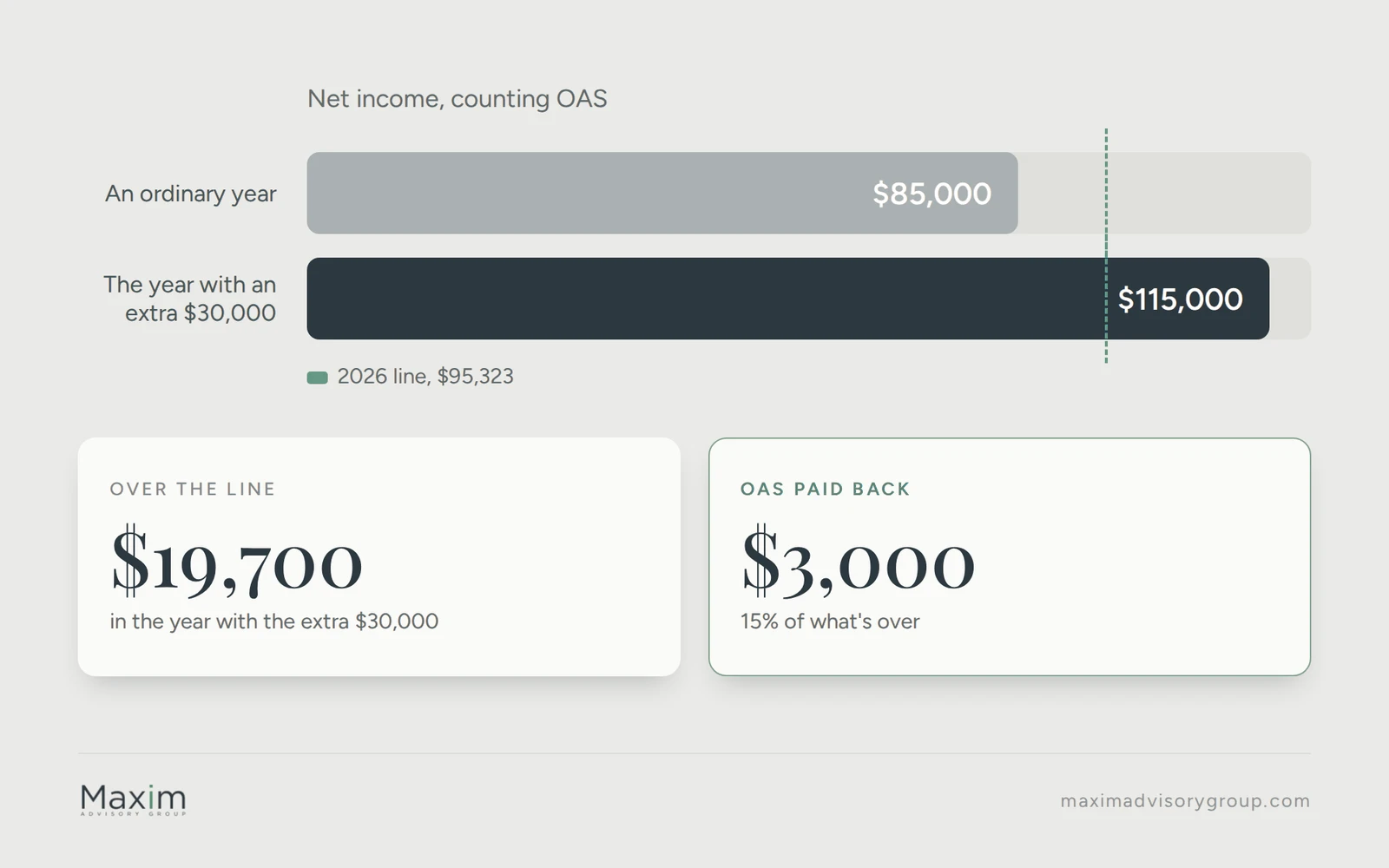
Here’s a vivid example for you. Let’s just say it’s an ordinary year. Your pension, CPP and a modest RRIF withdrawal come to about $85,000, counting your Old Age Security (OAS), the monthly federal pension for Canadians 65 and older.
Then one year is different. You take an extra $30,000 out of your RRIF for a new roof. Or you sell a rental, and $30,000 of the profit counts as income (for a capital gain, that’s half of a $60,000 gain). The two years before were ordinary too.
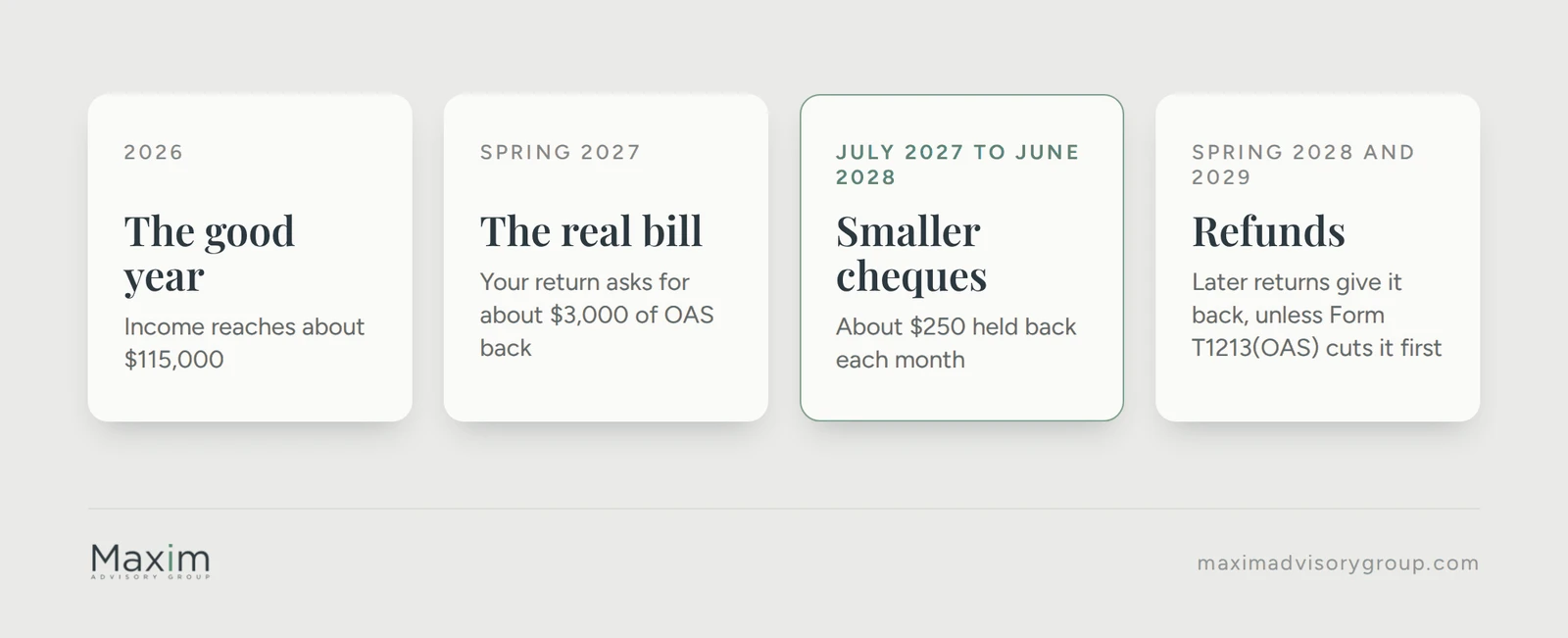
Next spring, your tax return asks for about $3,000 of your OAS back. From July, about $250 is also held back from each monthly payment.
Why? Your income went over the line where the government starts taking OAS back.
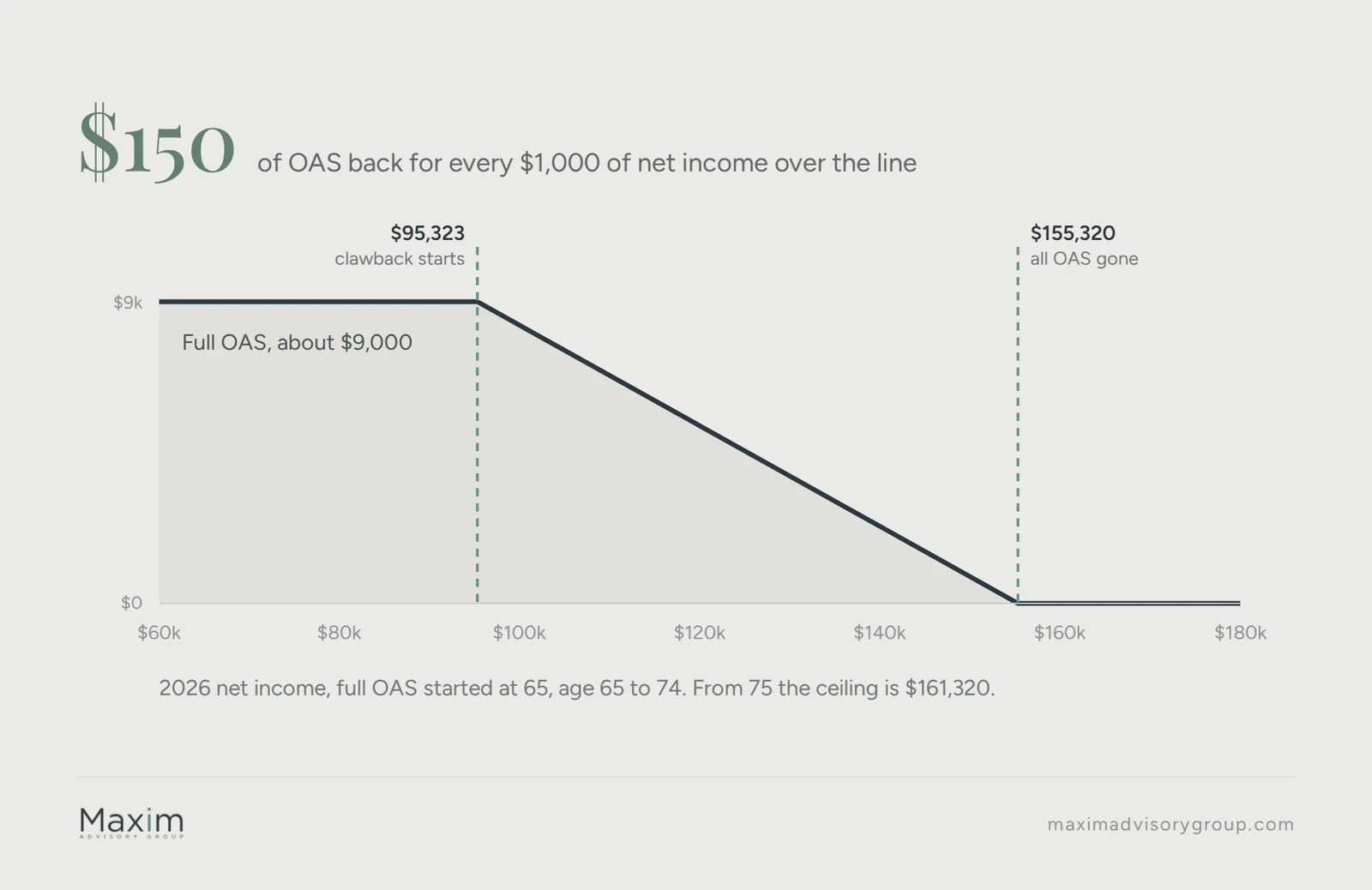
There is a “faucet tap” that the government can close in some cases on your OAS. Once your net income passes $95,323 for 2026, the government starts closing it. Net income is the income figure on your tax return after some deductions, such as RRSP contributions.
Every $1,000 over the line closes the tap by $150 of that year’s OAS. At about $155,000 (about $161,000 from 75, for a full pension started at 65), it’s fully shut, and all of that year’s OAS goes back. This is the OAS clawback, which the Canada Revenue Agency (CRA) calls the recovery tax.
The clawback won’t take back your CPP (though CPP counts toward your income), or your spouse’s OAS. And the $250 held back each month is a deposit. It’s credited on your 2027 and 2028 returns, and comes back as a refund if your income in those years is back under the line.
Here’s what people usually miss.
- Dividends from your own company count for more than you were paid.
- What’s held back from your payments is based on your income from one or two years ago.
- A tax-free share sale can still cost you a full year of OAS.
- Money held back after a one-off year comes back slowly, unless you ask for less to be held back.
- Moving abroad changes the answer, depending on the country.
Let’s dive into it.
On This Page
- Where Does the OAS Clawback Start in 2026?
- Which Year’s Income Does the OAS Clawback Use?
- Why Does Income From Your Corporation Count for More Than You Received?
- How Can You Reduce the OAS Clawback Before It Starts?
- What Happens to the OAS Clawback If You Move Outside Canada?
- Which Years Cause the Biggest OAS Clawback Surprises?
- What Else Do People Ask About the OAS Clawback?
- What Should You Decide Before Next Year’s Income Arrives?
Where Does the OAS Clawback Start in 2026?
Every $1,000 Over $95,323 Costs You $150 of OAS, Until There Is None Left.
The line moves up every year. The $95,323 is indexed, which means the government raises it with inflation. It went up 2.0% for 2026, from $93,454. The rule itself sits in section 180.2 of the Income Tax Act.
The 15% never changes, however far over you go. At some income it has taken every dollar of OAS for the year. That income is the ceiling, and it depends on your age.
| Income year | Clawback starts at | All OAS gone at, age 65 to 74 | All OAS gone at, age 75 and older |
|---|---|---|---|
| 2025 | $93,454 | $152,062 | $157,923 |
| 2026 | $95,323 | $155,320 | $161,320 |
Net income, one person. Service Canada’s figures. The 2026 ceilings became final in October 2026.
It’s higher at 75 because OAS itself is 10% larger from 75, so there’s more to take back.
Your own number may differ from these. These figures assume a full pension, started at 65. Start OAS later and your pension is bigger, so the tap shuts at a higher income. If you lived in Canada fewer than 40 years after 18, you get a partial pension, and it shuts sooner.
Below the line, the tap is wide open, and above the ceiling, it’s shut.
In between, every extra $1,000 of income costs you $150 of OAS.
Which Year’s Income Does the OAS Clawback Use?
Three Years at Once, and the Last Year Decides What You Owe.
Why would your payments shrink in July, long after the good year is over? Because the government sets each payment using an older tax return, then settles up once the real numbers are in.
Here’s calendar 2026.
| In 2026 | What sets the amount |
|---|---|
| OAS paid January to June | Recovery tax withheld from each payment, based on your 2024 net income |
| OAS paid July to December | Recovery tax withheld from each payment, based on your 2025 net income |
| Your 2026 tax return, filed in 2027 | The clawback you owe for 2026, on your 2026 net income |
One OAS recipient resident in Canada, calendar 2026. Sources are Income Tax Act s. 180.2(1) and (3) and CRA, line 23500.
The bottom row is the real bill. The first two rows are deposits the government takes out of your payments along the way, based on your net income from one and two years earlier.
1. What Comes Off Each Payment Is Set by an Old Return
One High Year Keeps Shrinking Your Payments After It Ends.
The Act calls the year behind each payment its “base taxation year”. It’s two years back for January to June, and last year for July to December. Service Canada’s version is shorter. Your 2025 income sets the recovery tax from July 2026 to June 2027.
Here’s how the year with the extra $30,000 plays out, if it’s 2026 and the years after are ordinary again.
| When | What happens |
|---|---|
| 2026 | Your income reaches about $115,000 |
| Spring 2027 | Your 2026 return asks for about $3,000 of OAS back |
| July 2027 to June 2028 | About $250 is held back from each payment, as if the good year will repeat |
| Spring 2028 | Your 2027 return refunds what was held back from July to December |
| Spring 2029 | Your 2028 return refunds what was held back from January to June |
One good year hits your cash twice. There’s the real bill in the spring, then a year of smaller payments that you only get back later. Form T1213(OAS) can shrink that second part.
2. Your Return Settles the Real Number
Money Held Back Is Credited Against the Real Bill.
When you file, the CRA counts what was held back as tax you’ve already paid. Your return then works out the clawback you owe for the year. That amount is added to your tax, and the same amount is deducted from your income, so you don’t pay income tax on OAS you give back.
Too much held back comes back in your refund, and too little adds to your balance owing.
Why Does Income From Your Corporation Count for More Than You Received?
Your Tax Return Counts Some Money at More Than You Got, and Some Not at All.
If you own a company, how you take money out of it changes what the clawback sees. The reason is a checkpoint on your tax return.
The clawback reads one line on your return, your net income. Almost everything added before that line counts. Some tax breaks come off after it, on the way to the income your tax is charged on, and those never reach the clawback.
Here’s what the checkpoint sees when the same $10,000 reaches you seven ways.
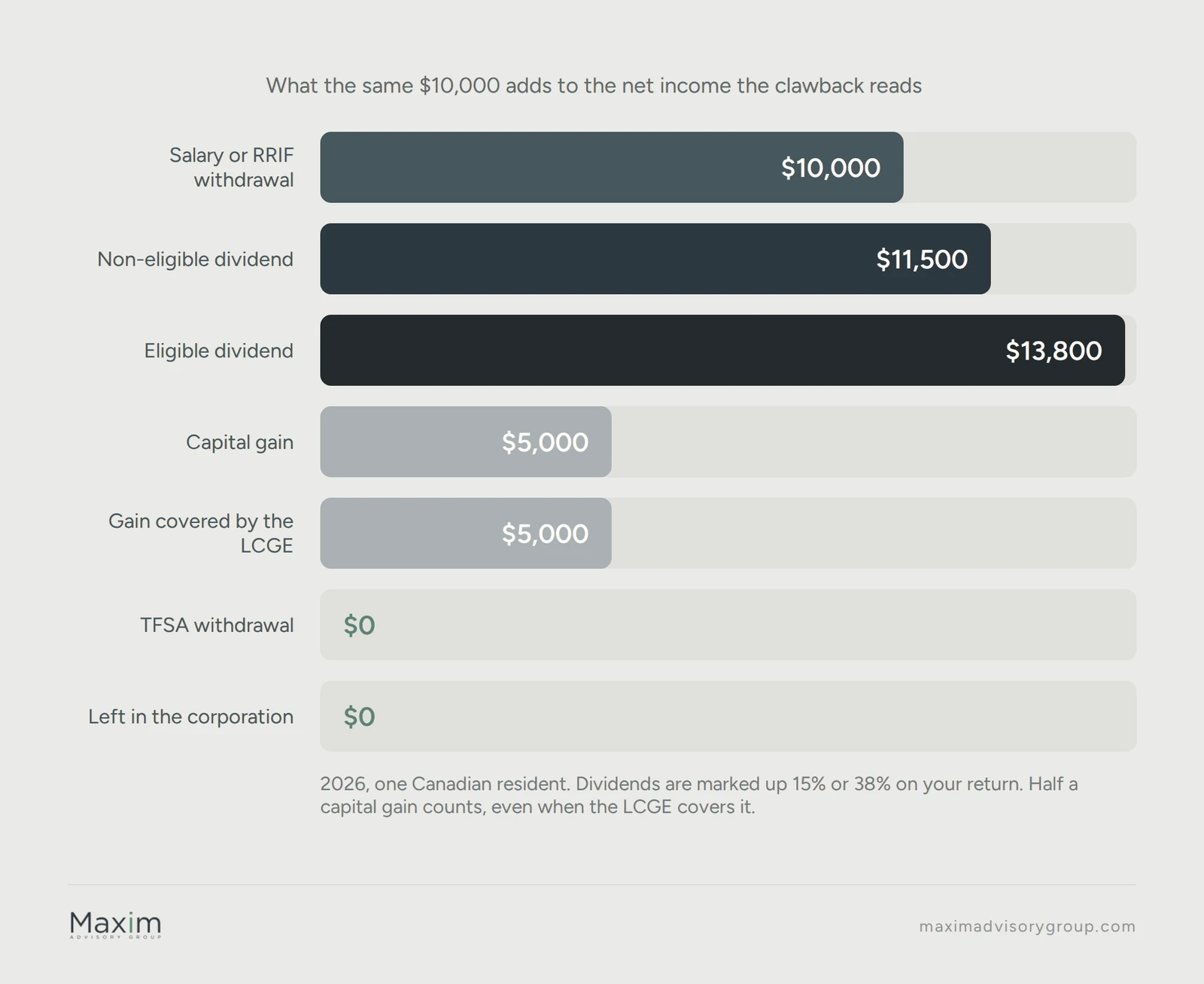
One Canadian-resident individual, 2026. Gross-ups, the amount added to a dividend on your return, from Income Tax Act s. 82(1)(b). One-half inclusion, meaning half a capital gain counts as income, from CRA guide T4037. TFSA figures from the CRA. Clawback at 15% under s. 180.2.
For most incorporated owners, the row that matters is a dividend row. Paying yourself salary instead is less of an escape than the first row suggests. A $10,000 salary uses $10,000 of company profit. A $10,000 dividend uses more, because the company paid tax on that profit first, and the gross-up roughly adds that tax back.
1. Dividends Are Marked Up Before the Clawback Sees Them
The Credit That Evens It Out Arrives Too Late for OAS.
Let’s say your company pays you $80,000 in eligible dividends, the kind paid out of profit taxed at the higher corporate rate, and that’s your only income besides OAS.
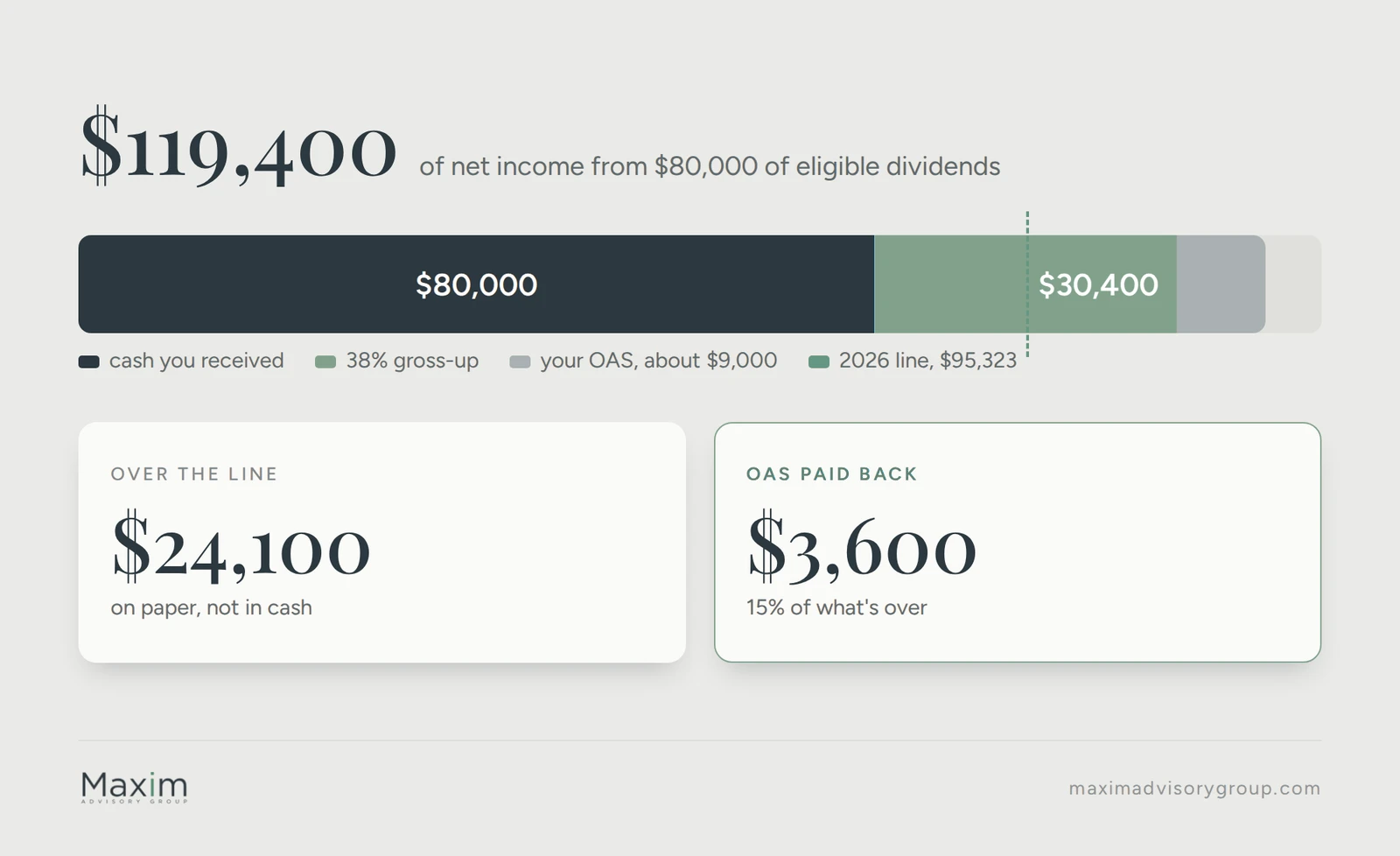
You did not earn six figures, but on paper, you did.
Your return assumes a dividend came out of profit your company already paid tax on, so it rebuilds the pre-tax figure. An eligible dividend gets 38% added. Other dividends, usually paid out of income taxed at the small business rate, get a smaller 15%.
In plain terms, a dividend tax credit later cuts your income tax to make up for the tax your company already paid, and that credit comes after the checkpoint, so the clawback still sees the full $110,400. With about $9,000 of OAS on top, your net income is about $119,400.
2. A Tax-Free Sale of Your Shares Still Counts Toward the Clawback
The Exemption Comes Off After the Clawback Has Already Measured You.
Say you sell your company’s shares at 67 for a $1,000,000 gain. If the shares qualify for the lifetime capital gains exemption (LCGE, $1,275,000 in 2026) and you haven’t used it before, it should cover the whole gain. Whether they qualify depends on what the company has owned for the past two years, so check well before a sale.
It might even feel like a year with almost no income. There’s no regular income tax on the gain. A claim this size can still bring in minimum tax, a backstop tax that limits how much certain breaks can save you in one year.
Here’s what the checkpoint sees.
| Step | Amount |
|---|---|
| Your gain on the shares | $1,000,000 |
| Half counted as income, the taxable capital gain | $500,000 |
| Net income at the checkpoint | $500,000 |
| The LCGE, a deduction taken after the checkpoint | minus $500,000 |
So the exemption arrives one line too late to help. A $500,000 year is more than three times the $155,320 income at which all OAS is gone, and that year’s OAS goes back in full.
3. Money Left in the Corporation Is Not Counted Until You Take It Out
Leaving Profit in the Company Lets You Choose the Year It Counts.
Profit that stays inside your company, and investment income the company earns on it, is taxed on the company’s return. The clawback looks only at yours, so that money stays outside it in the year it is earned.
It is still counted, gross-up and all, in the year you pay it out. Dividends drawn before your OAS starts, or spread evenly across your OAS years instead of taken in a lump, can mean a smaller clawback on the same money. A large dividend in the year just before OAS starts still sets the withholding from the July after it. Keeping money in the company isn’t free, though. Investment income inside a private company is taxed at a high rate until it’s paid out, so weigh that against the OAS saving.
How Can You Reduce the OAS Clawback Before It Starts?
Most of What Works Has a Deadline, and Some Close the Day OAS Begins.
The line is set for you. What you control is how much income reaches it, and in which year.
1. Pay Out Capital Dividends First
A Capital Dividend Never Touches Your Net Income.
If your company has a capital dividend account balance, from the tax-free half of capital gains or life insurance, it can pay that to you tax-free. It doesn’t count as income at all, so it never touches the clawback. In an OAS year it’s often the first dollar to take out.
2. Draw Down the RRSP in the Years Before OAS Starts
Money Taken Out Before OAS Begins Carries No Clawback.
A big RRSP can turn into a big clawback later. By the end of the year you turn 71, your RRSP has to be withdrawn, moved to a RRIF, or used to buy an annuity. An annuity is a fixed income for life or a set period.
Once it’s a RRIF, the rules make it pay you a minimum every year, starting the year after it’s set up. So a large RRSP becomes a large income you can’t switch off, in the same years OAS is paid.
Say you’re 60, with $800,000 in an RRSP and little else coming in.
| Your plan | What happens |
|---|---|
| Draw $50,000 a year from 60 to 64 | $250,000 is out before your first OAS payment, taxed at your rate then, with no clawback |
| Leave it all in | By 72 at the latest, the RRIF minimum comes on top of OAS every year |
The window closes when OAS starts. Starting OAS later keeps it open longer.
3. Split Eligible Pension Income With Your Spouse
From 65, Up to Half Your RRIF Income Can Move to Your Spouse’s Return.
If one of you has much more income than the other, the clawback can fall on one person while the other is nowhere near the line. Splitting moves some of the income across.
You can move up to half of your eligible pension income onto your spouse’s or common-law partner’s return. You do it with Form T1032, a form you both sign and file with your returns.
RRIF payments and RRSP annuity payments count once you’re 65 by the end of the year. Life annuity payments from a pension plan count at any age. Check first if it’s an individual pension plan, a pension plan your company sets up for you alone. Both of you must be resident in Canada on December 31.
Say you draw $40,000 from a RRIF and your spouse has little income. Move $20,000 across and your net income falls by $20,000. If you were at least that far over the line, and still getting some OAS, you keep $3,000 of it. That assumes the $20,000 doesn’t push your spouse over the line instead.
OAS itself can’t be split this way. Neither can CPP, the Canada Pension Plan, or dividends from your company.
Dividends to a spouse who owns shares. Dividends have a route of their own. From the year you turn 65, dividends paid to a spouse who owns shares in your company are generally outside the tax on split income. Those are the rules that can tax dividends a family member receives from a private company at the top rate. The exception holds as long as the dividends would have been outside those rules had you received them yourself.
If your spouse got the shares from you, the attribution rules can still put the dividends back on your return. Those rules tax income from property you gave or lent your spouse as if it were still yours. Whether your spouse can hold shares at all depends on your professional body.
4. Spend From the TFSA First
TFSA Withdrawals Never Touch Your Net Income.
Need money for a big expense? Where it comes from does matter. Withdrawals from a TFSA, and the income earned inside it, have no effect on OAS. Spend $20,000 from a TFSA instead of a RRIF and your net income is $20,000 lower for the same groceries.
5. Defer OAS to 70, and Know When That Backfires
Waiting Pays 36% More, and Against the Clawback It Helps Most If Your Income Drops Later.
If your income will be high in your late 60s, starting OAS later can pay. You can start any time up to 70, and each month you wait adds 0.6%, up to 36% at 70. For October to December 2026 the maximum is $762.50 a month at 65, against $1,037.00 at 70.
It works best when your income is high from 65 to 70 and drops after. You skip the years the clawback would have taken most of the cheque, then collect a bigger one once it wouldn’t.
It can also backfire. If your income stays over the line past 70, the bigger cheque adds to your income, and the clawback can take back more of it. You also give up five years of payments, with nothing back-dated for the months you waited.
Which way it goes depends on how long you live and what your income does in your seventies, and neither is known at 65.
6. Ask for Less to Be Held Back After a One-Off Year
One Form Asks the CRA to Hold Back Less After a High Year.
Had a one-off year, like an extra $30,000? Then the deposits taken from your payments are based on income you won’t see again.
Form T1213(OAS) asks the CRA to hold back less. File it as soon as the high year is behind you. Without it, the extra sits with the CRA until later returns catch up, which can take well over a year.
What Happens to the OAS Clawback If You Move Outside Canada?
Where You Live Decides Whether You File at All, and the US Is on the Exempt List.
Retiring abroad? Where you settle decides whether the clawback follows you.
Move to Oregon to be near your grandchildren, stay a US resident, and the Canadian clawback generally falls away. The Canada–US tax treaty is the deal between the two governments on who taxes which income. Under it, OAS paid to a resident of the United States is taxable only in the United States, as though it were US Social Security. Let Service Canada know about the move. Your state may tax OAS differently, because states don’t have to follow the treaty.
The United States is also on the CRA’s list of countries whose residents do not have to file the OAS Return of Income (Form T1136). That’s the yearly return non-residents file so the CRA can work out their recovery tax. The US then taxes the OAS as part of your income there, as the Canada–US tax treaty sets out.
First, check that OAS keeps coming. Paid outside Canada, it continues only if you lived in Canada for at least 20 years after turning 18. You can also reach 20 years by adding time in a country that has a social security agreement with Canada, a treaty that lets time in either country count toward the other’s pension. Short of that, your OAS may stop once you’ve been away more than six months, which settles the clawback question in the least welcome way.
Other countries. Anywhere else, check the CRA’s list of exempt countries by name. It includes the United Kingdom, Mexico, Portugal and Spain, among roughly forty others.
If your new country is on it, you’re exempt from filing as long as three things hold. You received OAS during the year, you live there at the end of it, and you don’t plan to move to a country off the list before the date the CRA sets. For the 2025 return, that date is July 1, 2027.
In plain terms, being on the list generally means the recovery tax doesn’t apply either. Service Canada applies it abroad only where Canada’s non-resident tax takes 25% or more of Canadian pensions. Non-resident tax is a flat tax withheld from pensions and certain other payments to people abroad.
The same 25% test decides who has to file. Non-resident tax may still come off your OAS at the lower rate your country’s tax treaty sets.
If your country is not on the list, the clawback follows you, with paperwork attached.
- You file Form T1136, the OAS Return of Income, every year. It reports your net world income, meaning your income from every source in every country, less allowable deductions.
- The return is due April 30. The 2025 return was due April 30, 2026. A late return costs a 5% penalty on the balance owing, plus 1% for each full month late, up to twelve months.
- If the CRA has not received the return, your OAS stops from July.
You also pay non-resident tax on Canadian income, OAS included. The CRA caps the two together, and states it flatly. “Under no circumstance will the non-resident tax and the recovery tax add up to more than the total OAS pension income, including supplements, received in the year.”
The year you leave is its own event, with departure tax attached. That’s the tax on growth in most property you still own, such as shares of your company, counted as if you sold it the day you left. That pretend sale counts toward your income for the year, so growth in your company’s shares can wipe out that year’s OAS even though you got no cash. Canadian real estate and your RRSP, RRIF and TFSA are among the exceptions, and the wider picture is in cross-border guidance.
If you only winter in the US and stay a Canadian resident, the clawback works as it does for anyone living here. The day counts that decide your residency are in Form 8840 and the snowbird tax rules.
Which Years Cause the Biggest OAS Clawback Surprises?
Most of These Come From One Year of Unusual Income.
Treating the year you sell your company’s shares as the only year it costs you. The same return sets what’s held back from the next July to June of payments. That money comes back only on later returns, unless Form T1213(OAS) gets the amount held back reduced.
Assuming it makes no difference when you empty the company. Take $300,000 as one eligible dividend and your return counts $414,000, so that year’s OAS goes back in full. Take $60,000 a year for five years instead, with only OAS besides, and you stay under the line.
Missing what happens at 71. The RRIF minimum that starts the following year is income the clawback counts. If your spouse is younger, you can elect to have the minimum based on their age instead.
Assuming the US rules follow you to your next country. Living in the US spares you the OAS Return of Income only while you stay in a country on the CRA’s list. Move on to one that isn’t before the date the CRA sets, and the return is due again, with your payments stopping in July if the CRA doesn’t receive it.
What Else Do People Ask About the OAS Clawback?
CPP Counts, Your Spouse’s Income Does Not, and a Home Sale Usually Does Not.
Does CPP Count Toward the OAS Clawback?
Yes, as income. CPP goes on your return as income, so it counts at the checkpoint. The recovery tax in section 180.2 reaches OAS only, so CPP has no clawback of its own.
Does Your Spouse’s Income Count?
No. The test is your own net income. Your spouse’s OAS is tested on theirs, which is what makes pension splitting worth a look.
Does Selling Your Home Count?
Usually not. If the home was your principal residence for every year you owned it, the gain is generally sheltered, so it adds nothing to the clawback. You still have to report the sale and designate the home on that year’s return, though. Skip that step and the penalty can run up to $8,000. Your principal residence is the one home you name as your main one. A rental, or a cottage you didn’t name as your main home for every year you owned it, is a different answer.
Is the OAS Clawback Different in Alberta?
No. It’s a federal tax with one national line, the same $95,323 for 2026 in Calgary as anywhere else in Canada.
What Should You Decide Before Next Year’s Income Arrives?
Which Year Each Big Payment Falls In, Because the Year Is What You Can Still Move.
By the time the T4A(OAS) slip, the tax slip showing the OAS you were paid and any recovery tax withheld, arrives, the year it describes is closed. The return you file in the spring only settles the bill. So the time to look is this autumn.
Add up next year before it happens. List what will reach your net income next year. That includes your OAS itself, CPP, pensions, RRIF withdrawals, salary, dividends and which kind, and any sale. Put a rough figure beside each. Mark dividends up the way your return does, by 38% or 15%.
Then move what can move. If the total crosses the line ($95,323 for 2026, raised each year with inflation), the tap starts closing. Ask which pieces have to happen next year and which could come earlier or later.
A sale might close in January instead of December. A big expense might come out of the TFSA instead of the RRIF.
If a company is part of the answer, or a move abroad, that’s where we’d start. The consultation is paid, at $500 an hour, with engagements generally 10 to 60 hours ($5,000 to $30,000). What you get is a clear answer on what next year’s income does to your OAS, and whether anything is worth moving.