

What Happens When You Leave Canada?
People leave Canada for all kinds of reasons. A job offer in another country, a remote role you can do from anywhere, or even a few years of travel that turns into a new home base.
Whatever the reason, most people plan the move and assume the tax side takes care of itself. Then they learn the harsh truth: Canada has an exit tax.
Its formal name is departure tax. When you stop being a Canadian tax resident, the CRA treats you as having sold certain things you own, at what they’re worth that day. That is called a deemed disposition. You owe tax on the gain even though nothing was sold and no cash came in.
Your job title doesn’t decide whether it applies to you. Executives, business owners and employees can all be caught. What decides it is what you own. A private company, a non-registered investment account, crypto, or property outside Canada can all trigger it. A paycheque and a chequing account on their own will not.
This page covers what gets taxed, when it happens, and how to reduce it. Most of the useful planning happens before you leave, so the earlier you read it, the more of it you can use.
Departure Tax (The Short Version)
If you read nothing else, read this.
What it is. Departure tax (or exit tax) is a deemed sale of certain property on the day you stop being a Canadian tax resident. A deemed sale, which the CRA calls a deemed disposition, means the tax rules treat you as if you sold an asset at fair market value when you didn’t. No money actually traded, but you owe tax on the growth in value since you acquired it.
It does not touch everything, though. Your Canadian home is out. So are your RRSP, TFSA, RESP and other registered accounts, and assets used in a Canadian business you keep running here. Exempt now does not mean tax-free forever. You may still owe Canadian tax when you sell the home or take money out of a registered account. Continuing to own these assets might complicate things in your new jurisdiction as well.
When it applies. Timing departure tax is usually the thing most people get wrong. It applies on the day you stop being a Canadian tax resident, which is often later than the day you fly. The CRA looks at your ties to Canada as a whole: your home, your spouse or partner, your dependants, and smaller ties like bank accounts, health coverage and a driver’s licence. The date usually ends up on the latest of three: when you leave, when your spouse and dependants leave, and when you become resident somewhere else. The full set of facts can push it later or pull it earlier.
How to reduce it. Most of the ways to pay less expire on your residency date. Setting that date deliberately, fixing the cost base of your shares, and reorganising your company all work best before you go. A few reliefs exist afterward, but they are narrower and slower. There are usually lots of options as long as you plan ahead.
You can also delay the payment. Elect to postpone the tax until you sell for real, and the CRA charges no interest while you wait. If the federal tax is over $16,500, you post security. The election is due 30 April of the year after you leave.
What This Page Covers
- What departure tax is. A deemed sale of what you own, and how the gain gets worked out.
- The date that triggers it. Set by your ties to Canada as a whole, and often later than your flight.
- What is exempt, and what is caught. The exclusion list is long enough to change the answer before you do anything.
- How to reduce the bill. Seven levers, almost all of which expire on your residency date.
- How to defer the bill. One form, no interest, and security only on the part above $16,500.
- Alternative minimum tax. The rule that can turn a timing cost into a permanent one, and the reason a large gain needs modelling.
- What your return looks like. The year splits in two, credits get prorated, and couples file separately.
- Forms and deadlines. Two you must file, three you may, and two different due dates.
- Traps and questions. The seven that cause reassessments, the family trust, and the ones clients ask most.
What Departure Tax Is
Some people call it Canada’s exit tax, and the CRA calls it something drier. When you cease to be a Canadian resident you trigger a deemed disposition. Certain property you own is treated as sold at fair market value, and treated as bought back immediately afterwards at that same value.
The gain between your cost and that value goes on your departure return.
The deemed sale happens a moment before your residency ends, not after. That is the whole point. The gain arises while you are still a Canadian resident, so it goes on a Canadian return at Canadian rates. Leaving first does not move it.
When you leave Canada, most, but not all, of your property falls into this tax. We’ll explore the exemptions shortly. People are surprised to learn their hard-earned savings might be subject to tax. For example, non-registered investments, foreign property and shares in privately held corporations are all subject to the tax.
Go back to the company you started with $100 of share capital eleven years ago. That $100 is your cost. Subtract it from today’s valuation and the gain is close to the entire value of the company.
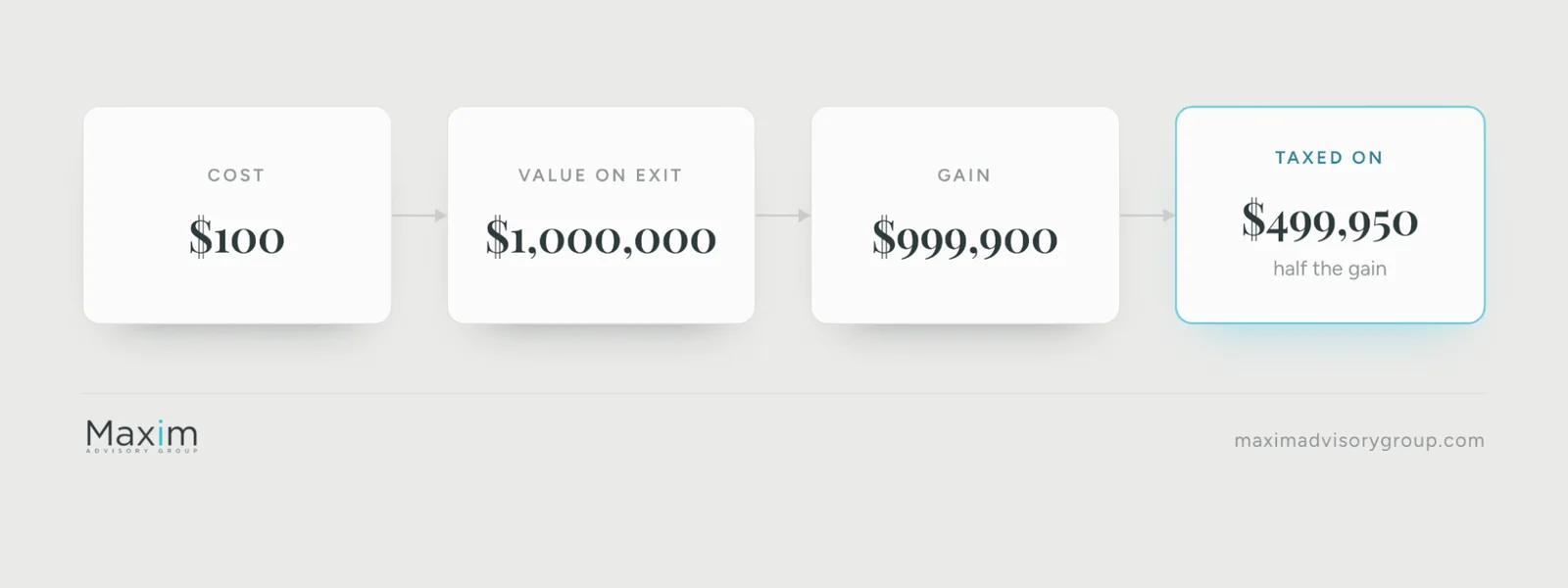
This is where founders get the number wrong. Your cost is the adjusted cost base of your shares, which is the tax record of what you paid for them. It is not the total you have put into the business over eleven years. For most founders, the starting value of their shares is $100.
The Date That Triggers Departure Tax
Ask most people when departure tax hits and they’ll say the day the flight leaves. It keys off the day you stop being a tax resident of Canada, and those can be different days, sometimes months apart.
This is the first thing to settle on any departure file, because getting it wrong changes every valuation on the return.
1. Significant Ties Carry More Weight Than Secondary Ones
So what decides it? Not your passport, and not where your mail goes. Canadian tax residency turns on your residential ties to Canada, and the CRA’s Income Tax Folio S5-F1-C1 sets out the rules. They’re split into two broad categories: primary and secondary.
Primary ties carry a lot more weight. There are three:
- Your primary dwelling place,
- your spouse or common-law partner, and
- your dependants.
Secondary ties count in combination rather than alone, and this is where most of the work on a residency question sits. The folio’s list runs long, including:
- Personal
- Social, and
- Economic
Those categories include ties such as your job, bank accounts, rental properties, shares in private companies, provincial health coverage, a driver’s licence, a registered vehicle, a seasonal dwelling, a Canadian passport and professional memberships.
The trick in determining residency is understanding the ordering of the rules and the cumulative impact of each tie. Practically speaking, it’s normal to have a few remaining ties when people separate from Canada. A classic example might be a bank account or Canadian pension income.
There is also the older common-law idea the folio still uses: you are ordinarily resident where, “in the settled routine of his life”, you “regularly, normally or customarily” live. Intending to come back does not by itself keep you resident, but a settled routine that still runs through Canada might.
2. The Date Is Usually The Latest Of Three
The CRA’s position is that you become a non-resident on the date you sever your residential ties. That usually coincides with the latest of three dates:
- The date you leave Canada
- The date your spouse or common-law partner and dependants leave
- The date you become a resident of the country you’re moving to
Those dates are a marker for when your ties are cut. The test itself is the ties, weighed together. A home you keep available in Canada can hold your residency past all three dates. A treaty tie-breaker, covered below, can end it sooner.
Say you fly in March and your family follows in July, when the school year ends. Your residency changes in July, and every asset gets valued at its July figure.
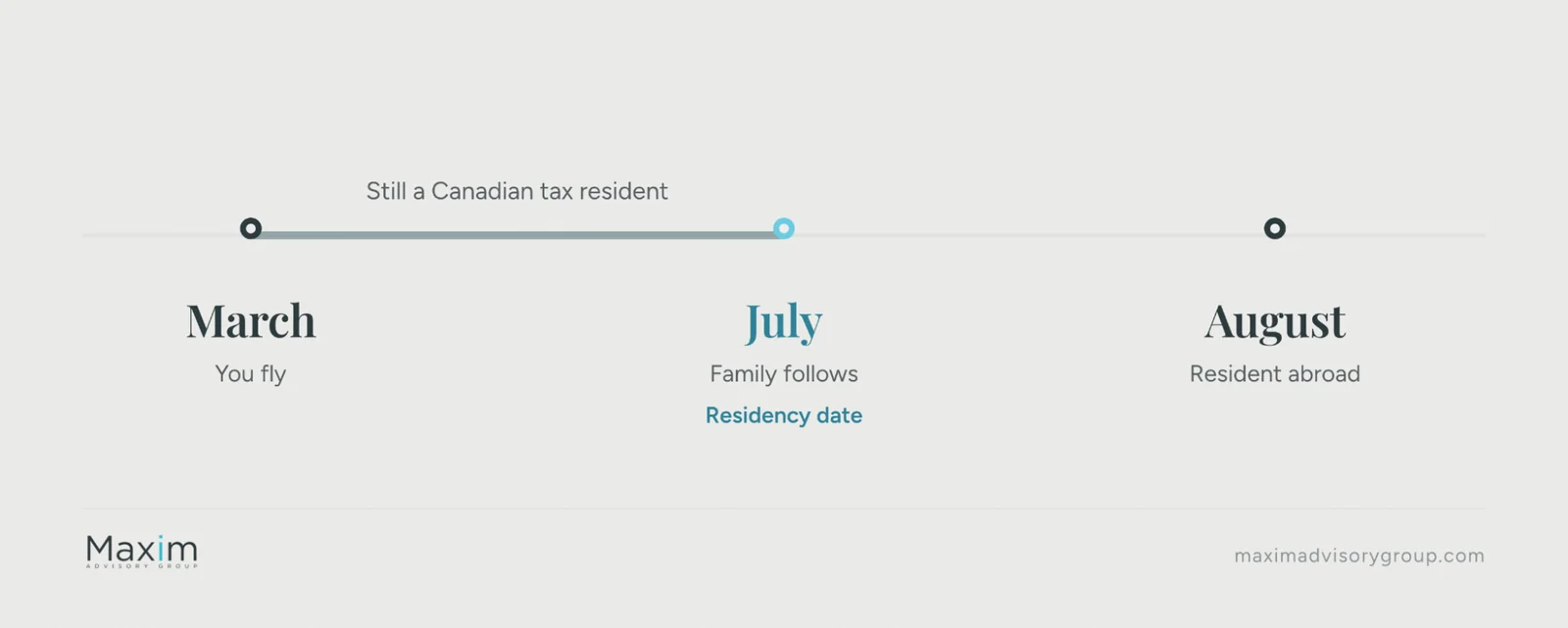
In a rising market that difference is the whole planning question. In a falling one it works the other way.
3. Form NR73 Is Optional, And Filing It Has A Cost
Form NR73 asks the CRA to give an opinion on your residency status. Filing it is voluntary.
The folio is clear: the opinion “is not binding on the CRA and may be subject to a more detailed review at a later date.” So you’ve volunteered a full account of your ties, and the answer you get back binds nobody. It is a hard trade to recommend.
Where the facts are clean it can be reassuring. Where they’re marginal, you’ve handed the CRA a file it would otherwise have had to go looking for. On marginal facts it is usually better left unfiled.
One more layer to add: a tax treaty may treat you as resident in the other country under its tie-breaker rules. Where it does, subsection 250(5) deems you a non-resident of Canada, even where the domestic ties test would’ve kept you here.
What Is Exempt From Departure Tax
The CRA’s page says you are deemed to have disposed of certain property. That one word is more important than anything else on the page.
The rule reaches some of what you own and leaves the rest alone. People routinely arrive at a figure that frightens them before checking which side each asset falls on.
| Commonly Caught | Commonly Outside |
|---|---|
| Shares of your private corporation | Canadian real or immovable property, Canadian resource property, timber resource property |
| A non-registered investment portfolio, including mutual fund units | Canadian business property, including inventory, where the business runs through a permanent establishment in Canada, meaning a fixed place of business the CRA can point at |
| Cryptocurrency held as capital property | RRSPs, RRIFs, RESPs, RDSPs, TFSAs, FHSAs, pooled and registered pension plans, annuities, deferred and employee profit-sharing plans, salary deferral and retirement compensation arrangements |
| Real estate held outside Canada | Rights under an employee stock option agreement; CPP, provincial pension and Old Age Security entitlements |
| Collectibles, art and other personal-use property | Property you owned when you last became a Canadian resident, or inherited after that, if you were resident for 60 months or less in the 10 years before you left, and you are not a trust |
Federal, and written for an individual leaving Canada. Sources: Canada Revenue Agency, dispositions of property for emigrants, current to 20 January 2026, and the excluded rights and interests defined in subsection 128.1(10) of the Income Tax Act.
The columns are two lists rather than matched pairs, so read down each one. Neither column is the whole list. The statutory definition of an excluded right or interest runs to twelve paragraphs.
Check your own holdings against the legislation before you estimate anything. In practice this single step is what brings the number down, more often than any planning move that follows it.
1. Your Canadian House Is Not Caught
Your Canadian home sits outside the deemed disposition. Nothing surprises a departing client more.
Tax on it, if there’s any, arrives on a real sale. For the years the home qualified as your principal residence there may be no taxable gain at all; years of non-residence fall outside that exemption.
The mechanics do change. A non-resident vendor has to notify the CRA within ten days of the sale. Without a certificate of compliance, the purchaser is entitled to withhold 25% of the gross proceeds. That is withholding on the whole price rather than on the gain, and getting the excess back means filing for it.
Renting it out instead has its own regime, with withholding on gross rent and an election to be taxed on the net figure. Both are their own conversation, and neither is departure tax.
2. The 60-Month Test Looks Back A Decade, Not This Stay
There is a break for people who came to Canada for a stretch and are now leaving again. If you were a resident for 60 months or less in the 10 years before you go, the property you owned when you arrived is not caught. It leaves with you, untaxed.
Sixty months is five years. The count is cumulative, not consecutive, and it covers the whole 10-year window. The length of the stay you happen to be on now is beside the point.
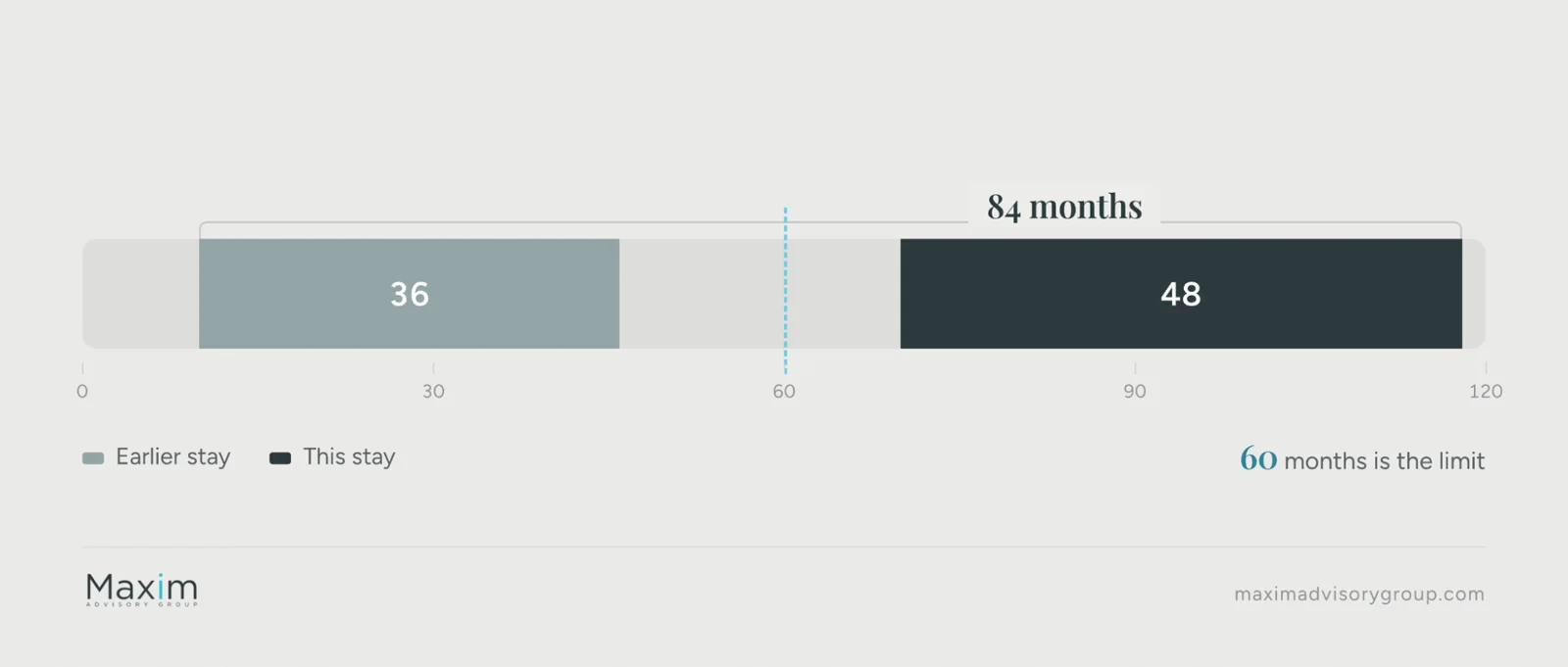
So four years this time, plus three years earlier in the same decade, is 84 months. You are over, and the break does not apply. That arithmetic often lands on people who were certain they qualified, and it is never welcome. If you do come in under, the break covers what you brought with you and what you inherited here, but not what you bought after you arrived.
3. You Can Elect To Pull Excluded Property In
The Act calls it an elective disposition. Under paragraph 128.1(4)(d) an individual can pull property in the first two excluded categories back into the deemed disposition, at fair market value, on the way out. The election is made on Form T2061A. It reaches no further: registered accounts and the short-term-resident category stay outside.
Why would anyone volunteer for a bill? Two reasons. The election steps the cost base up. And it lets you spend something that’s about to expire: an unused capital loss, a remaining lifetime capital gains exemption, a year in which your other income is unusually low.
It’s a real planning lever, and it is only available before you go.
4. Losses Count Too
A deemed disposition runs in both directions, which is a hugely under-used fact. Where a holding is under water, the deemed sale realises the loss. The superficial-loss rule would normally deny a loss on property you reacquire straight away, and it doesn’t reach the emigration case.
There is a second piece of relief further out. Say a holding of taxable Canadian property was deemed disposed of at a gain on departure, and you later sell it for real at a loss. Under subsection 128.1(8) an election can carry that loss back against the departure-year gain.
So a departure tax bill computed at the top of a market isn’t necessarily final.
How To Reduce Your Departure Tax Bill
Deferral changes when you pay, but it doesn’t change how much.
Paying less is a different question. And most of the ways to pay less stop working the day your residency changes.
Here’s the order to check them in.
Set the date deliberately. The residency date follows the facts, and the facts include when your family moves and when you establish residency abroad. A few months of sequencing can do more than everything else on this list.
Fix the adjusted cost base before you leave. Shareholder loans, prior crystallisations and paid-up capital adjustments all change your cost. All three are far easier to document while the company is still a Canadian resident’s company.
Use the lifetime capital gains exemption if the shares qualify. For a qualifying small business corporation this is the largest single number available in a departure year.
There is also a residency rule that you might’ve heard of. The CRA’s guide says you must be resident throughout the year, but subsection 110.6(5) deems you resident throughout it anyway, provided you were resident at some point in the year, and for the whole of either the year before or the year after. Someone leaving after years in Canada satisfies that on the preceding year. Someone who arrived partway through the year before satisfies neither, which is the same short-term resident the 60-month test is written for.
Realise losses into the same year. The deemed disposition and any real sales are reported on the same departure-year return, so a loss position taken deliberately can offset the deemed gain.
Line the two countries up. Where the destination is the United States, the treaty election asks the other side to start counting from the value Canada just taxed.
Look at the corporate structure while it’s still simple. A freeze, a reorganisation or a distribution has a different cost before the residency date than after it. A freeze here means locking today’s value into fixed shares, so future growth accrues to someone else.
None of this is exotic. It’s ordinary planning, and it works best in advance. Three reliefs can reach back afterwards: a later sale at a loss, a return to Canada, and the treaty election. None of them substitute for getting the date right.
How To Defer Your Departure Tax Bill
So what do you do about the cash you haven’t got? There’s an answer, and it’s the part of this that clients are most relieved to hear.
You can elect to defer paying the tax on the deemed disposition until you sell the property for real, and you can do it whatever the amount. You pay later, and you pay without interest.
The deemed disposition is calculated on Form T1243. The election to defer is a separate form, T1244, due by 30 April of the year after you leave, under subsection 220(4.5).
1. Above $16,500 Of Federal Tax, You Post Security
If the federal tax on your deemed disposition comes to more than $16,500, you have to give the CRA adequate security before it will let you wait. Former residents of Quebec cross at $13,777.50, because the Quebec abatement lowers their federal share.
In gains, $16,500 is roughly your first $100,000. Half a capital gain is taxable. At the top federal rate of 33%, tax on $50,000 is $16,500.
One number covers everything you own. That’s the part people typically miss. The CRA totals the tax on every deemed disposition, then compares the total to $16,500. Two properties with $60,000 of gain each clear the line together, but neither clears it by themselves.
Treat $100,000 as a minimum, not a rule. The 33% federal rate only kicks in above roughly $250,000 of taxable income. Below that, it takes a bigger gain to produce the same $16,500.
The million-dollar company above produces roughly $165,000 of federal tax. Ten times the threshold, and that owner isn’t skipping the security question.
One note on the rate. The increase from one-half to two-thirds announced in June 2024 was cancelled. Any arithmetic you read built on two-thirds predates the answer.
2. Your Province Adds To The Bill, Though Not To The Threshold
The $16,500 threshold is measured on federal tax alone, and that part is the same wherever in Canada you left from. Your province then taxes the same taxable half again, at its own rate.
Take Alberta as an example. The top provincial rate is 15%, against the federal 33%:
| Federal | Alberta | Combined | |
|---|---|---|---|
| Taxable half of a $1,000,000 gain | $500,000 | $500,000 | — |
| Top tax rate | 33% | 15% | 48% |
| Tax at the top rate | $165,000 | $75,000 | $240,000 |
Illustrative, federal plus Alberta only. Assumes the whole taxable half is taxed at the top rate in both systems, which overstates it for most people, and ignores credits. Rates from the CRA’s 2026 tables, current to 25 June 2026.
Leave from British Columbia and the provincial rate is higher again. The CRA also says you “may also be required to provide security to cover any applicable provincial or territorial tax payable.” So $16,500 decides whether the federal piece needs securing, and caps nothing beyond that.
3. You Only Post Security Above The Floor
The CRA’s summary makes it sound like your whole bill needs securing. It says security must “cover the amount.” The Act is narrower, and the difference is worth money.
Subsection 220(4.51) deems the Minister to have already accepted security for part of what you owe. The amount: whatever tax a Canadian-resident trust would pay on $50,000 of income. At the highest individual percentage, that comes to $16,500 exactly.
So $16,500 isn’t only the line where security starts. It’s a slice already covered. You furnish security for what’s above it and nothing more.
| At the threshold | On the illustrative company | |
|---|---|---|
| Capital gain | $100,000 | $1,000,000 |
| Federal tax at 33% | $16,500 | $165,000 |
| Treated as already secured | $16,500 | $16,500 |
| Security you furnish yourself | nil | $148,500 |
Illustrative. Federal only, at the top 2026 federal rate of 33% and the enacted one-half inclusion rate. Provincial tax, bracket effects and credits ignored.
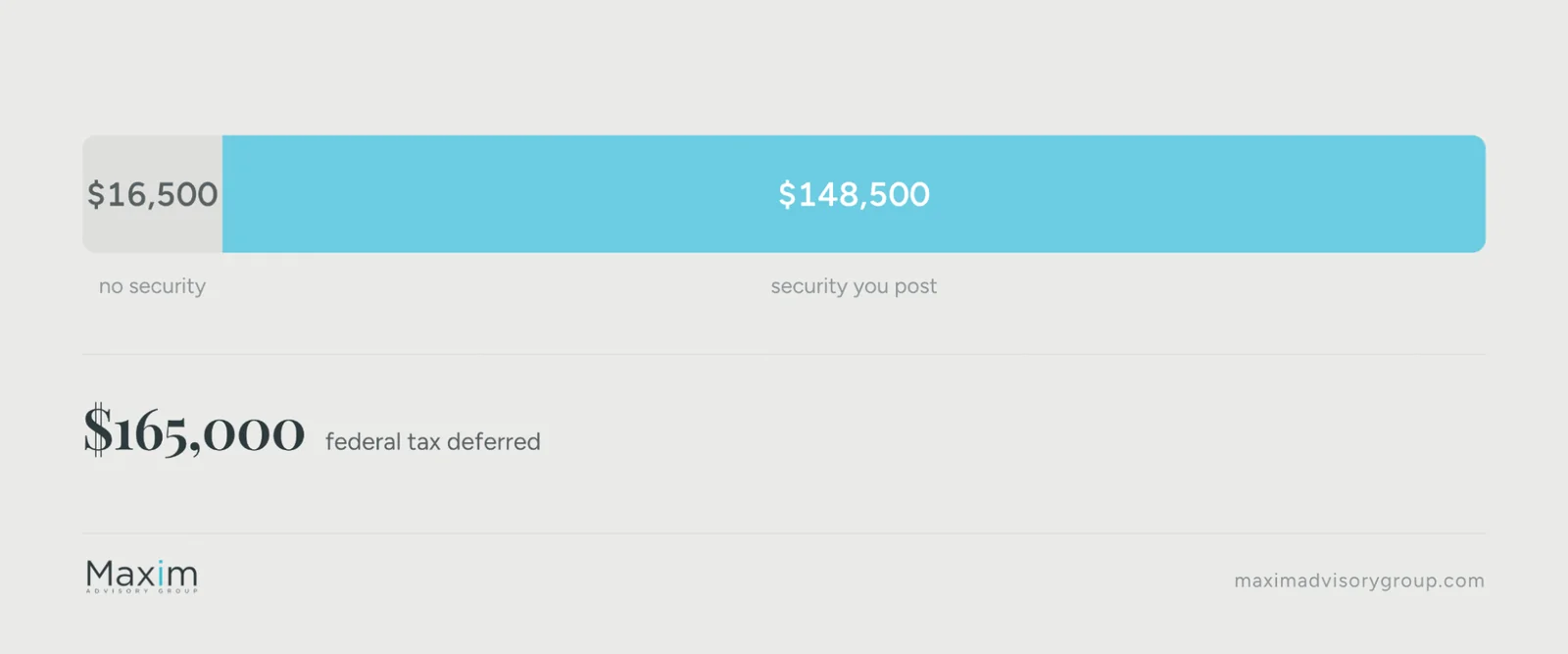
The floor stays put while the bill grows. At the threshold itself you furnish nothing at all.
What the CRA will accept is its own question, and it is best settled with them directly. Posting security is straightforward if your wealth is liquid. It’s a real constraint if your wealth is the company, the same owner who needed the deferral in the first place. There is no neat answer to that, and anyone offering one hasn’t priced the collateral.
4. What Ends The Deferral
The protected amount gets recalculated every year. The question each time is, “What would you owe if the only property deemed sold were the property you still hold?”
Sell something for real and it drops out of that calculation. The tax attached to it comes due, and everything you still hold stays deferred. So the deferral doesn’t end on a date. It shrinks, one asset at a time.
Selling is not the only exit. Subsection 70(5) deems you to have disposed of each capital property at fair market value immediately before death. That is a disposition, so property still sitting under the deferral when the owner dies drops out of the protected amount then, and the tax it was carrying falls due. If the deferral is doing work in your estate plan, that is the assumption to check first.
Alternative Minimum Tax Can Make This Permanent
Regular tax counts half your capital gain. AMT counts all of it. Section 127.52 sets the fraction at 1/1.
A deemed disposition big enough to worry about is exactly the income AMT was built to catch.
Normally that’s a timing cost. Section 120.2 turns the extra tax into a credit you can apply against regular tax for seven years.
But here’s the part not many people know about. The credit only works against Canadian tax. Leave, owe Canada nothing for seven years, and you have nothing to apply it to. A tax built to be temporary becomes permanent.
What Your Departure-Year Return Looks Like
The departure year splits in two, and the return has to show the split.
Up to your residency date you are taxed the way you always were, on your worldwide income. After it, Canada reaches only Canadian-source income. Section 114 sets out that split, and the deemed disposition sits on the resident side of it, because the Act places that sale a moment before your residency ends.
Your personal credits get prorated. Under section 118.91, most of them are cut back to the part of the year you were resident. The credits that shelter a normal year shelter less of this one.
The province is the one you left from. Not the one you were sitting in on 31 December. The CRA’s instruction is to “use the income tax package for the province or territory where you resided on the date you left Canada.” Leave Alberta in March and you file an Alberta return, wherever you spend the rest of the year.
And couples file separately. Canada has no joint return. Each of you has your own deemed disposition, on your own property, needing your own valuation. A married owner reading this page tends to picture one bill, and it is two. Jointly held property gets split across the two returns.
Forms And Deadlines
| Form | What it does | Required or elective | When it is due |
|---|---|---|---|
| T1243 | Calculates and reports the deemed disposition | Required where property is deemed disposed of | With your departure-year return |
| T1161 | Lists the property you owned when you left | Required where the total was more than $25,000 | With your departure-year return |
| T1244 | Elects to defer payment until you sell | Elective | 30 April of the year after you leave |
| T2061A | Elects to pull excluded Canadian property in | Elective | With your departure-year return |
| NR73 | Asks the CRA for an opinion on your residency status | Elective | No deadline; sits outside the return |
Federal, and written for an individual leaving Canada. Sources: Canada Revenue Agency, dispositions of property for emigrants, current to 20 January 2026, and the 30 April date from subsection 220(4.5).
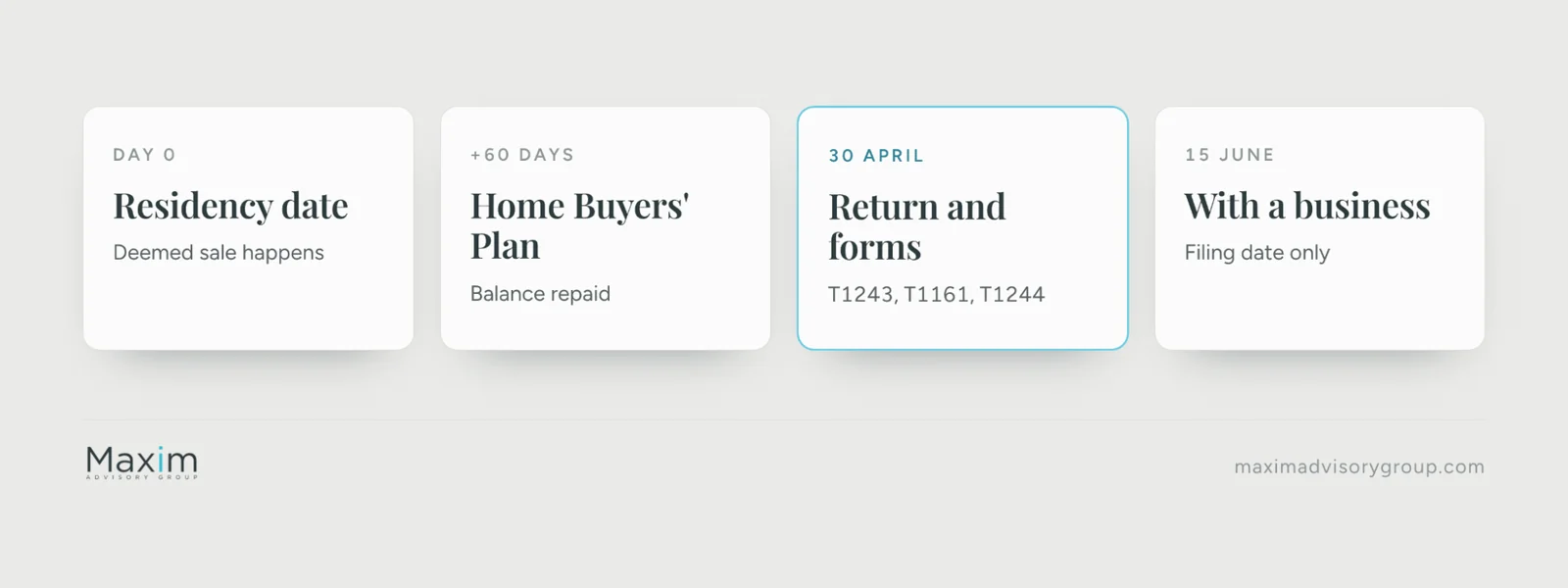
The two required rows are filings; the three elective ones are decisions, and nobody makes a decision for you. If you miss one thing on this page, don’t let it be the deferral election because that’s the one with a hard date.
The filing deadline is 30 April, extended to 15 June if you or your spouse carried on a business. The payment deadline stays 30 April either way.
7 Common Departure Tax Traps
Reassessments almost always arrive about something the client had already thought about, and got wrong by one degree. Not carelessness. People usually come to a reasonable conclusion… that just happened to be wrong.
Here are the common ones.
- Treating the flight as the residency date. The date is the latest of three, and the family’s move governs more often than people expect.
- Leaving a residential tie in place that you thought was minor. A house kept available for your own use, or a spouse who stays behind for a year, weighs more than a stack of secondary ties.
- The NR73 nobody asked you to file. It is optional, the answer binds nobody, and it hands over a full account of your ties.
- Assuming the registered accounts are settled. They are outside the deemed disposition, which is the Canadian half of the question. The country you move to is under no obligation to respect the shelter.
- Forgetting the Home Buyers’ Plan. An outstanding balance has to be repaid by the date you file for the year you become a non-resident, or 60 days after you become one, whichever comes first. Miss both and the balance goes into income.
- Assuming the deferral is automatic. It is an election, on a form, by 30 April of the following year.
- Reading a tax treaty online and taking it at face value. Treaty articles interact with domestic law and with each other, and the tie-breaker rules in particular are not self-executing.
All of them are far cheaper to find early than after the CRA does.
Departure Tax Frequently Asked Questions (FAQs)
I Left And Never Filed Any Of This. Now What?
If everything you owned when you left came to more than $25,000, you were meant to list the reportable part of it on Form T1161, which is more people than you’d think. The late penalty is $25 a day, capped at $2,500, which makes it a poor reason to leave a bigger problem alone. People do exactly that.
The CRA runs a Voluntary Disclosures Program for the bigger problem: come forward before they come to you, and you get protection from prosecution and relief from penalties and some interest. Check the date on anything you read about it. The program was rewritten for applications received on or after 1 October 2025, and the new version is more forgiving. The relief narrows once the CRA contacts you, so waiting is the one move with no upside.
What Happens To My TFSA And My RRSP?
Good news first. Your TFSA comes with you. You keep the account, and you keep the exemption from Canadian tax on the income and withdrawals inside it. What stops is new room. Your contribution room stops growing while you’re away.
Contributions themselves need care, because the rule is not what most people think. You can physically pay into a TFSA as a non-resident. The CRA then charges 1% of that contribution for every month it sits there, until you take it out or become a resident again. So it isn’t blocked. It’s expensive, and an accidental transfer is the common version of this.
That’s the Canadian half, and it’s the smaller half. The shelter is a Canadian one, and the country you move to is under no obligation to recognise it. If you’re heading to the United States, the TFSA is the account most likely to be treated differently there, and the treaty does less for it than people assume. RRSPs and RRIFs work differently again. Settle both before you move anything.
What Happens To My Investment Accounts?
A non-registered portfolio is caught by the deemed disposition, so the tax side is the main subject of this page. The practical question is separate, and it arrives at a bad moment: ask your brokerage, in writing and before you go, what it does with an account whose owner becomes a non-resident. Firms differ, and some restrict what a non-resident account can do. It’s a cheap question to ask now and an expensive one to discover later.
What If I Move Back To Canada Later?
If you left after 1 October 1996 and later become a Canadian resident again, you can elect to adjust the deemed disposition you reported on the way out. You need to still own some or all of the property; where you do, you can reduce the gain you reported for your departure year, up to the amount you reported.
The election is a written request, due on or before your filing due date for the year you re-establish residency. People write the money off, believing that door had closed.
What If The Other Country Taxes The Same Gain Again?
Here’s the trap most worth seeing coming. Canada taxes the gain on the way out, at the value on your departure date. Years later you sell for real, and the United States works out its own gain from its own cost base, which is what you originally paid. The same growth gets taxed twice.
The treaty has an answer. Where one country treats you as having alienated property and taxes you on it, you may elect to be treated in the other country as if you had sold and repurchased at fair market value immediately beforehand, under Article XIII(7) of the Canada-US treaty. In plain terms, it asks the United States to start counting from the number Canada just taxed you on.
Does My Company Become American If I Run It From Texas?
No. A corporation incorporated in Canada after 26 April 1965 is deemed resident in Canada, and it stays that way wherever its owner goes. Run your Calgary company from a kitchen table in Texas and you haven’t moved it out of Canada. It may, though, stop counting as controlled by a Canadian. That can cost it its status as a Canadian-controlled private corporation (CCPC), and that’s a big deal.
In addition, what you may have done is give another country’s tax authority something to look at. Whether that creates a filing obligation there is answered under that country’s law and the treaty, and it’s the first thing to check before you go.
A company can cease to be Canadian resident if central management genuinely moves, and that regime is considerably harsher, with none of the exclusions an individual gets and a further 25% tax under section 219.1. If that’s on the table, it’s a conversation to have before anyone moves, not after.
What If A Family Trust Holds The Shares?
For an owner-managed structure this is usually the biggest thing left off a page like this.
A trust is not a bystander. Subsection 104(2) deems a trust to be an individual in respect of the trust property, so the deemed-disposition rule can reach the trust in its own right. A trust’s residence follows where it is actually managed and controlled, which in practice means the trustees, so trustees who move abroad can push a trust offside without anyone intending it.
That produces a second deemed disposition, on the trust’s property, separate from yours. And the short-term-resident relief in the exclusion table above is expressly unavailable to a trust.
If opco, holdco and a family trust are stacked, the structure wants looking at as a whole before anyone’s residency changes. That is a conversation to have first, not afterwards.
Speak with a cross-border advisor
Who Needs Cross-Border Tax Advice?
Maxim’s cross-border work falls into three groups:
- Departing residents. Leaving Canada and facing departure tax.
- New arrivals. Structuring things before you become a Canadian tax resident.
- Split-year families. Two countries, two filing obligations, and a household in between.
If you own a business, a move brings corporate consequences stacked on top of the personal ones. Maxim handles both together, because in practice they don’t come apart.
Valuations For Your Departure Tax Return
A deemed sale needs a value, and the CRA is entitled to take a different view of it than you do. This is the part of a departure file that deserves the most attention, because it’s the one number you supplied yourself.
Maxim builds valuations meant to hold up under that scrutiny. The work is scoped separately, and it is only worth paying for when the tax at stake justifies the cost.
What Cross-Border Tax Advice Costs
Depending on how many countries are involved and how much modelling the situation needs, engagements generally run 10 to 60 hours, which works out between $5,000 and $30,000.
You’ll have a precise estimate after the first consultation, well before you commit to anything. And where the tax at stake doesn’t justify the work required, you’ll be told that instead.
You Have Enough To Manage Before You Leave Canada
Wherever you are in the timeline, the file can be picked up from there. You’ll leave the first consultation knowing which tax issues are real for you, and what it costs to deal with them.
If you take one thing from this page, make it this: timing is the lever that stops working the day your residency changes. And the deferral election is due by 30 April of the year after.