

What Does The Canada-US Tax Treaty Do For You?
Money crosses the Canada-US border for all kinds of reasons. For example:
- You moved to the US and kept a rental property in Calgary.
- You live in Canada and collect a US pension.
- You hold a US passport but haven’t lived there in years. Canada is home now.
A cross-border financial life can feel confusing. People worry about double tax, two sets of rules, multiple tax filings and overpaying all the time. The Canada-US tax treaty sorts that out. It decides which country taxes each kind of income, and caps how much the other can take.
People bump into the tax treaty all the time. The problem is that they don’t always get it right.
For example, say you live in the US, and a Canadian company pays you a $1,000 dividend. Canada taxes non-resident dividends at 25%, withheld before you’re paid. You expect $750.
The treaty caps that at 15% for US residents, so $850. But instead, you got $750. Nothing went wrong. Treaty rates are ceilings, not automatic discounts. You have to claim them in writing before the money moves. Until you do, your payer has to withhold the full 25%.
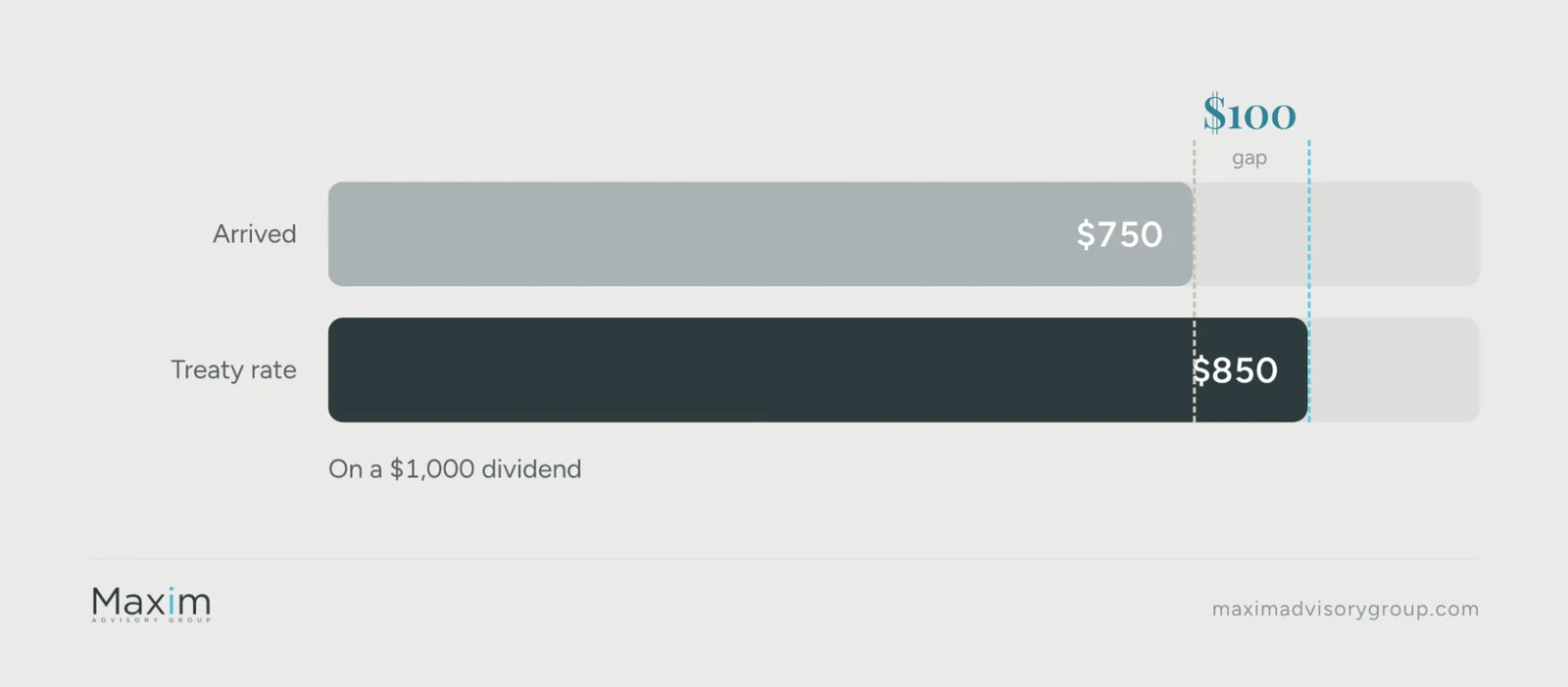
That missing $100 comes down to one form nobody sent. This page covers which form, and what else the treaty changes.
The Canada US Tax Treaty, Explained
What the treaty does. It decides which country taxes each type of income you earn across the border. Where both countries can tax it, the treaty caps what the country the money comes from can take. Some income is only taxed where you live: ordinary interest, most software, patent and copyright royalties, and social security.
How you get the lower rate. The treaty rate is a maximum you claim, not a rate you get automatically. You claim it with a form you give the company paying you, not a tax authority. Give Form NR301 to a Canadian payer, and Form W-8BEN to a US one.
What it doesn’t change. If you’re a US citizen, you file a US tax return every year, wherever you live. The treaty keeps that rule in place. It stops you paying tax twice, but it doesn’t remove the filing.
Two dates matter. Your NR301 expires three years from the end of the year you signed it. If too much Canadian tax was taken, you have two years from the end of the year it was sent to the CRA to claim it back.
On This Page
- How The Treaty Decides Which Country Taxes What
- Canada US Treaty Withholding Rates By Income Type
- How To Claim A Canada US Treaty Rate
- What The Treaty Means For US Citizens In Canada
- What The Treaty Does For Your Retirement Accounts
- When Form 8833 Is Required
- 8 Common Canada-US Treaty Mistakes To Avoid
- Canada US Tax Treaty Frequently Asked Questions (FAQs)
- Get The Treaty Working Before The Next Payment
How The Treaty Decides Which Country Taxes What
The treaty is long, which is why most people never open it. It’s really a list of numbered articles. Each one takes a type of income and says which country can tax it. You usually only need the one or two that cover your own income.
Most Income Goes To One Country
Employment income, meaning your salary or wages, is the simplest. Article XV says your salary is taxed where you live, unless you do the work in another country. Live and work in Calgary, and Canada taxes your pay. Cross the border to do the work, and the US can tax that part.
Short trips have exceptions. Say your Calgary employer sends you to Seattle for 90 days to set up a new client. Your pay usually stays Canadian, because you were there for under 183 days and your Calgary employer paid you, not a US one. The table below lists both tests.
Property sales depend on the property. Under Article XIII, a gain on a house in Arizona can be taxed by the US, because the house is there. If you’re a Canadian tax resident, you report that gain in Canada too, and Canada gives you a credit for the US tax so you don’t pay twice.
A gain on your investment portfolio is usually taxed only where you live. If your investments are held outside your home country, that country may withhold tax on them. Again, the treaty lets you claim foreign tax credits so you avoid double taxation.
Pensions follow Article XVIII, covered in the retirement section below. US citizens are the big exception to all of this, covered in the section on US citizens.
Where Both Countries Can Tax, The Treaty Sets A Maximum
For some income, both countries get a share. The treaty lets the country the money comes from take some, up to a limit. Every limit is in the table below. Three things about them don’t fit in the table.
- Beneficial owner. Most limits only apply if you’re the beneficial owner. That just means the income is really yours, not held for someone else by a broker or nominee.
- Regular pension payments. The 15% limit on pensions covers regular payments. A lump-sum RRSP withdrawal isn’t one, so Canada’s full 25% applies instead.
- Ordinary interest. Most interest from Canada never needed the treaty. Canadian tax law only taxes interest between connected people, or interest tied to the borrower’s profits. The non-resident tax page explains how.
First, The Treaty Decides Where You Live
Everything else depends on which country you live in for tax purposes. Usually that’s obvious. Sometimes both countries claim you in the same year, each under its own rules. Canada looks at your ties here, like a home, a spouse and dependants. The US looks at citizenship, a green card, or days spent there. The snowbird page covers the US day count.
When both countries claim you, Article IV breaks the tie. It runs through a set of tests in order and stops at the first one that gives an answer, starting with where you have a permanent home. If every test ties, the two tax authorities settle it between themselves, which can take a long time. The best way to avoid that is by creating a residency timeline and narrative with a cross-border professional.
Canada US Treaty Withholding Rates By Income Type
Here’s what the treaty caps, and the form each country’s payer needs before using the lower rate:
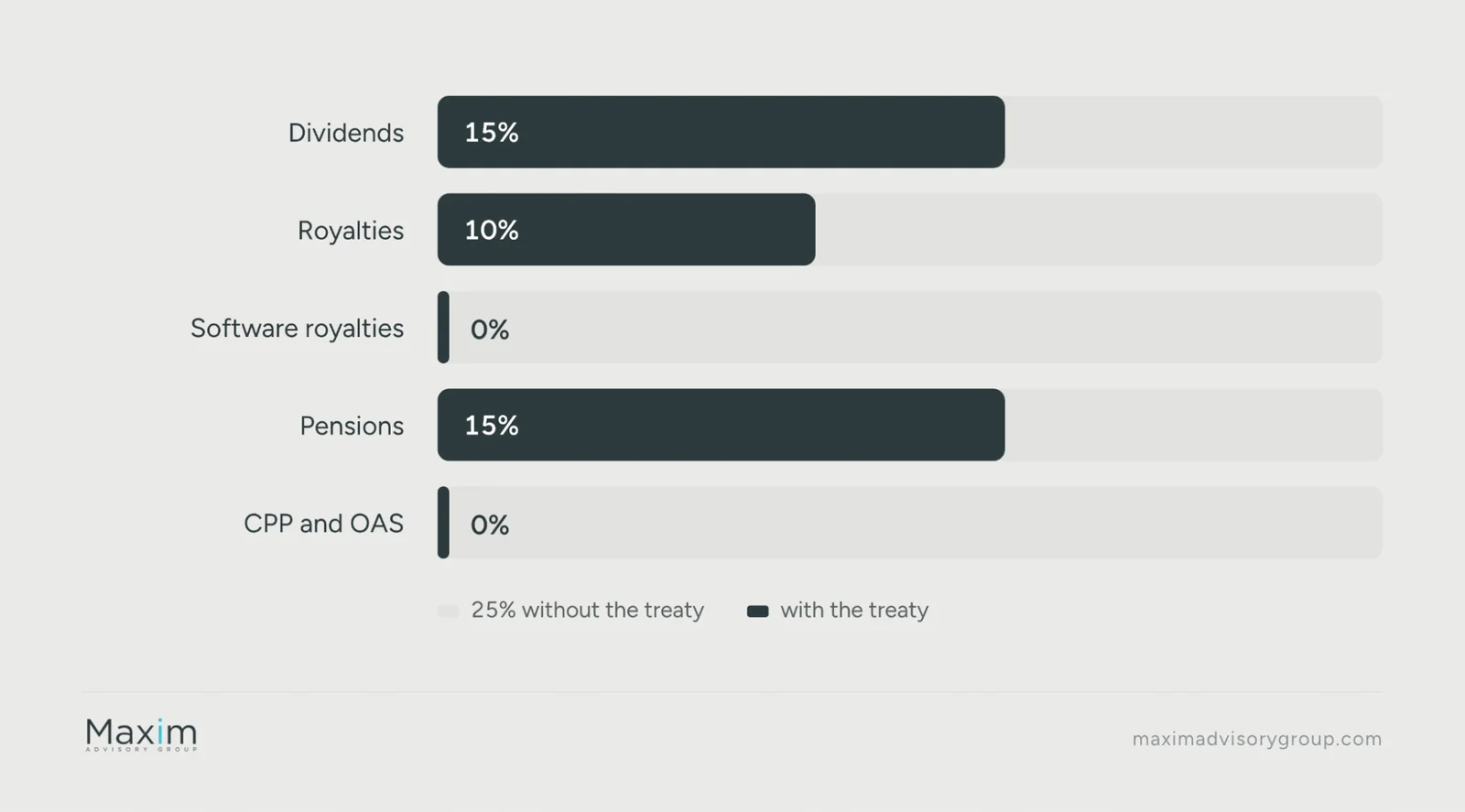
| Income type | Who may tax it | The source country’s ceiling | Article | To a Canadian payer | To a US payer |
|---|---|---|---|---|---|
| Dividends, ordinary | Both countries | 15% | X(2) | NR301 | W-8BEN |
| Dividends, to a company owning 10%+ of the votes | Both countries | 5% | X(2) | NR301 | W-8BEN-E |
| Interest, arm’s length and not participating | The recipient’s country only | Nil, and s. 212(1)(b) never reaches it | XI(1) | Nothing, for the rate | W-8BEN |
| Interest, non-arm’s-length | The recipient’s country, except on any excess | Nil, except any excess over an arm’s-length amount | XI(1), XI(5) | NR301 | W-8BEN |
| Interest, participating or cash-flow-linked | Both countries | 15% | XI(6)(a), XI(6)(b) | NR301 | W-8BEN |
| Royalties, general | Both countries | 10% | XII(2) | NR301 | W-8BEN |
| Royalties on software, patents, know-how and copyright (except film and TV) | The recipient’s country only | Nil | XII(3) | NR301 | W-8BEN |
| Royalties on film and TV | Both countries | 10% | XII(2), by exclusion from XII(3) | NR301 | W-8BEN |
| Periodic pension payments | Both countries | 15% | XVIII(2) | NR301 | W-8BEN |
| Social security | The recipient’s country only | Nil | XVIII(5) | Nothing, for the rate | Nothing, for the rate |
| Employment pay, at $10,000 or less; or inside 183 days AND not paid or borne in the other country | The recipient’s country, where the conditions hold | Not a withholding ceiling | XV(2) | A CRA waiver, applied for ahead of the work | Form 8233, for personal services |
| Gains on real property in the source country | Both countries | Not a withholding ceiling | XIII(1) | A separate clearance process applies | A separate clearance process applies |
| Gains on other property | The recipient’s country only | Not a withholding ceiling | XIII(4) | Nothing given to a payer | Nothing given to a payer |
Rates as updated by the protocol signed 21 September 2007, the treaty’s most recent change. Without the treaty, Canada’s default rate is 25%, and the US default is 30% on most US income paid to foreign people.
The forms go to the company paying you, not a tax authority. Form 8233 is the exception: the payer sends a copy to the IRS within five days. The US column assumes you’re not a US person. US citizens and green card holders give the payer a Form W-9 instead.
Here are some more things to keep in mind:
- Similar-sounding income can be taxed very differently. A software royalty and a film royalty are both royalties. Only the film royalty can be taxed where it’s paid from. On a big contract, that difference can be worth six figures.
- Canadian employers withhold even when the treaty exempts you. If you work in Canada and the treaty says Canada can’t tax the pay, your Canadian payer still has to withhold, unless you have a CRA waiver or they’re a certified non-resident employer. The waiver is Form R102-R, and it should be filed 30 days before the work starts.
- US payers need a tax number. A W-8BEN needs a taxpayer identification number, American or foreign, with a narrow exception for some investments. Payment for personal services uses Form 8233 instead.
- US social security is taxed where you live. If you live in Canada, Canada taxes your US social security like a CPP benefit, and 15% of it is tax-free. Plenty of people believe the opposite and act on it for years.
How To Claim A Canada US Treaty Rate
Back to that $1,000 dividend and the missing $100 we mentioned before. The fix is a form you give your payer before they pay you.
The CRA tells payers to confirm three things before using a treaty rate:
- that the income is really yours
- which country you live in for tax purposes
- that you qualify for the treaty
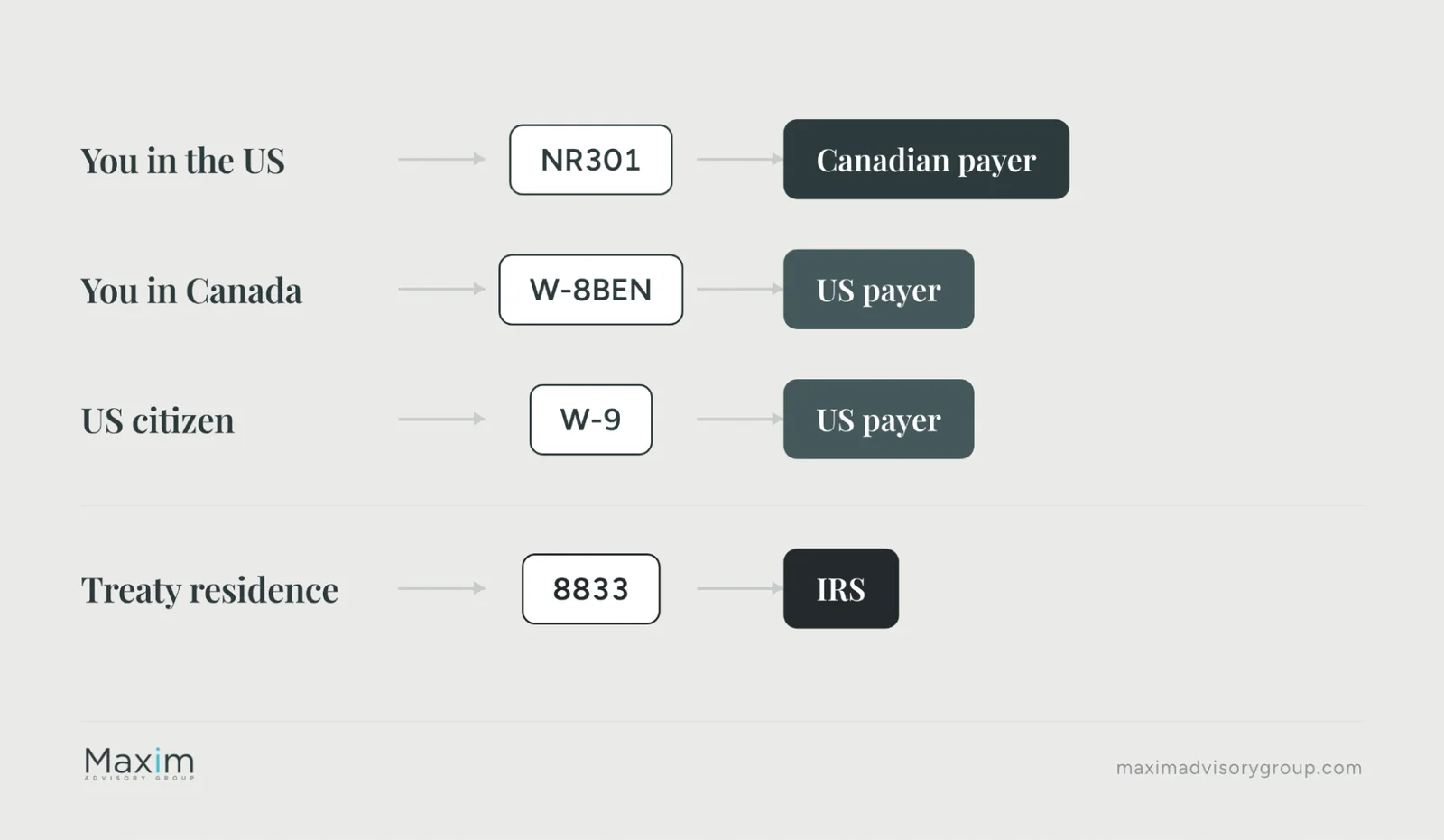
Form NR301 is the usual way to confirm all three. The CRA accepts the same details in another written form, but NR301 is the simplest route. Partnerships and some other entities use a different form.
If a payer asks for these details and you don’t give them, the CRA tells the payer to withhold the full 25%. More often, nobody asks and the form never comes up. Either way, the declaration is what changes the rate.
Qualifying for the treaty sounds hard, but for a person it isn’t. Article XXIX A limits the treaty to “qualifying persons”, and any individual who lives in Canada or the US counts. That article is really aimed at companies and trusts.
The biggest mistake is thinking the lower rate applies to you automatically. It’s the rate you’re allowed to ask for. Asking means a form, and it has to reach your payer before your payment does.
If Too Much Was Already Taken
You can often get it back. Form NR7-R is how you apply for a refund of over-withheld Canadian tax. The CRA has to receive it within two years of the end of the calendar year the tax was sent to the CRA. After that, the money is gone.
Your NR301 also expires. It lasts three years from the end of the calendar year you signed it, or less if your situation changes. A form signed any time in 2023 runs out at the end of this year, and nobody writes to remind you.
What The Treaty Means For US Citizens In Canada
Most of the treaty divides income between the two countries, one type at a time. Then one clause, called the saving clause, changes the picture for US citizens.
It’s in Article XXIX(2)(a). In short, it says the treaty doesn’t change how each country taxes its own residents, and in the US’s case, its own citizens. Canada taxes the people who live here. The US taxes its citizens wherever they live, and the treaty leaves that alone. There are exceptions, including the double-tax relief and most of the pension rules.
The IRS says it plainly. If you’re a US citizen or green card holder living in Canada, you still have to file a Form 1040 and report your worldwide income every year. A lot of US citizens living in Canada are surprised they still have US tax filing obligations.
This catches people who barely think of themselves as American. Say you were born in Calgary to an American parent and got a US passport at 19 because it seemed useful. You’ve lived in Canada your whole life. Once your income passes the US filing threshold, you owe a US return every year, and you have since it passed.
The treaty does stop you paying tax twice. Under Article XXIV, Canada gives you credit for US tax first, up to what a non-citizen would have paid the IRS on that income. The US then credits the Canadian tax that’s left.
That fixes the tax, but not the paperwork. You still file two returns every year, and someone has to prepare both. There’s no planning around this one. If you’re a US citizen building a life in Canada, talk with a cross-border CPA so you stay onside with the IRS.
What The Treaty Does For Your Retirement Accounts
One part of the treaty, Article XVIII(7), protects retirement accounts held across the border. It also works in both directions.
Your RRSP, Seen From The US Side
If you’re a US citizen or resident with an RRSP, the default is surprising. The US taxes the growth inside the RRSP every year, even if you never take money out. The treaty lets you switch that off, but you have to choose it.
That used to mean filing Form 8891, and many people missed it. Since 2014, Revenue Procedure 2014-55 treats most people as having made the choice automatically, back to the first year they could have. The IRS dropped Form 8891 completely. If anyone tells you to file it for past years, that advice is more than a decade out of date.
There’s one catch. If the growth inside your RRSP ever appeared on a US return of yours, the automatic choice doesn’t cover you. You’d need to ask the IRS for permission to choose late.
This covers RRSPs, RRIFs, registered pension plans and deferred profit sharing plans. It doesn’t cover a TFSA, because a TFSA isn’t a pension. It also doesn’t change your reporting. Form 8938 and the FBAR, FinCEN Form 114, have their own thresholds, and you may still need to file them.
Your 401(k) Or IRA, Seen From The Canadian Side
The same rule works in reverse. If you live in Canada and hold a 401(k) or IRA, you can choose to defer Canadian tax on the growth inside it.
A Roth IRA needs extra care. The CRA’s guidance on Roth IRAs says it only counts as a pension if you make no contributions while living in Canada. Put in even one contribution after you move, and the account splits. What was already there keeps its protection. Growth after that becomes taxable in Canada every year.
The Roth election also has an early deadline. It should be filed by your Canadian tax filing deadline for the year you became a resident, which is usually the first spring after you move.
Get it right and qualified Roth withdrawals stay tax-free in Canada, the same as they would in the US.
Withdrawals have their own trap. Regular payments from a US plan to someone in Canada are capped at 15%, the same as Canadian pensions paid into the US. Take everything in one lump sum and the cap doesn’t apply, so the full 30% US rate does.
When Form 8833 Is Required
The US wants to know when you use the treaty to override its own tax rules. The form is Form 8833, and missing it can cost $1,000, or $10,000 for a C corporation.
For most people, that’s less scary than it sounds. The IRS doesn’t need the form for everyday treaty claims: a lower rate on dividends, interest, rent or royalties, or treaty rules on your pay, pension, annuities or social security. That covers almost everything in the table above. The IRS says its list isn’t complete, so treat it as a guide.
You do need it when the treaty changes where you live for tax, not just your rate. The main example is using the Article IV tie-breaker to be treated as a Canadian resident when the US would otherwise count you as its own.
That comes with a serious trap for green card holders. Hold a green card long enough and the US treats you as a long-term resident. If you then use the treaty to be treated as a Canadian resident, the form says you “will be deemed to have expatriated.” In plain terms, it can end your US tax residency and bring in the US expatriation tax. Get advice before you file it.
So keep the two apart. A treaty rate is routine and goes to your payer. A treaty claim about where you live goes to the IRS, on a form, with a penalty for getting it wrong.
8 Common Canada-US Treaty Mistakes To Avoid
Avoid these treaty mistakes to prevent future headaches.
- Assuming the lower rate is automatic. It’s a maximum you have to claim. Without a form on file, your payer takes the full rate, and they’re right to.
- Letting your NR301 expire. It lasts three years from the end of the year you signed it, or less if things change. Nobody reminds you.
- Filing NR301 for ordinary interest. Ordinary interest from an unconnected borrower isn’t taxed by Canada, so there’s nothing to claim and no form to send.
- Taking a retirement plan as a lump sum. The 15% cap only covers regular payments. A single withdrawal gets the full 25% or 30%.
- Contributing to a Roth after moving to Canada. One contribution splits the account, and growth after it becomes taxable in Canada.
- Missing foreign tax credits. Tax paid in one country usually counts against the other. Tax paid on that Arizona home sale, for example, is credited on your Canadian return.
- Assuming a TFSA shelters you from US tax. The US doesn’t honour it. A US citizen or resident pays US tax on the growth.
- Skipping foreign reporting. A country that doesn’t tax an account may still want it reported. A US person with an RRSP, for example, still has to disclose it. Both countries have disclosure rules with penalties of their own.
Canada US Tax Treaty Frequently Asked Questions (FAQs)
What is the Canada US tax treaty?
The Canada US tax treaty is an agreement between the two countries that decides which one taxes each kind of cross-border income. Where both can tax it, the treaty caps what the country the money comes from can take. It applies to anyone who lives in one country and earns income from the other, like dividends, pensions, rent or pay for work.
How do I get the treaty rate on Canadian dividends?
Give Form NR301 to the Canadian company or broker paying you, before they pay you. Without it, your payer has to withhold the full 25% on dividends. With it, a US resident usually pays 15%. The form confirms the income is yours, where you live for tax purposes, and that you qualify for the treaty.
Do Canadians need to fill out a W-8BEN?
Yes, if you’re a Canadian resident earning income from a US source, like dividends from US stocks. You give Form W-8BEN to your US broker or payer, not the IRS. It cuts US withholding on dividends from 30% to 15%. Your Canadian social insurance number usually works as the foreign tax number the form asks for. The form stays valid until the end of the third calendar year after you sign it.
Can I keep my Roth IRA if I move to Canada?
Yes. A Roth IRA can stay tax-free in Canada, but only if you stop contributing once you become a Canadian resident. Even one contribution after you move makes future growth taxable in Canada every year. You also need to file an election with the CRA by your filing deadline for the year you became a resident, which is usually the first spring after you move.
How is US social security taxed if I live in Canada?
If you live in Canada, only Canada taxes your US social security. The US doesn’t withhold on it. Canada treats it much like a CPP benefit, and for most people 15% of it is tax-free. Many people assume the US taxes it because that’s where it comes from, and report it the wrong way for years.
Does the treaty stop double taxation for US citizens living in Canada?
It stops you paying tax twice, but it doesn’t stop you filing twice. US citizens file a US return every year wherever they live, because of the treaty’s saving clause. Canada gives you credit for US tax first, and the US then credits the Canadian tax that’s left. You still need both returns prepared every year.
Do I need to file Form 8833?
Most people don’t. The IRS waives Form 8833 for everyday treaty claims, like a lower rate on dividends, interest or royalties, or treaty rules on pensions and social security. You do need it when you use the treaty to change where you live for tax, for example claiming Canadian residence under the tie-breaker rules. Missing it can cost $1,000.
What if too much Canadian tax was withheld?
You can apply for a refund on Form NR7-R. The CRA has to receive it within two years of the end of the calendar year the tax was sent to the CRA. After that, the money can’t be recovered. To stop it happening again, give your payer Form NR301 before the next payment.
Get The Treaty Working Before The Next Payment
Almost everything the treaty offers has to be set up before you’re paid. A form that arrives in February doesn’t help a dividend paid in January.
So if money moves between Canada and the US regularly, whether it’s a dividend, a royalty, a pension or rent on a property you kept, ask two questions. Has someone filed the form that makes the treaty apply to you? And when does that form run out?
For most people that takes one conversation. If you have a company in one country and a home in the other, it takes longer, and finding out late can cost you that 10% gap on everything already paid. The first consultation is paid, and it ends with a straight answer, even when the answer is that nothing needs doing.