

Who Do The Snowbird Tax Rules Apply To?
Plenty of Canadians spend the winter in the US. You might rent in Arizona, own a condo in Florida, or drive down with an RV each November. Most go back and forth for years without thinking about US tax. Personally, I spend about four months a year between Arizona and California. I love the weather and lifestyle.
But here’s the problem. The US has its own test for who counts as a resident for tax purposes. It’s called the substantial presence test, and it counts days, not months. Pass it and the US can tax your worldwide income the same way it taxes an American’s. Form 8840 is the short form that keeps most snowbirds out, by showing the IRS their real home is in Canada.
Snowbird Tax Rules Key Takeaways
What the US counts. It counts days across three years: all of this year’s, a third of last year’s, and a sixth of the year before (more on that below). A total of 183 means you pass the substantial presence test.
How you stay out. File Form 8840, the Closer Connection Exception Statement, for each year you pass the test. It shows your real home is in Canada. It’s due by the Form 1040-NR deadline, extensions included, and each person files their own. File it late and you lose the exception for that year, unless you can show clear and convincing evidence for the delay.
Where it goes wrong. Form 8840 only works if you spent fewer than 183 actual days in the US that year. Above that, the Canada US tax treaty decides where you live. Lose that tie-breaker and Canada treats you as having left, and the CRA taxes you as if you sold things you still own.
On This Page
- How The Substantial Presence Test (Really) Works
- What Four Months A Year Adds Up To
- Why Does 183 Days Show Up Twice?
- How Long Can Canadians Stay In The US?
- Form 8840 And The Closer Connection Exception
- The Canada US Tax Treaty Tie-Breaker At 183 Days
- What This Means For Your Canadian Tax Residency
- 5 Areas This Page Doesn’t Cover
- Snowbird Tax Rules Frequently Asked Questions (FAQs)
- Count Your Last Three Years Before You Book The Next Winter
How The Substantial Presence Test (Really) Works
You’ve probably heard of the substantial presence test. But did you know the IRS test has two parts? You meet it if you were in the US for at least 31 days this year, and at least 183 days across three years: this year and the two before it.
The first part catches almost every snowbird. A four-month winter passes 31 days before Christmas.
If you hold a green card, you can skip this section. You’re already a US tax resident for any year you hold one, whatever your days say.
The second part is where people go wrong. The IRS counts all of this year’s days, a third of last year’s, and a sixth of the year before.
Here’s an example: say you spend 120 days in Arizona every winter, year after year. Here’s how the IRS adds that up for this year’s test:
- This year: 120 days, count all of them → 120
- Last year: 120 days, count a third → 40
- The year before: 120 days, count a sixth → 20
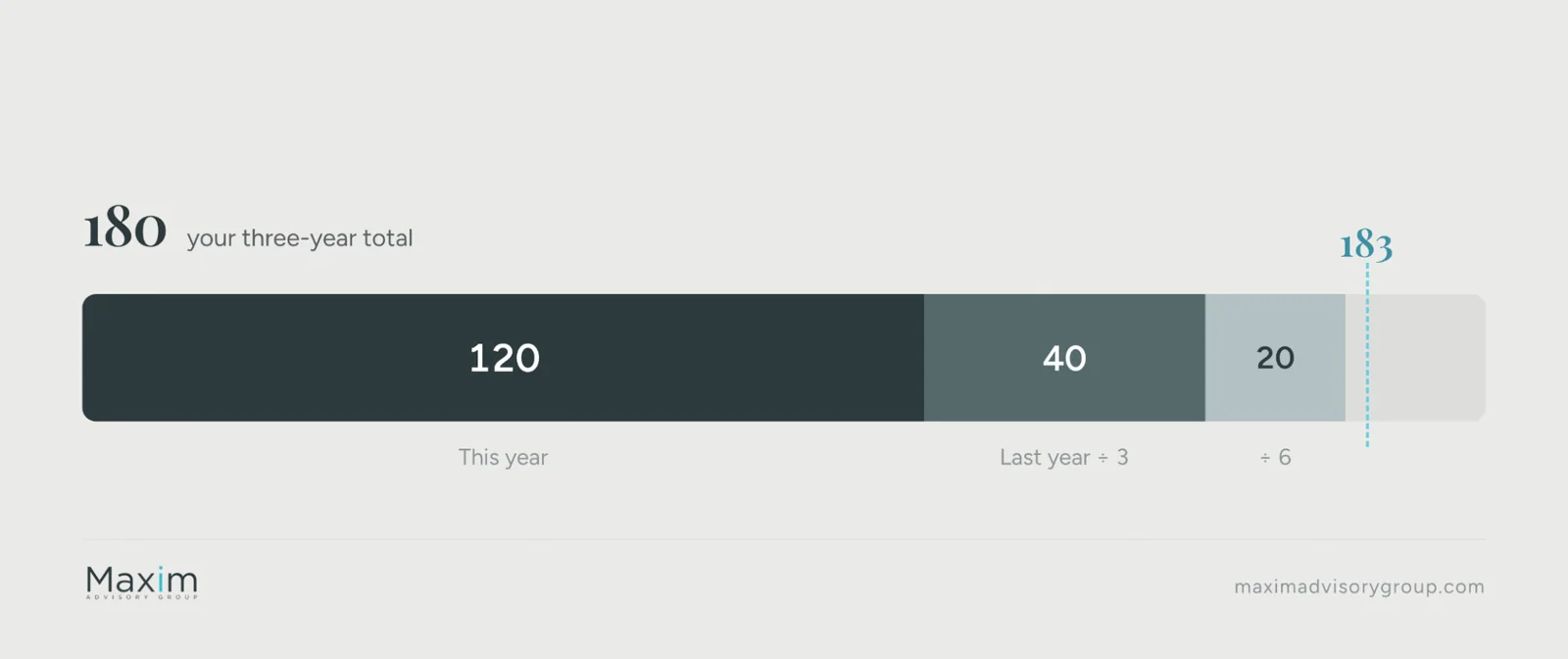
Total: 180. Three days under the 183 that triggers the test.
If your trip is the same length every year, this evens out and the table below works. Change the pattern, with one long stay or one skipped winter, and the numbers shift. One long stay can catch you that year and keep counting against you for the next two. If you’re changing the shape of a winter, check the count before you book, not after.
A Part Day Counts As A Whole Day
Any day you’re in the US, even for an hour, counts as a full day. Arriving in the evening uses a day, and so does leaving in the morning. For a snowbird who crosses twice a winter, that’s two days a year you might not have counted.
The count covers the 50 states and Washington, DC. It doesn’t include US territories or US airspace. A week in Puerto Rico doesn’t count, and neither does a flight that crosses the US without landing.
Some days are left out of the count. Two come up often:
- Transit days. Less than 24 hours in the US on your way between two places outside it, like a connection through Dallas. Leave the airport for a meeting and it counts.
- Medical days. Days you couldn’t leave because of a medical condition that started while you were there. You claim these on Form 8843.
The others cover commuting from Canada or Mexico for work, ship crews, NATO personnel and a few special categories. Publication 519 lists them.
What Four Months A Year Adds Up To
One, plus a third, plus a sixth, adds up to one and a half. So if your trip is the same length every year, the IRS’s three-year total is your trip times 1.5.
Here’s what that looks like for common trip lengths:
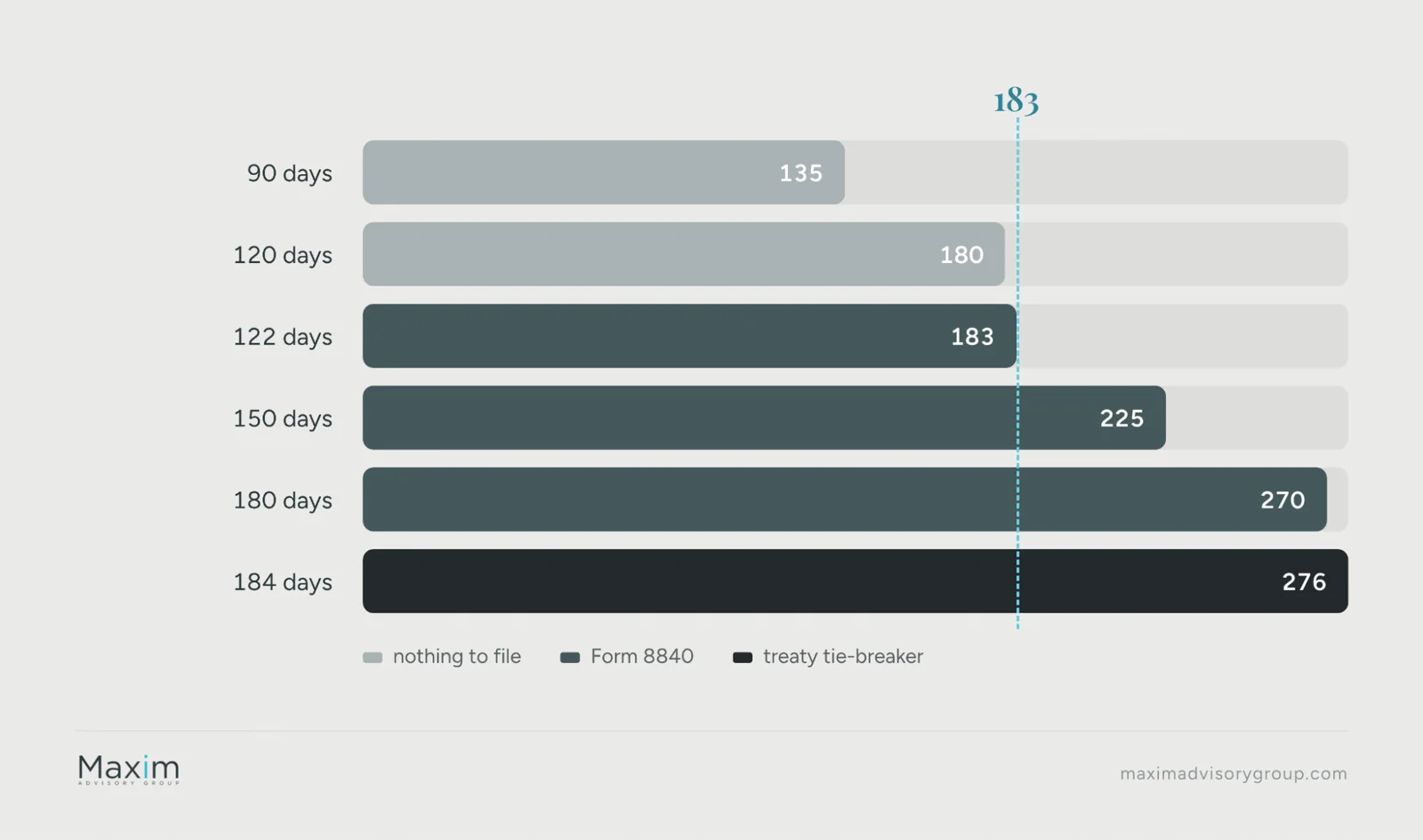
Taking a look above, notice that:
Four months is closer than it looks. At 120 days a year, it only takes 123 days in one winter to tip you. That leaves three days, which a delayed flight and a long weekend can use up.
The line falls at 122 days. A steady trip of just over four months a year meets the test.
Form 8840 covers more than people expect. Once you meet the test, the form is available in any year you spend under 183 actual days in the US. A five-month trip is covered, and a six-month trip is covered, just barely.
Why Does 183 Days Show Up Twice?
183 #1, the three-year weighted total. This decides whether the IRS even opens a file on you. Add this year’s days in full, a third of last year’s, a sixth of the year before. Hit 183, and you’re “caught,” and the substantial presence test applies to you.
183 #2, the plain count, this year only. This decides whether Form 8840 can get you back out. No weighting. Just: how many actual days were you in the US this year? Under 183, the form works. At 183 or over, it doesn’t, no matter what the form says.
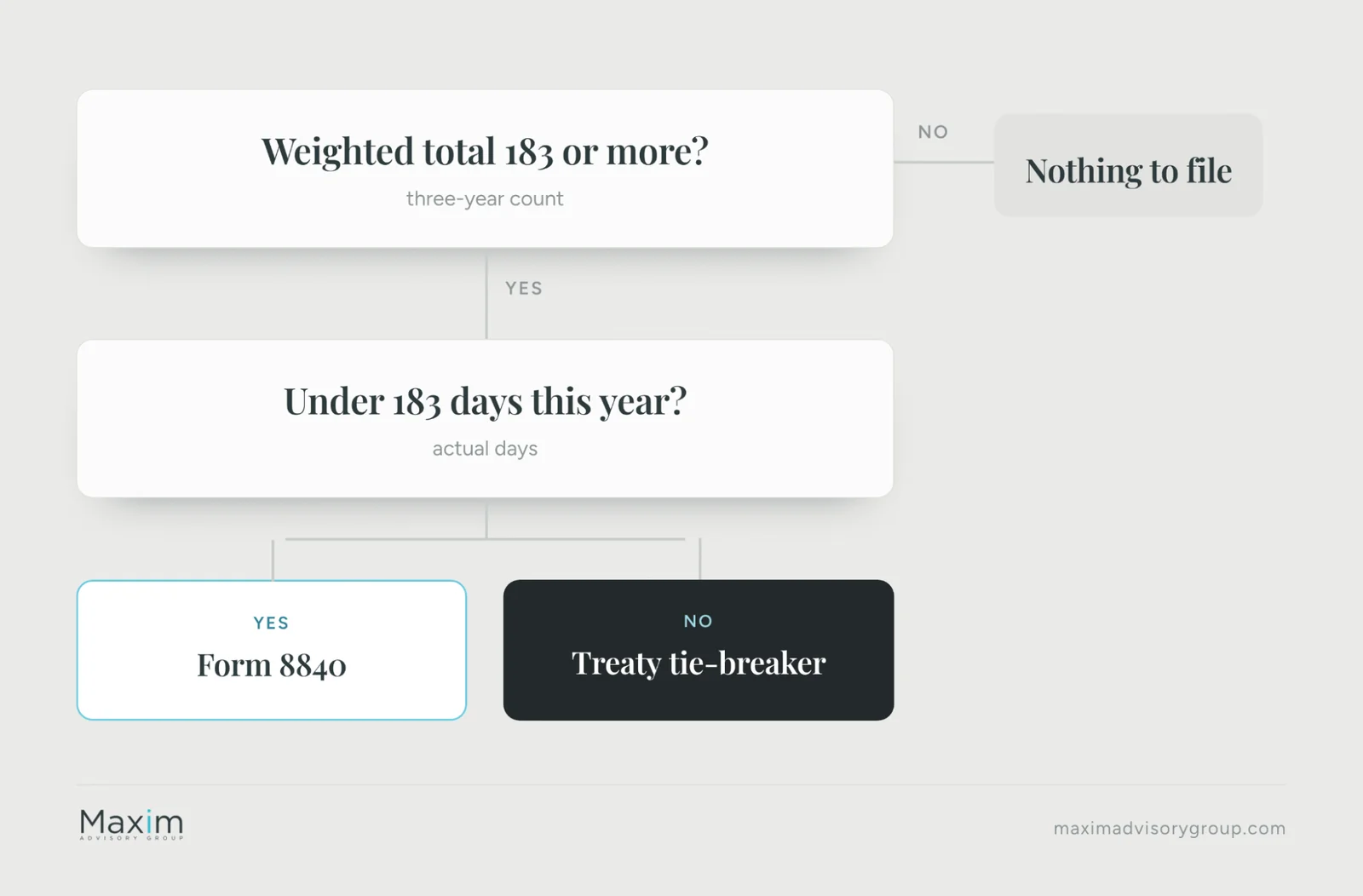
Here’s why that trips people up: both thresholds are 183, but they’re counting completely different things. You can fail the first one and still pass the second.
What changes the outcome is whether this year alone stayed under 183 real days.
How Long Can Canadians Stay In The US?
As a visitor, usually up to six months at a time. Canadians don’t need a visa for a visit, and the border officer decides how long you can stay each time you enter. Six months is the usual maximum, not a right.
Since 2025, anyone staying 30 days or more also has to be registered with the US government. Flying in usually covers it, because you get an I-94 record at the airport. Crossing by land may not, and then you register online with Form G-325R.
That’s the immigration answer, and an immigration lawyer is the right person for anything beyond it. The tax answer is separate, and it can catch you sooner. The IRS runs its own count, and it doesn’t care what the border officer wrote on your record.
Form 8840 And The Closer Connection Exception
Here’s the good news. If you meet the substantial presence test but your life is clearly still in Canada, you can say so, and the IRS treats you as a non-resident for that year. This is called the closer connection exception.
You claim it on Form 8840 and it only exists once you file it. If you don’t file, you don’t have it.
Most snowbirds don’t file a US return, so you mail Form 8840 on its own to: Department of the Treasury, Internal Revenue Service Center, Austin, TX 73301-0215. It’s due by the Form 1040-NR deadline, extensions included. If you do file a US return, it goes with that.
File it late and you lose the exception for that year, unless you can show clear and convincing evidence that you tried to learn the rules and took real steps to follow them. That’s a high bar.
Two practical points:
- You don’t need a US tax number. The form only asks for one if you have it. Leave the line blank if you don’t.
- Each person files their own. A couple wintering together needs two forms. Plenty of people file one and assume it covers both.
To use the exception, you need all four of these:
- You were in the US less than 183 days that year. That’s the second 183.
- Your tax home was in one foreign country all year. For work, that’s where your main place of business is. If you don’t work, it’s where you normally live. For a retired snowbird, that’s usually Canada.
- You had a closer connection to that country than to the US.
- You had not applied for, or taken steps toward, a green card.
For the closer connection part, the IRS looks at facts about your life, like where your home, family and belongings are. The table further down compares its list with Canada’s. One small tip: keep your Alberta driver’s licence. Swapping it for a state licence because the line was shorter is a bad trade.
The fourth condition is absolute. Apply for a green card, or start the process, and the exception is gone for that year, however Canadian the rest of your life is. If you’re thinking about staying in the US, plan both decisions together.
What If You’re Already Over And Never Filed?
Some readers will do this math and find winters that have already crossed the line. The form is clear: if you don’t file on time, you can’t use the exception and may be treated as a US resident.
The only way back is the same test as before: clear and convincing evidence that you tried to find out about the rule and took real steps to comply. That depends on your own facts, looking backwards, with US residency at stake. It’s the one part of this page not to handle alone. Bring the years and the day counts, and the exposure can be worked out before anyone files anything.
The Canada US Tax Treaty Tie-Breaker At 183 Days
Spend 183 actual days in the US in a year and Form 8840 no longer works. Now both countries can treat you as a resident: Canada because your ties are here, and the US because of its day count.
The Canada US tax treaty settles it, in Article IV. It runs through a set of tests and stops at the first one with an answer. The first test asks where you have a permanent home. Most snowbirds expect that to be Canada, and it usually is. Whether a place you use four months a year also counts as a permanent home depends on your facts, and it’s far cheaper to check in advance than after.
The treaty page covers the rest of the tests, and what this means if you hold a green card. Claiming residence under the treaty also has to be disclosed on Form 8833, filed with a US return.
And here’s the part that catches people. If the tie-breaker goes the US’s way, it fixes your US problem by creating a Canadian one.
Find out where your tie-breaker would land
What This Means For Your Canadian Tax Residency
The Canadian side catches fewer people, but when it does, it’s the expensive mistake.
Your Ties Keep You Canadian While You’re Away
Canadian residency depends on your ties, not your days. The CRA treats three ties as almost always decisive: a home here, a spouse or partner here, and dependants here. Other ties count in combination. The table below sets the CRA’s list next to the IRS’s.
Being away for a while doesn’t change that. The CRA’s guidance notes that the courts have consistently treated temporary absences, even long ones, as not enough to end Canadian residency.
For a snowbird, that’s good news. You stay a Canadian tax resident and keep filing here, and four months in the sun changes none of it.
Losing The Tie-Breaker Means Leaving Canada
Under Canadian law, if a treaty makes you a resident of another country, Canada treats you as a non-resident, even if you’d otherwise count as Canadian.
So if you spend enough days that Form 8840 stops working, and the treaty then decides you live in the US, Canada stops treating you as a resident. You didn’t move. A tie-breaker went the wrong way.
Leaving Canada has a cost. The CRA treats you as having sold certain property at its market value on the day you leave, even though you still own it, and taxes the gain. That’s departure tax, and the departure tax page explains it.
From then on, Canada taxes you like any other non-resident: only on your Canadian income, not on everything you earn.
Here’s what each country looks at:
| The fact | On the IRS closer connection list | On the CRA residential ties list |
|---|---|---|
| Where your home is | permanent home | dwelling place, significant |
| Your spouse and dependants | family | spouse or common-law partner, dependants, significant |
| Your belongings | personal belongings | personal property, secondary |
| Your driver’s licence | where you hold it | a provincial licence, secondary |
| Clubs and memberships | social groups | social ties, union and professional memberships, secondary |
| Where you do business | business activities, excluding your tax home | economic ties, secondary |
| Where you vote | where you vote | not on this list |
| Which charities you give to | charitable contributions | not on this list |
| Health coverage from a province or territory | not on this list | secondary |
| Your passport | not on this list | Canadian passport, secondary |
Sources: the IRS closer connection factors as of 16 July 2026, and the residential ties in CRA folio S5-F1-C1. “Not on this list” means that country doesn’t name the factor, not that it can never matter.
5 Areas This Page Doesn’t Cover
So far, we’ve talked about the day count. Here are five topics that feel related but run on different rules:
- Owning a US property. Renting it out, selling it, and US estate tax each have their own rules. The estate tax is the one people misjudge most.
- Immigration. How long the US lets you stay is a separate system from the tax day count.
- Provincial health coverage. Each province limits how long you can be away before coverage lapses, and the limits differ. Check yours against the trip you’re planning.
- State taxes. Each state has its own income tax and residency rules. Nothing above is about any one state.
- US reporting. If you’re treated as a US tax resident, reporting rules reach your Canadian accounts and registered plans, with penalties of their own. That’s a separate piece of work.
Snowbird Tax Rules Frequently Asked Questions (FAQs)
How many days can a Canadian snowbird stay in the US before paying US tax?
If you spend the same amount of time in the US every year, you can stay about 121 days a year without meeting the substantial presence test. Stay longer and you meet it, but you can still avoid US tax by filing Form 8840 each year, as long as you spend fewer than 183 days in the US that year and your real home stays in Canada.
What is the substantial presence test?
The substantial presence test is how the IRS decides whether a visitor counts as a US tax resident. You meet it if you spend at least 31 days in the US this year, and at least 183 days across three years. That count uses all of this year’s days, a third of last year’s, and a sixth of the year before.
What is Form 8840?
Form 8840, the Closer Connection Exception Statement for Aliens, tells the IRS that your real home is in Canada even though you met the substantial presence test. Filed on time, it keeps you a non-resident for US tax that year. It only works if you spent fewer than 183 days in the US that year and haven’t applied for a green card.
When is Form 8840 due?
Form 8840 is due by the deadline for Form 1040-NR. For most snowbirds with no US wages, that’s 15 June of the following year. If you don’t file a US return, you mail Form 8840 on its own to the IRS in Austin, Texas. Filing late usually means losing the exception for that year.
Do both spouses need to file Form 8840?
Yes. Each person files their own Form 8840, even if you travel together and share every day of the trip. A couple wintering in the US needs two forms every year they meet the test. Filing one form for the household is one of the most common mistakes snowbirds make.
Do I need a US tax number to file Form 8840?
No. Form 8840 asks for a US taxpayer identification number only if you already have one. If you’ve never had one, leave that line blank. The form is still valid, and you don’t need to apply for an ITIN just to file it.
What happens if I never filed Form 8840?
If you met the substantial presence test in past years and didn’t file, the IRS can treat you as a US resident for those years. The only way back is to show clear and convincing evidence that you tried to learn the rules and took real steps to comply. Get advice before filing anything late.
How long can Canadians stay in the US?
Canadian visitors can usually stay up to six months at a time, and the border officer decides the exact limit each time you enter. Anyone staying 30 days or more also has to be registered with the US government, which a flight’s I-94 record usually covers. The tax day count is separate, and it can apply sooner than the six-month border limit.
Count Your Last Three Years Before You Book The Next Winter
Here’s how to check yourself:
- Find three years of border crossings.
- Count the days by calendar year, not by winter.
- Take this year’s days in full, last year’s at a third, and the year before at a sixth.
- Find your row in the table above.
Under 183, you have room, and now you know how much. At 183 or above, you have a filing to make for that year. The sooner you know which year, the more choices you still have.
Bring that number to a consultation. Consultations are paid, and the scope is set out before you book. If your count has room in it, you’ll hear that, and you can go back to booking flights.