

Key Takeaways
For 2026 the Exemption Covers $1,275,000 of Profit per Person. That’s the $1.25 million limit raised for inflation. That’s also the figure CRA has published for 2026.
Only Half Your Profit Is Normally Taxed, So It Saves Less Than It Sounds. It takes up to $637,500 off your taxable income, which is worth about $306,000 at Alberta’s top rate. In the year of a big sale, minimum tax can claw back a good chunk of that, at least for a while.
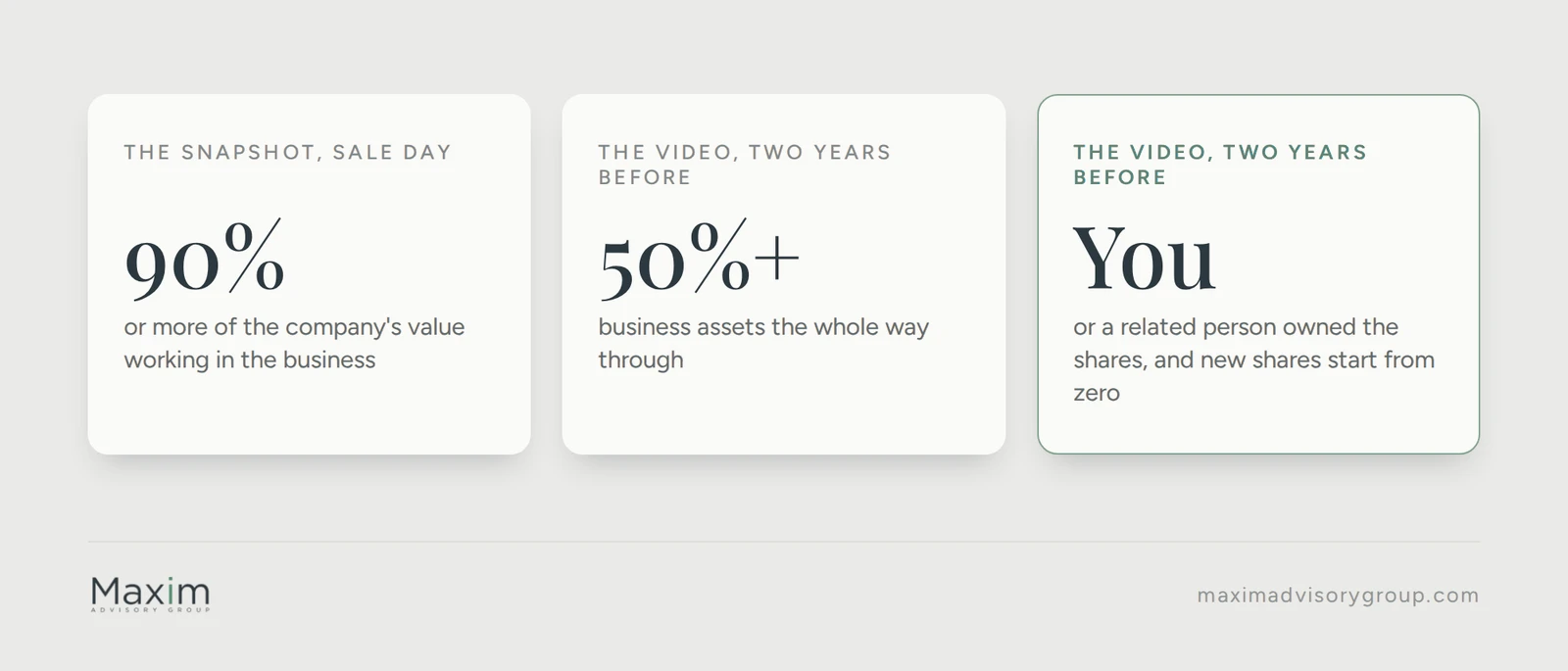
Your Company Has to Pass Three Tests, and Two Look Back Two Years. At least 90% of its assets have to be in the business on sale day, more than 50% for the two years before, and nobody but you or related family can have owned the shares in that time.
Four Things Can Cut the Claim or Cost You Tax Anyway. Old investment-loan interest, losses in the sale year, not living in Canada, and minimum tax.
The Two-Thirds Rate Was Cancelled. Only half your profit is taxed.
How much tax will you save when you sell your company? Probably less than you think, and possibly nothing at all.
Let’s say, for example, an email arrives on a Friday afternoon. A larger company wants to buy your business, and it is offering $2.4 million for your shares. It sounds like a sweet deal, considering you incorporated fifteen years ago with just $100 of share capital.
You hire your accountant to go over the offer, and they say you’ll use your capital gains exemption, a tax rule that makes up to about $1.25 million of profit on your company’s shares tax-free. Then the conversation moves on to the closing date.
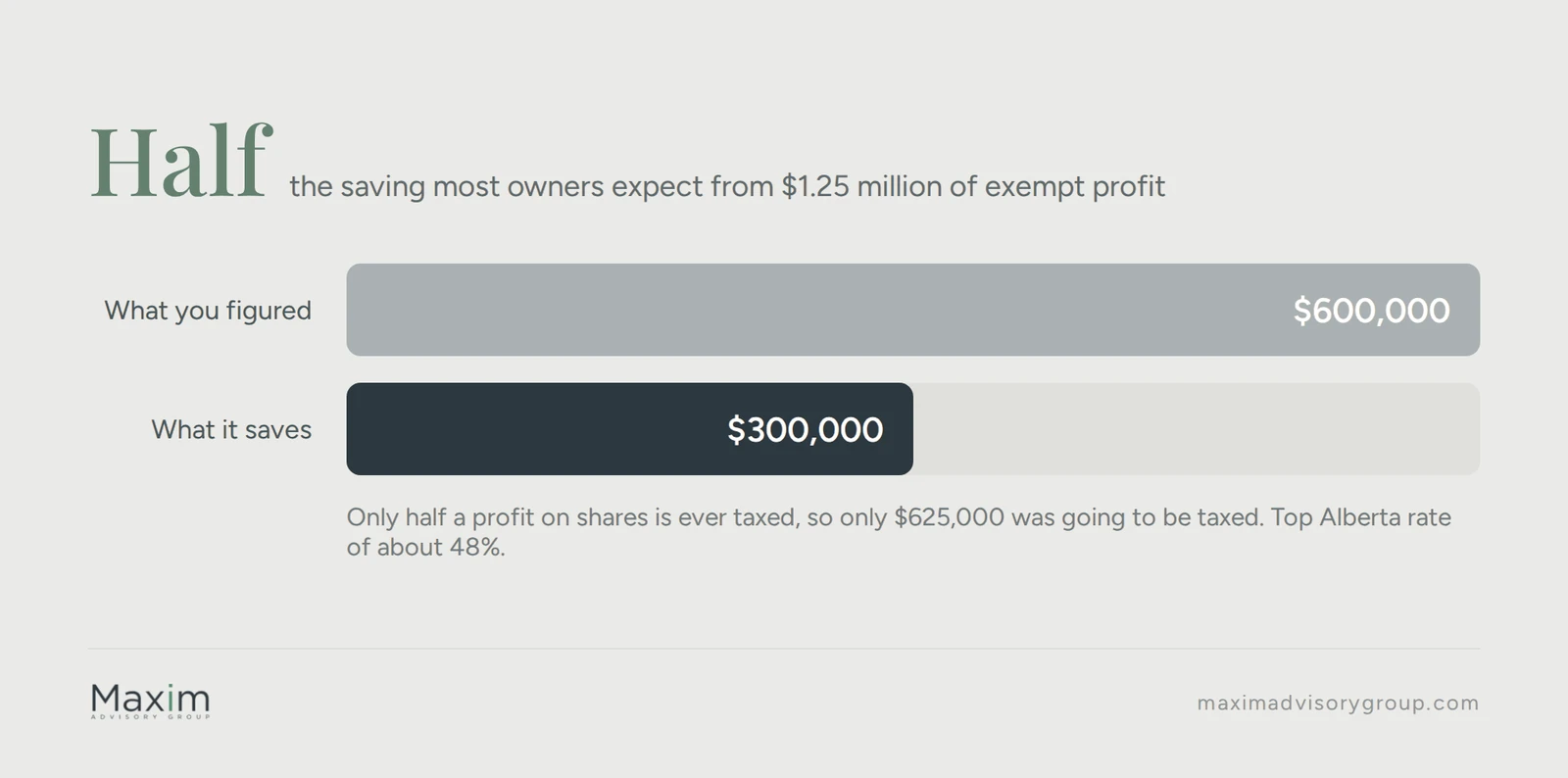
On the drive home, you do the math in your head. $1.25 million tax-free, at Alberta’s top rate of about 48%, saves you $600,000.
The problem is that estimate is wrong… twice.
First, only half of a profit on shares is ever taxed, exemption or not. So the exemption covers $1.25 million of profit, but only $625,000 of it was going to be taxed.
Second, your shares may not qualify at all. The company has to pass three tests, and two of them look back two years.
Here’s what else people usually miss.
- Cash and investments left in the company can fail those tests.
- A large sale can still bring a minimum tax bill, from a second tax calculation with fewer deductions.
- Selling the company’s assets instead of your shares loses the exemption.
- Losses and old investment-loan interest can shrink the claim.
- Leaving Canada or holding US citizenship changes the answer.
We’ll walk through each one.
On This Page
- How much of your sale does the exemption shelter?
- Will your company pass the three qualifying tests?
- How much tax does the exemption save on a sale?
- What can shrink or block your claim?
- Can you lock in the exemption before you sell?
- Can each family member claim their own exemption?
- What if you leave Canada or hold US citizenship?
- Common traps
- Quick answers
- When should you check whether your shares qualify?
How Much of Your Sale Does the Lifetime Capital Gains Exemption Shelter?
Only Half Your Profit Is Normally Taxed, So the Exemption Saves Less Than It Sounds.
Think of the exemption as a tax-free allowance. Every person who lives in Canada gets one, and it lasts a lifetime. Each time you sell qualifying shares, you draw some of it down, and whatever is left waits for your next sale.
Here’s how the allowance fits into the tax on a sale.
Your profit on a sale is called a capital gain. It’s the sale price minus what you paid for the shares, which the tax rules call your adjusted cost base.
The government only taxes half of your profit. It adds that half to your income. The half is set by the inclusion rate, and a plan to raise it to two-thirds was cancelled in March 2025.
Your accountant claims the allowance on your return as the capital gains deduction on line 25400. Because only half your profit was going to be taxed anyway, the deduction is half the allowance.
Here’s how that plays out on the $2.4 million sale.
| Your profit (capital gain) | $2,400,000 |
|---|---|
| Half added to your income | $1,200,000 |
| Capital gains deduction | minus $637,500 |
| Left to be taxed | $562,500 |
| Tax the deduction saves, at about 48% | about $306,000 |
This assumes your shares qualify.
In plain terms, the allowance takes $637,500 off your taxable income, and that saves about $306,000 at the top rate. The other $562,500 is still taxed.
How Much Is the Exemption Worth in 2026?
Your Allowance Is $1,275,000 This Year, Because It Rose With Inflation.
The allowance was $1.25 million for sales from June 25, 2024 through 2025, and that figure is now in the Income Tax Act. From 2026 it rises with inflation each year, and the government’s 2.0% indexation factor takes it to $1,275,000. That makes the deduction $637,500.
You may still see $1.25 million on some CRA pages, because the tax guides are written for the 2025 tax year. CRA’s indexation table already lists $1,275,000 for 2026.
Will Your Company Pass the Three Qualifying Tests?
Your Shares Have to Pass Three Tests, and Failing Any One Loses the Whole Exemption.
Not every company’s shares get the allowance. The ones that do are called qualified small business corporation shares, and your company has to pass three tests in section 110.6 of the Income Tax Act to get there. Fail any one and you lose the whole exemption on that sale.
It helps to picture the tests as a snapshot and a video. The government takes a snapshot of your company on sale day. It also watches a video of the two years before.
Farm and fishing property, such as shares of a family farm or fishing company and the land and boats it uses, qualifies under its own rules and draws on the same allowance.
Test 1. Is the Company 90% Active Business Assets on the Day You Sell?
The Sale-Day Snapshot Has to Show a Company That Is at Least 90% Business.
On sale day, at least 90% of what the company’s assets are worth has to be tied up in running the business in Canada. Shares of, or loans to, other small businesses in your group count too. Spare cash and investments don’t.
Take an incorporated dentist.
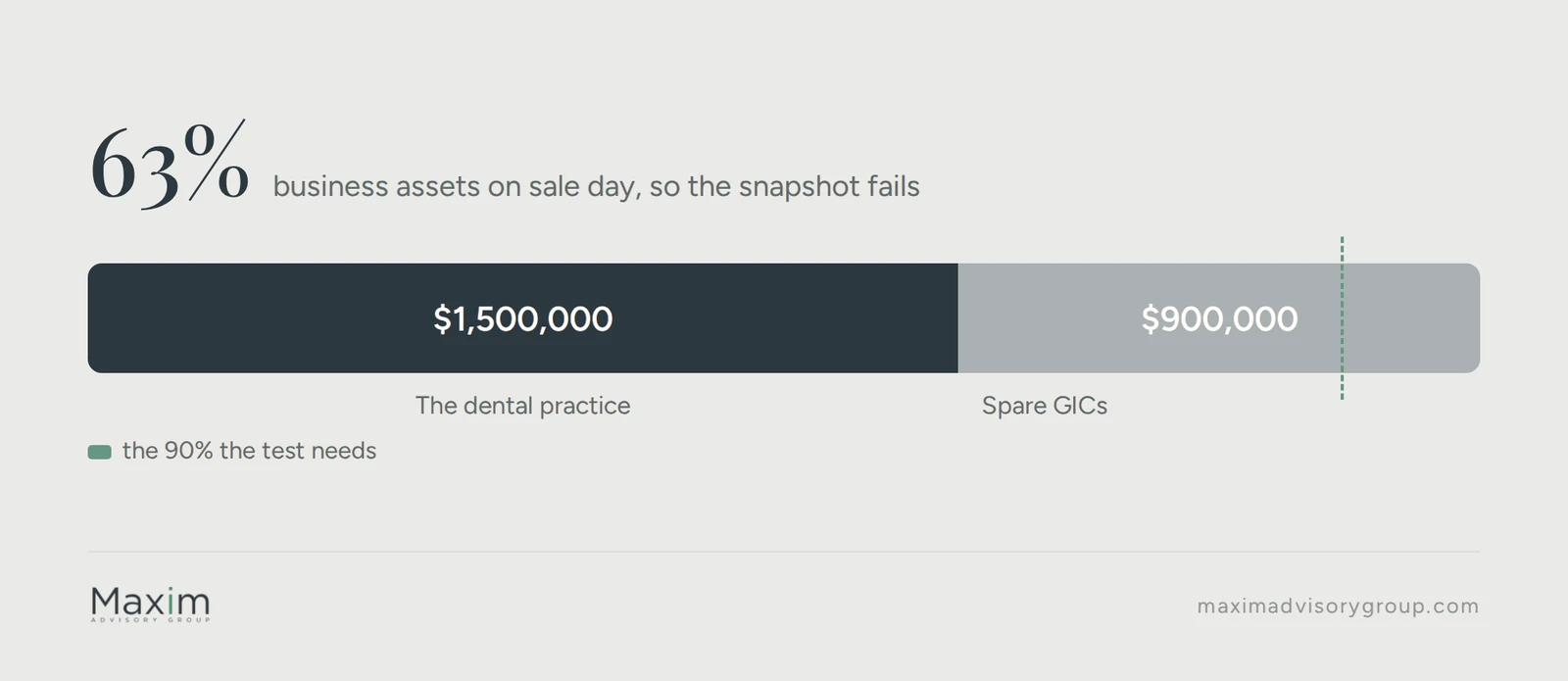
At 63%, the dentist fails the snapshot, with a practice that’s doing well.
If You Own the Company Through a Holding Company
If you sell the holding company‘s shares, the tests reach through it, more strictly, and investments parked in the holding company count against you.
Test 2. Was It Over 50% Active Assets for the Previous Two Years?
The Two-Year Video Has to Show More Than 50% Business the Whole Way Through.
The bar is lower here, but it runs longer. For the full two years before you sell, more than half of what the company’s assets are worth has to be in the business. It also has to stay a Canadian-controlled private corporation throughout, meaning a private company not controlled by non-residents or a public company.
The dentist passes if the company stayed around 63% the whole time. But say it dropped to 40% last year. Moving the GICs out now fixes the snapshot, but the video still shows last year. Test 2 stays failed until the company has two clean years again.
Clearing spare cash and investments out of a company before a sale is called purification. Whether you can do it without a tax bill depends on how the company is owned.
Test 3. Did Anyone Other Than You or a Related Person Own the Shares in Those Two Years?
New Shares Can Fail This Test Even When Only Family Ever Held Them.
The same two-year video also checks who owned the shares. Over those same two years, only you, a partnership you belong to, or a related person can have owned them.
“Related” has a legal meaning narrower than family. It covers your spouse, children, grandchildren, parents, grandparents, siblings and in-laws, plus a company you control. It leaves out cousins, nieces, nephews, aunts and uncles.
The catch is new shares. When the company issues shares, the rules treat them as if a stranger had owned them just before, so their two years of footage start from zero.
Shares you get in exchange for your old shares, such as the fixed-value shares in an estate freeze, are an exception. So are shares you get for your business when you first incorporate it. New growth shares your family or a trust buys for cash are not, so shares bought eighteen months before the sale fail Test 3.
How Much Tax Does the Exemption Save on a Sale?
Once Your Profit Passes $1,275,000, the Saving Stops Growing.
Your allowance has a ceiling, so past a certain point a bigger sale doesn’t bring a bigger saving. Here’s what it does at three sale sizes.
| $500,000 profit | $1.5 million profit | $3 million profit | |
|---|---|---|---|
| Profit the exemption covers | $500,000 | $1,275,000 | $1,275,000 |
| Half added to your income | $250,000 | $750,000 | $1,500,000 |
| Capital gains deduction | $250,000 | $637,500 | $637,500 |
| Left to be taxed | $0 | $112,500 | $862,500 |
| Tax saved at about 48% | $120,000 | $306,000 | $306,000 |
| Counted toward minimum tax (30% of the covered profit) | $150,000 | $382,500 | $382,500 |
Assumes one person with the full 2026 allowance unused, no investment losses, other income already in the top bracket, and shares that pass all three tests. 48% is the 2026 top combined federal (33%) and Alberta (15%) rate, and the savings are before any minimum tax. Sources are Income Tax Act s. 110.6, s. 117.1 and s. 38, CRA 2026 tax brackets, Form AB428, and CRA Form T691 (2025).
The saving tops out at $306,000. Once the allowance is used up, every extra dollar of profit is taxed normally, which is why families with a big sale look at giving more than one person an allowance.
The last row is the one people skip. Minimum tax is a second tax calculation the government runs alongside your regular one, and the profit your allowance covers still counts in it. That can turn into a bill in the year you sell.
What Can Shrink or Block Your Claim?
Even If Your Shares Qualify, Four Things Can Cut Your Claim or Bill You Anyway.
1. Old Investment-Loan Interest Can Block Part of It
Years of Deducted Investment Interest Leave a Tab That Can Shrink Your Claim.
If you’ve ever borrowed to invest and deducted the interest, you may be carrying an old tab. The rules call it your cumulative net investment loss, CNIL for short. It’s the amount your investment costs since 1988 have run ahead of your investment income, and Form T936 adds it up.
The tab only bites when your profit isn’t far above your allowance, and the bigger the tab, the further up it reaches. Say you sell at a $1.2 million profit with a $150,000 tab.
| No CNIL | $150,000 CNIL | |
|---|---|---|
| Half the profit, added to income | $600,000 | $600,000 |
| Capital gains deduction | $600,000 | $450,000 |
| Left to be taxed | $0 | $150,000 |
In plain terms, $300,000 of profit you expected to be tax-free gets taxed. On a $2.4 million profit the same tab blocks nothing, because the taxed half of the profit is far more than the deduction anyway.
The blocked room stays available for a later sale. To use it on this sale, the tab has to shrink before December 31.
2. Losses Claimed in the Sale Year Cut That Year’s Claim
A Loss in the Same Year Comes Off the Profit the Exemption Can Cover.
Say you sell your shares at a $1 million profit and lose $200,000 on stocks the same year. The two get netted first, so the allowance now covers only $800,000. Your loss got used up against profit that was going to be tax-free anyway.
Two kinds of loss work this way. The first is ordinary capital losses. The second is an allowable business investment loss, which is a loss on an investment in a small business that you can deduct against any income. Business investment losses you claimed in earlier years can shrink the claim too, so dig them out before a sale. Old capital losses carried forward from earlier years are optional to use, so leave them unclaimed in the sale year.
3. Minimum Tax Can Still Bill You
On a Large Sale, Some Minimum Tax Is Hard to Avoid.
That second calculation taxes income above $181,440 in 2026 at 20.5%, and Alberta adds 35% of any federal minimum tax. You pay whichever of the two calculations comes out higher.
Here’s why a big sale trips it. Regular tax counts half your profit, then lets the allowance wipe out up to $637,500 of that half. Minimum tax counts 30% of the profit your allowance covers, plus every dollar of the profit it doesn’t cover. On a large sale, that can come out higher than your regular tax for the year.
You can recover minimum tax over the next seven years, in years when your regular tax is higher than your minimum tax. That takes taxable income, and after selling the business that earned yours, you may not have enough to recover it all.
4. You Generally Have to Live in Canada
You Must Be a Canadian Resident for the Year, With a Rule for the Years You Arrive or Leave.
You can claim if you lived in Canada for the whole year of the sale. You also count as resident for the whole year if you lived here for part of it and all of the year before or after. So if you move away in June after a full year here, you still qualify. If you arrived in June and leave next spring, you don’t.
Can You Lock In the Exemption Before You Sell?
Crystallizing Uses Your Allowance Now, While Your Shares Still Qualify.
You don’t need a buyer to use your allowance. Crystallizing means trading your shares on paper for new shares, usually of the same company, claiming the exemption on the profit, and keeping ownership.
Why bother? Because the snapshot is taken on sale day. A company that passes today can fail in five years as cash builds up, and the 90% test is the one most likely to slip.
Say your shares are worth $1.2 million more than you paid and pass all three tests today. You crystallize, and your cost base, which is what the tax rules treat as what you paid, goes up by $1.2 million. Years later, if the company no longer qualifies, you only pay tax on the growth above that new cost.
It’s often done with a section 85 election, which lets you choose how much profit to trigger. You’ll pay for a valuation and professional fees, and it can bring some minimum tax into that year. It also has to steer clear of the anti-avoidance rules and section 84.1, which can turn a sale to your own company into a dividend.
Can Each Family Member Claim Their Own Exemption?
Every Person Has Their Own Allowance, So Spreading Shares Across a Family Can Multiply It.
Your allowance is yours alone. Your spouse has their own, and so does every other family member living in Canada. If you and your spouse each own half the company, you can each use your own.
Here’s what that does on a $2.5 million profit.
| You own it all | You and your spouse each own half | |
|---|---|---|
| Profit per person | $2,500,000 | $1,250,000 each |
| Covered by the exemption | $1,275,000 | All of it |
| Taxed normally | $1,225,000 | $0 |
A family trust can spread it further. When the trust sells, it can pass the profit out to family members, and each one uses their own allowance. The rules for children under 18 are stricter.
Two things decide whether this works.
- Timing. New shares start their two years of footage from zero, so family members need to own theirs well before the sale.
- Where the shares came from. If you gave your spouse the shares, or lent them the money to buy them, the attribution rules, which stop couples shifting income to each other, can treat their profit as yours. Then your spouse’s allowance goes unused.
What Happens to the Exemption If You Leave Canada or Hold US Citizenship?
Moving Away Can Use Up Your Allowance Without a Real Sale, and a US Passport Means the IRS Taxes the Profit Anyway.
Leaving Canada Counts as Selling Your Shares
Your Allowance Can Cover That Paper Sale, Because You Still Count as Resident That Year.
Moving away for good triggers an exit sale on paper. Canada treats you as having sold most of what you own at market value just before you leave, even though nothing changed hands. Canadian real estate and property used in a business you run here are left out. Your private company’s shares are not. This is called the departure tax.
Here’s the good news. You lived here for part of the year you leave and all of the year before, so you still count as resident for that whole year. If your shares pass the three tests when you leave, your allowance can cover the profit on that paper sale.
After you leave, you can’t use the allowance. Canada has taxed the growth up to the day you left. Growth after that is generally taxed by your new country, unless most of the company’s value comes from Canadian real estate.
If you’re planning both a move and a sale, the order can decide whether you get the allowance at all. Non-resident tax in Canada explains how Canada taxes you once you’ve left.
If You’re a US Citizen, the IRS Still Taxes the Profit Canada Exempts
The Allowance Is Canadian, and the IRS Doesn’t Recognize It.
Say you hold US citizenship, live in Alberta, and sell your company’s shares at a $1 million profit. In Canada your allowance covers all of it, so your regular Canadian tax is zero, though minimum tax may still apply.
The US taxes its citizens on everything they earn, wherever they live, and nothing in US law exempts profit on shares of a Canadian private company. Normally, tax you pay in Canada is credited against your US bill so you aren’t taxed twice. Here there’s little or no Canadian tax to credit.
So the $1 million Canada lets you keep tax-free can be fully taxable on your US return, generally at US capital gains rates of up to 20%, plus the 3.8% net investment income tax in some cases. If you own 10% or more of the company, the US may treat part of the gain as a dividend. Whether the Canada–US tax treaty helps in your case, and how the timing lines up, is worth settling before the sale. Cross-border guidance covers the rest of that picture.
Common Traps With the Lifetime Capital Gains Exemption
Most of These Start With a Decision Made Long Before a Sale.
Assuming a successful company qualifies. Profit left in the company as cash and investments can fail the sale-day snapshot. If spare money ever made up half of what the company owned during the past two years, the video fails too.
Treating a share sale and an asset sale as the same deal. The exemption only works when you sell shares, so if the company sells its equipment, clients and goodwill instead, the profit is the company’s and your allowance can’t touch it. If a buyer wants assets, price in the allowance you’d give up.
Missing the two-year window on new shares. Shares a family member or a trust buys for cash start their two years of footage the day they’re issued.
Assuming a sale to your own family’s company works like any other sale. Selling to a company you or your family control can turn part of the price into a dividend under section 84.1, with no exemption, and the anti-avoidance rules can deny the claim. Get it checked before you agree on a price.
Missing old investment-loan interest. Interest you deducted years ago can leave a tab that blocks part of the claim, so find out what’s on it a year before the sale.
Treating the exemption as the whole tax bill. Minimum tax can still send you a bill in the year you sell.
Assuming the two-thirds rate applies. That increase was cancelled in March 2025, so a plan built on it is solving a problem that no longer exists.
Quick Answers on the Lifetime Capital Gains Exemption
Can My Corporation Claim the Exemption?
No. Only people can. If your holding company sells your operating company’s shares, the profit belongs to the holding company, and nobody can use the exemption on it.
Does the Exemption Have to Be Used All at Once?
No. Whatever you don’t use carries over to your next qualifying sale. Every earlier claim counts against your lifetime limit, including one you’ve forgotten.
Which Forms Report the Claim?
Three forms and one line. Schedule 3 reports the profit, Form T657 works out the deduction, and Form T936 works out your cumulative net investment loss (CNIL). The deduction goes on line 25400.
Does Alberta Tax the Profit the Exemption Covers?
Only through minimum tax. Alberta starts from the same taxable income as your federal return, after the deduction, so the exemption comes off both. Alberta then adds 35% of any federal minimum tax.
Does It Cover a Rental Property or Public Company Shares?
No. Only qualifying small business shares and farm or fishing property count. Profit on a rental or a stock portfolio is taxed normally.
When Should You Check Whether Your Shares Qualify?
Two Years Before a Buyer Exists, Because That’s How Far Back the Video Runs.
Go back to that Friday email. By the time it arrived, most of what decides your allowance had already happened. Two years of balance sheets were on the record, and so was the list of who had owned which shares.
Check these early.
- Is the company still at least 90% business assets today, and has it stayed above half for the past two years?
- Who owns the shares, and when was each class issued?
- What’s your cumulative net investment loss (CNIL)?
- Is a move abroad or a US passport part of the picture?
If You Already Have an Offer
You still have some room. Spare cash can sometimes come out before the sale day, which helps the snapshot. Shares versus assets is still up for negotiation. Your tab can shrink before December 31. And because the video counts back from the closing date, moving that date can help.
We do this as a paid review of your structure. You leave knowing whether your shares qualify today, what it would take to fix them if they do not, and whether the fix is worth what it costs.