

Key Takeaways
- You File a US Return Every Year, Even When You Owe Nothing. For 2025, a single filer under 65 had to file once gross income reached $15,750, wherever they lived.
- The Tax You Pay Canada Works Like a Coupon Against Your US Bill. On an ordinary salary it usually covers the US tax in full, so the cost sits in the forms.
- Several Forms Carry Fixed-Dollar Penalties. An FBAR is due once your accounts outside the US pass $10,000 combined, and a missed Form 5471 for your corporation costs $10,000 a year to start.
- Your RRSP Gets a US Pause Button, and Your TFSA Doesn’t. Growth inside a TFSA goes on your US return each year. An eligible RRSP’s growth waits until you take money out.
- If You Fell Behind Without Meaning To, There’s a Penalty-Free Way Back. If your failure was non-wilful, the Streamlined procedure takes three years of returns and six years of FBARs. An IRS examination closes it.
Do you still have to deal with the IRS once you live in Canada? For most Americans here, the question arrives in the mail.
If you’ve moved to Canada from the US, you might’ve gotten a one-page form asking whether you’re a US person for tax purposes. Every US citizen is one, and so is anyone with a green card.
That form may be the first time anyone has asked about your citizenship. Your bank asked because it has to report accounts belonging to US persons to the CRA, the Canada Revenue Agency. The CRA passes that information to the IRS, the US tax agency.
The US taxes you as a citizen, no matter where you live. So even though you live and pay tax here in Canada, the IRS expects a US return from you every year.
The tax you pay Canada usually counts against your US bill, so many people owe the IRS little or nothing. Several of the forms still carry fines set in dollars, and those apply even when you owe no tax at all.
Here’s what people usually miss.
- A US return is due every year, even when you owe nothing.
- Your Canadian bank and investment accounts need their own US report once they total more than US$10,000.
- Your TFSA is tax-free in Canada and taxable in the US.
- Selling your home for a big gain can leave a US bill that Canada never charged.
- If you own a corporation, it needs its own US form every year, and profit it keeps can be taxed to you.
- If you’re behind, the IRS has a catch-up route with no penalties, if you qualify.
On This Page
- Do You Still Owe US Tax When You Live in Canada?
- Which Country Taxes Your Income First?
- Should You Use the Foreign Earned Income Exclusion?
- Which Forms Do You File, and When Are They Due?
- How Do You Catch Up on Missed US Returns and FBARs?
- How Does the IRS Treat Your RRSP, TFSA and RESP?
- What Changes When You Own a Canadian Corporation?
- What Happens When You Sell Your Home in Canada?
- Where Do US Filings From Canada Usually Go Wrong?
- What Else Do US Citizens in Canada Ask?
- What Should You Sort Out Before Next June 15?
Do You Still Owe US Tax When You Live in Canada?
You Almost Always Owe a Return, and Often Little or No Tax.
The trigger for a US return is how much you earned, whatever you end up owing. A return is due once your gross income passes a set amount. Gross income is all the income the US can tax, before any deductions. It includes your foreign pay and the gain on your home, even if you can leave some of it off later. For 2025, a single filer under 65 has to file at $15,750. Most working adults pass that.
Where you live doesn’t change it. The IRS taxes a US citizen’s worldwide income “regardless of where you are living.” A green card works the same way, until the card is formally given up or taken away. A card sitting in a drawer in Calgary still counts.
If you hold a green card and live here, the treaty may let you be taxed as a non-resident of the US. If you’ve had the card for at least 8 of the last 15 years, that claim can trigger the US exit tax, so get advice before you make it.
Canada taxes you because you live here. As a resident, you pay Canadian tax on all your income, wherever it comes from. The CRA decides whether you live here by your ties, such as a home, a spouse and dependants.
The Fix Is a Credit That Works Like a Coupon
The tax treaty leaves both claims in place. What stops you paying twice is a credit, and the easiest way to imagine it is a coupon. The tax you pay Canada becomes a coupon you hand the IRS. It’s worth dollar for dollar against the US tax on that same income, up to the size of the US bill. The treaty page explains how the two claims fit together.
Everything here is about the federal return. The state you left may still treat you as a resident if you kept a home, driver’s license or voter registration there, and states don’t follow the treaty.
Which Country Taxes Your Income First?
Canada Taxes What You Earn Here First, and the US Gives You Credit for It.
What Happens to Income You Earn in Canada?
Canada Goes First, and Your Canadian Tax Becomes Your US Coupon.
Your Canadian paycheque is Canada’s to tax for two reasons. You live here, and the work happens here. The US taxes that same pay only because you’re a citizen. So the treaty has the US give you credit for “the appropriate amount of income tax paid or accrued to Canada.”
Canada won’t do the same in return. It gives no credit for US tax you owe only because you’re a US citizen, on income you earned here.
Here’s a $120,000 salary on both returns.
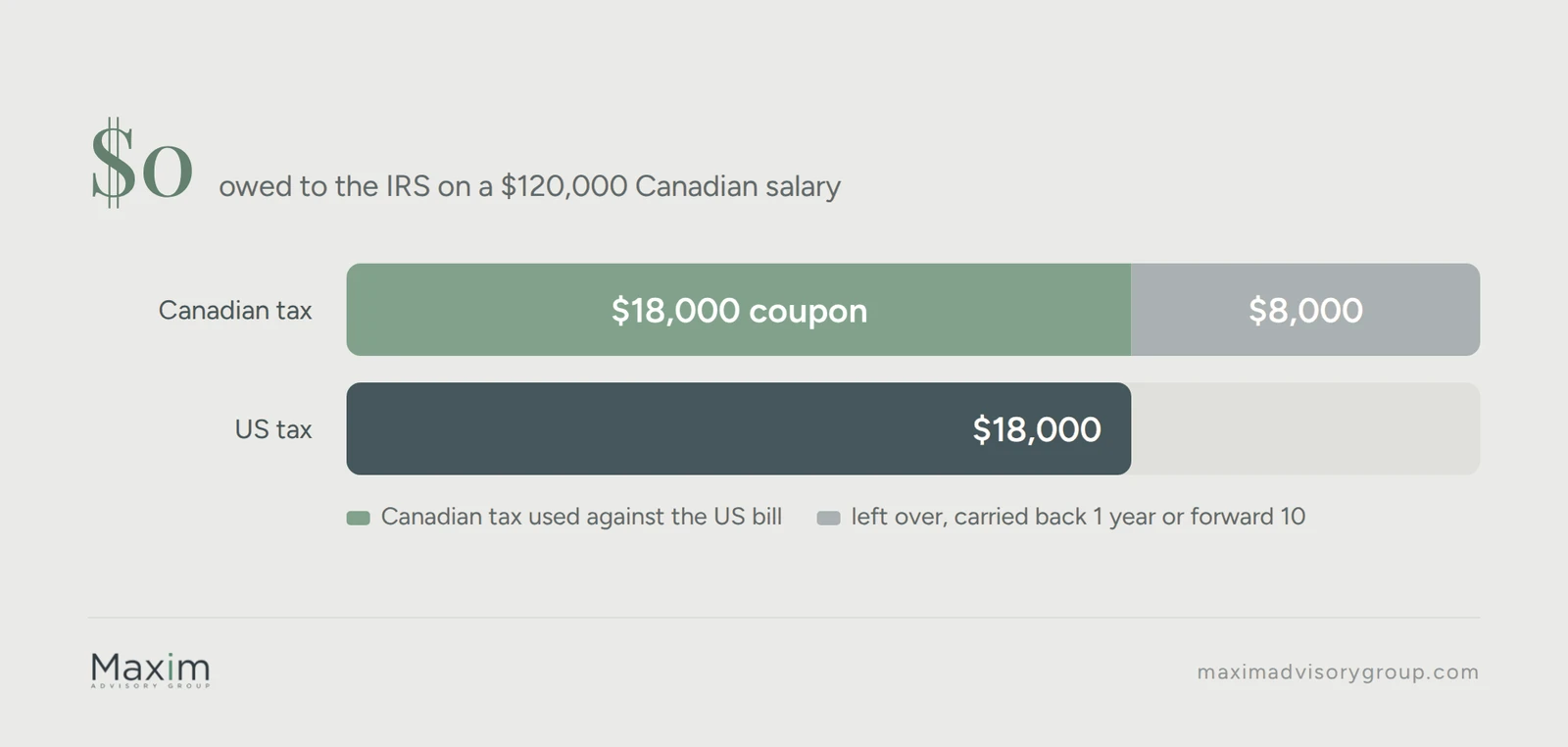
You still filed to get there.
The leftover $8,000 is the part of your coupon the IRS couldn’t use. You can carry it back 1 year or forward 10 years. It can only be spent against the IRS’s bill on similar income, and only in a year when that bill exceeds what Canada charged on it. If all your income is Canadian and taxed at Canadian rates, that year may never come, and the coupon goes unused.
On a Canadian salary, the tax you pay Canada usually covers your US bill in full. The extra Canadian tax seldom helps you later.
Income from the US, such as dividends on a US brokerage account, follows its own order under the treaty, set out on the treaty page.
Which US Tax Gets No Credit?
A 3.8% Tax on Investment Income Is One Bill the Coupon Can’t Touch.
The net investment income tax adds 3.8% on investment income, such as interest, dividends, rent and capital gains. It only starts above set income levels.
The test uses your modified adjusted gross income. For most people abroad, that’s your total income on the US return after a few adjustments, plus any foreign pay you left off it. The tax starts once that passes $200,000 if you’re single, $250,000 if you file jointly, or $125,000 if you file separately. Those amounts don’t rise with inflation.
The 3.8% applies to whichever is smaller, your investment income or how far you’re over the threshold. Say you’re single, with $240,000 of income, $60,000 of it from investments.
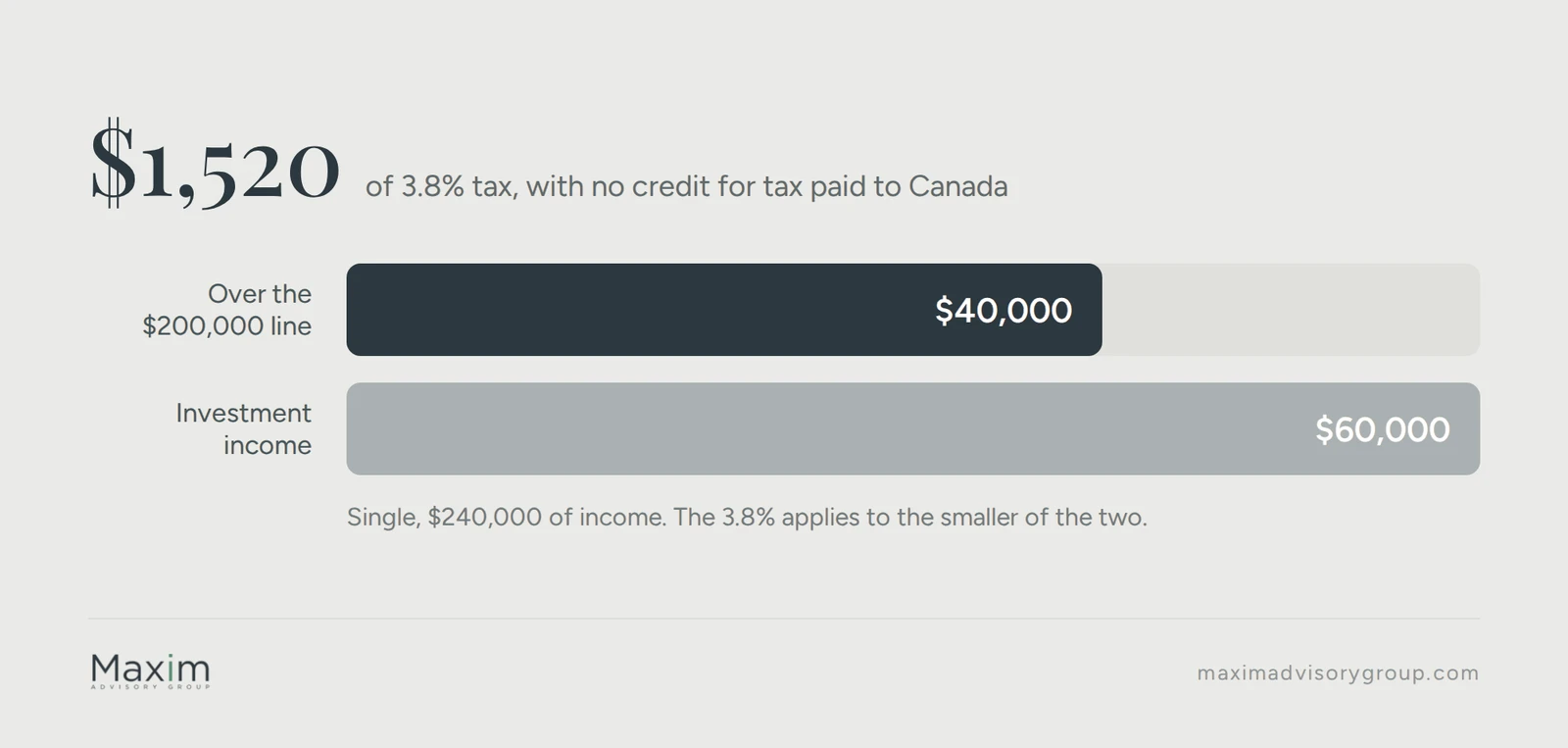
Tax you pay Canada can’t be credited against it. A US citizen living in Canada argued that the treaty allowed a credit anyway, and in August 2026 a US federal appeals court ruled that it doesn’t. Further appeal was still possible when this was written.
Should You Use the Foreign Earned Income Exclusion?
In Canada It Usually Costs You More Than the Coupon Does.
Say you’re doing your first US return in years. You find a form that lets you leave your Canadian pay off the return entirely. It’s tempting. That’s the foreign earned income exclusion, and it covers up to $130,000 of foreign pay for 2025 and $132,900 for 2026.
At Canadian tax rates it usually loses to the coupon, for three reasons.
It only covers pay. Pensions, social security, interest, ordinary dividends and capital gains are left out. It does nothing for your investment or retirement income.
It tears up your coupon. Canadian tax on pay you exclude can’t be credited. Exclude all of a $120,000 salary, and the $26,000 of Canadian tax on it can never cut your US bill, in that year or later.
Parents lose a refundable credit. File Form 2555, the form that claims the exclusion, and you lose the additional child tax credit. That’s the part of the child tax credit the IRS pays you even when you owe no tax, up to $1,700 per child for 2025. It needs a child with a valid Social Security number.
Use the coupon first. Reach for the exclusion only if the coupon leaves US tax owing, and check what it does to your children’s credit before you file.
Which Forms Do You File, and When Are They Due?
Most of the Cost Sits in Forms With Fixed-Dollar Penalties.
Each spring, two countries want paperwork from you, and they don’t share a checklist. Here are the core filings for a US citizen living in Alberta, for 2025 returns filed in 2026. Some situations add others, such as Form 8854 when you renounce.
| Form | You file it if | Due | If you miss it |
|---|---|---|---|
| T1, your Canadian return | You have tax to pay, want a refund, sold property such as your home, owe CPP on self-employment income, or want to keep receiving benefits such as the Canada child benefit. The CRA’s full list is longer | April 30, 2026. Self-employed, June 15, 2026, with any balance paid by April 30 | 5% of what you owe, plus 1% a month for up to 12 months |
| T1135, Canada’s report of property you own outside Canada | It cost more than C$100,000 at any time in the year. A US brokerage account counts | With your T1 | $25 a day, up to $2,500 |
| 1040, your US return | Your gross income reached $15,750 if single, $23,625 as head of household, $31,500 married filing jointly, or $5 married filing separately, with higher amounts if you are 65 or older. You also file if you had $400 of self-employment earnings or owe certain other taxes | Pay by April 15 to avoid interest. File by June 15 automatically, October 15 with Form 4868, or December 15 by letter | 5% of the unpaid tax for each month late, up to 25% |
| 1116, which claims credit on your US return for tax paid to Canada | You want that credit | With your 1040 | US tax on income Canada already taxed |
| FBAR (FinCEN Form 114), a report of your accounts outside the US, filed online with FinCEN, a US Treasury bureau, separately from your return | Your accounts together topped $10,000 at any time in the year. Count your own accounts, your corporation’s accounts if you own more than half of it, and any account you can sign on, even one you do not own | April 15, extended automatically to October 15 | Up to $16,536 per report if the failure was non-wilful, which includes carelessness. Wilful failures cost far more |
| 8938, a second US report of foreign assets | Your foreign financial assets, including shares in your own corporation, were over $200,000 at year-end or $300,000 at any time. Married filing jointly, $400,000 or $600,000 | With your 1040 | $10,000, and up to $50,000 more after an IRS notice |
| 8621, the report for a foreign investment fund, which the US calls a passive foreign investment company | You hold one. A Canadian mutual fund or ETF usually is. Small holdings can skip the yearly summary | With your 1040 | The IRS can reopen your whole return until three years after you file the form. You also lose the elections that tax the fund yearly (qualified electing fund or mark-to-market), so gains and large distributions are taxed with interest |
| 5471, the report on a foreign corporation you own | You hold at least 10% of a corporation that US owners together control, or you control one yourself, including your own professional corporation. Buying 10% of one, or serving as its officer or director, can also require it | With your 1040, extensions included | $10,000 per corporation per year, up to $50,000 more after an IRS notice, a 10% cut to your credit for foreign tax, and a return the IRS can reopen until three years after you file the form |
US forms in US dollars, Canadian forms in Canadian dollars. Thresholds and dates are for 2025 returns, filed in 2026. Check them again once the CRA and IRS publish the figures for 2026 returns. Sources are CRA filing dates and who has to file a return, CRA late-filing penalty, CRA on Form T1135 and its penalties, Form 1040 instructions, Publication 54, IRS failure-to-file penalty, IRS on the FBAR, 31 CFR 1010.350 and 1010.821, the IRS manual on FBAR penalties, 26 USC 6501, and the instructions for Form 1116, Form 8938, Form 8621 and Form 5471.
If you’re self-employed here and paying CPP, you generally don’t also owe US self-employment tax under the Canada-US social security agreement, but you have to claim it on your US return.
The two penalties tied to a balance owing, on the T1 and the 1040, shrink toward nothing when there is little tax to pay, and the credit usually sees to that on the US side. Four of the others, the T1135, FBAR, 8938 and 5471, are set in dollars and take no notice of what you owe.
The FBAR penalty for a non-wilful failure, which covers mistakes and carelessness, is counted per report, not per account. The Supreme Court settled that in 2023, and the IRS applies it that way. Five years of missed reports is five penalties, however many accounts sit behind each one.
It gets far more expensive if the IRS decides the failure was wilful. That can happen if you knew the rule and ignored it, ignored an obvious risk that you were breaking it, or took care not to learn about it.
The FBAR and Form 8938 ask for much of the same information, and you may owe both. Filing Form 8938 doesn’t replace the FBAR.
Form 8621’s yearly summary isn’t needed if your funds total $25,000 or less at year-end ($50,000 on a joint return), you sold none at a gain, none paid an unusually large distribution, and you made no election.
The Deadlines, in Plain Terms
The June 15 extension covers paying as well as filing, so there’s no late-payment penalty before June 15. Interest still runs from April 15 on any tax not paid. For December 15, you write to the IRS by October 15, and the IRS decides whether to grant it.
How Do You Catch Up on Missed US Returns and FBARs?
The IRS Has a Penalty-Free Way Back for People Who Fell Behind by Mistake.
Maybe this is the first you’ve heard of any of this. That’s common, and the IRS built a way back for it. It’s called the Streamlined Foreign Offshore Procedures, and it’s for people living abroad who fell behind without meaning to. An IRS examination of your returns closes it, so use it before one starts.
There are two main conditions that decide whether it’s open to you…
- You live outside the United States. In at least one of the last three years whose US filing deadline has passed, you had no US home and were physically outside the country for at least 330 full days.
- Your failure was non-wilful. In the IRS’s terms, that covers a mistake, carelessness, or a good-faith misunderstanding of the rules. You confirm it in writing on Form 14653.
You’ll also need a valid Social Security number.
You file three years of US returns, with every reporting form you missed, and six years of FBARs. You pay the tax those returns show, with interest. The IRS charges no penalties on those years, FBAR penalties included. If your Canadian coupon covered most of your US tax, catching up can mean three returns with little to pay.
What It Does for Your RRSP
Normally the US puts a pause button on the growth inside your RRSP, so it’s taxed only when you take money out. The automatic pause depends on your US returns being up to date. Without it, you’d have to ask the IRS for permission. When you catch up, the IRS asks you to say in your Form 14653 statement that you meet the conditions for it, so the missed years are covered too.
How Does the IRS Treat Your RRSP, TFSA and RESP?
The US Respects Your RRSP and Taxes Your TFSA.
Canada built these accounts to shelter savings from Canadian tax. The United States agreed to respect one of them.
Here’s where each account stands for a US citizen living in Canada.
| Account | In Canada | US tax on what grows inside | US reporting |
|---|---|---|---|
| RRSP or RRIF (registered retirement savings plan or income fund) | Deferred until you withdraw | Deferred automatically, if you are eligible | FBAR, and Form 8938 above its threshold. No Form 3520 |
| TFSA | Tax-free | Taxed each year like any other account | FBAR, and Form 8938 above its threshold. Forms 3520 and 3520-A are unsettled |
| RESP (registered education savings plan) | Sheltered, with a government grant | No treaty or IRS relief | FBAR, and Form 8938 above its threshold. Forms 3520 and 3520-A are unsettled |
| Canadian mutual fund or ETF held outside an RRSP, including inside a TFSA or RESP | Taxed as earned | Usually taxed under the passive foreign investment company rules | Form 8621 for each fund |
Status as of September 2026. Sources are Rev. Proc. 2014-55, which the IRS issued in 2014, Form 3520 instructions, Rev. Proc. 2020-17, Form 8621 instructions, and the treaty, Article XVIII(7).
If your TFSA or RESP holds Canadian ETFs or mutual funds, those are generally PFICs for US purposes too, with a Form 8621 for each fund and a harsh default tax. Only the RRSP is protected.
The treaty settled the RRSP. It puts US tax on the growth inside the plan on pause until you take money out. IRS guidance from 2014 (Rev. Proc. 2014-55) gives you that pause automatically if you’re eligible.
Among other conditions, eligible means you met your US filing requirements for every year you were a US citizen or resident. The treaty page lists all four conditions, and catching up through the Streamlined procedure covers the years you missed. Your RRSP contributions still save you Canadian tax, but they generally aren’t deductible on your US return.
The TFSA has no pause button, though people assume it’s covered too. The treaty and the IRS guidance that protect the RRSP never mention it. So the interest, dividends and gains inside it go on your US return each year.
A TFSA that earned $5,000 this year puts $5,000 on your US return. The “tax-free” on the Canadian statement stops at the border.
Forms 3520 and 3520-A are the US reports for foreign trusts. The IRS excuses some tax-favoured foreign trusts from them, mostly retirement plans and plans for medical, disability or educational benefits. As of September 2026, nothing it has published names a TFSA or an RESP, or says whether either one is a trust at all. Whether to file them is a call to make with whoever prepares your return.
Canadian Funds Carry Their Own US Problem
The US treats a foreign fund as a passive foreign investment company if 75% or more of its income is passive, or at least 50% of its assets produce passive income. Most Canadian mutual funds and ETFs meet that test. When you sell one at a gain, the gain is spread back over the years you held it and taxed with an interest charge.
What Changes When You Own a Canadian Corporation?
A Corporation You Control Brings Its Own US Form, and Its Profit Can End Up on Your Return.
Say your accountant suggested incorporating, and you did. It’s a common move in Canada, whether you run a professional practice or a small business. In Canada, profit your company keeps stays the company’s until you pay it out.
The US can see through the company to you. Picture the corporation as glass. Once US owners who each hold at least 10% of it, by votes or value, together hold more than half, the IRS treats it as US-controlled. Each of those owners picks up the filings and tax that follow.
Does Your Corporation Need a US Form Every Year?
Yes. Form 5471, Filed With Your Own Return.
If you’re one of those owners, you file Form 5471 every year, attached to your US return by its due date, including extensions. Missing it costs $10,000 a year to start, whether or not the corporation owes the IRS anything.
The corporation shows up on your personal reports too. If you own more than half of it, or you can sign on its accounts, its bank and investment accounts go on your FBAR and count toward the $10,000 threshold. Its shares count toward your Form 8938 threshold, even though Form 5471 already reports them. If it holds Canadian mutual funds or ETFs, you may owe a Form 8621 for each one.
Can Profit You Leave in the Corporation Be Taxed to You?
Yes, Each Year, Whether or Not You Pay Any of It Out.
This is where the glass matters most. The IRS reaches profit the company keeps in two ways.
Investment profit is the first. Interest, dividends, rent and gains on the corporation’s investments are what the IRS calls foreign personal holding company income, a kind of passive income. The US taxes your share to you in the year the corporation earns it. Small amounts are exempt.
Business profit falls under the second rule, called NCTI. It used to be called GILTI (global intangible low-taxed income). From the corporation’s first tax year starting in 2026, it’s called net CFC tested income, or NCTI. CFC stands for controlled foreign corporation, the IRS term for a company like yours. NCTI taxes you each year on your share of the corporation’s active business profit.
Profit you leave in your company to grow can show up on your US return anyway, in the year it’s earned.
There are two ways the bill can shrink. Profit taxed heavily in Canada can be left out, if you choose that on your return each year. It needs a Canadian rate above 18.9%, which is 90% of the 21% top US corporate rate. Profit taxed at the federal small business rate of 9% plus Alberta’s 2% comes nowhere near that. Profit over the small business limit is taxed at a higher Canadian rate and may qualify.
The other way is a section 962 election. It lets you be taxed on these amounts as if you were a US corporation, at the 21% corporate rate, with credit for your share of the Canadian tax the corporation paid. Whether it leaves anything to pay depends on your numbers, so run it each year.
What Happens When You Pay Yourself a Dividend?
Profit Already Taxed to You Mostly Comes Out Free, and New Profit Can Leave US Tax Owing.
Profit the US has already taxed to you generally comes out free of regular income tax when the corporation pays it to you. There are two catches. If you used the section 962 election, the part of the payout above the US tax you already paid on that profit is taxed again. And investment profit taxed to you each year can still count toward the 3.8% tax on investment income when it’s paid out, unless you made a separate election for that tax in the year it was taxed.
For profit not yet taxed to you, the two countries do different math. Canada taxes a dividend lightly in your hands, because the corporation already paid tax on the profit behind it. The dividend tax credit is how Canada accounts for that.
The US can treat a dividend from a corporation you control as a qualified dividend, taxed at its lower dividend rates. Your personal Canadian tax on the dividend works as a coupon. The corporation’s own Canadian tax can be used that way only on profit taxed to you each year under a section 962 election. An ordinary dividend gets no coupon for it.
A dividend can leave US tax owing, because the light Canadian tax on it makes a small coupon. Work out both returns before you declare one. It’s also why the salary and dividend mix that suits a Canadian owner can be wrong for a US citizen. Salary carries full Canadian tax, which makes a full coupon.
What Happens When You Sell Your Home in Canada?
Canada Can Exempt the Whole Gain, While the US Exempts Only the First $250,000 for a Single Filer.
If your house has gone up a lot since you bought it, in Canada, selling it often costs you no tax at all. But the US may still send you a bill.
Each country puts a ceiling on the part of your gain it leaves untaxed. Canada’s principal residence exemption has no dollar ceiling. It can make the whole gain on your home tax-free, for each year it was your home, as long as you report the sale and name the home as your principal residence when you file.
The US exclusion stops at $250,000. If you owned the home and lived in it for at least two of the last five years, you can leave the first $250,000 of gain off your return, or $500,000 for a married couple filing jointly. The rest is taxable.
Here’s a house bought for $400,000 and sold for $1,100,000, by someone who lived in it the whole time they were in Canada and files their US return as single.
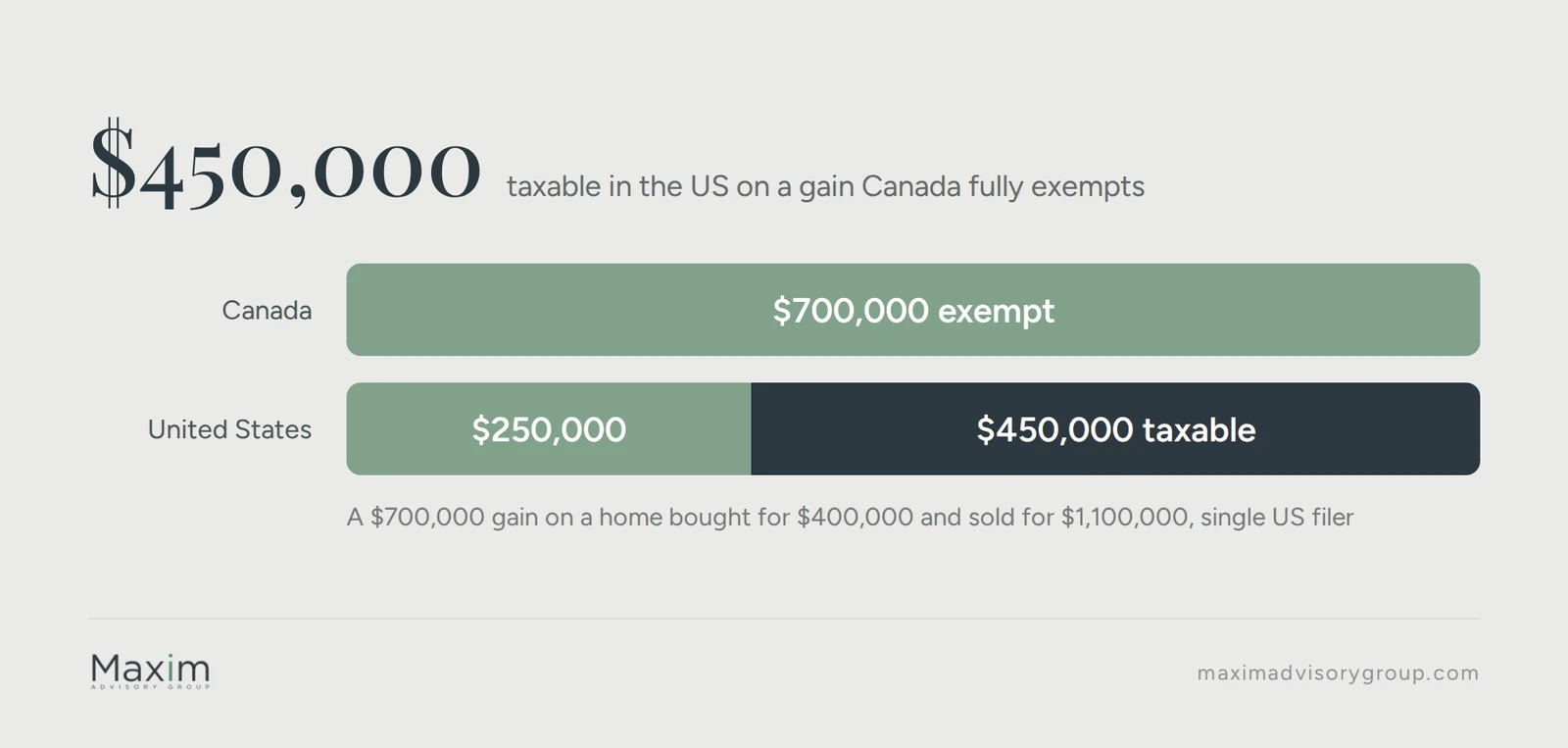
Canada charged no tax on the sale, so there’s no coupon to hand the IRS.
The taxable part of the gain counts as investment income for the 3.8% tax, and it counts toward the $200,000 threshold too. Here, the $450,000 gain is $250,000 over the threshold on its own, so you’d owe the 3.8% on at least $250,000 of it, which is at least $9,500.
The real US figure is worked out in US dollars, at the exchange rates when you bought and when you sold. So it can come out larger or smaller than the Canadian one. One more catch. If you pay off a Canadian-dollar mortgage after the loonie has gone up, the US can tax the drop in your debt as a currency gain, even though a loss on your home isn’t deductible. Get it worked out before you sell.
Cottages and Timing
A cottage is where the gap tends to be widest. The US exclusion is for your main home, so a place you used on weekends will usually get none of it, whatever you name on the Canadian side.
If you’re thinking of selling, work out the US tax before you sign a listing agreement. The timing, and who holds title, can change it, and both are harder to rearrange once there’s a buyer.
Where Do US Filings From Canada Usually Go Wrong?
Each of These Looks Reasonable at the Time, and the Cost Shows Up Years Later, Usually in a Letter.
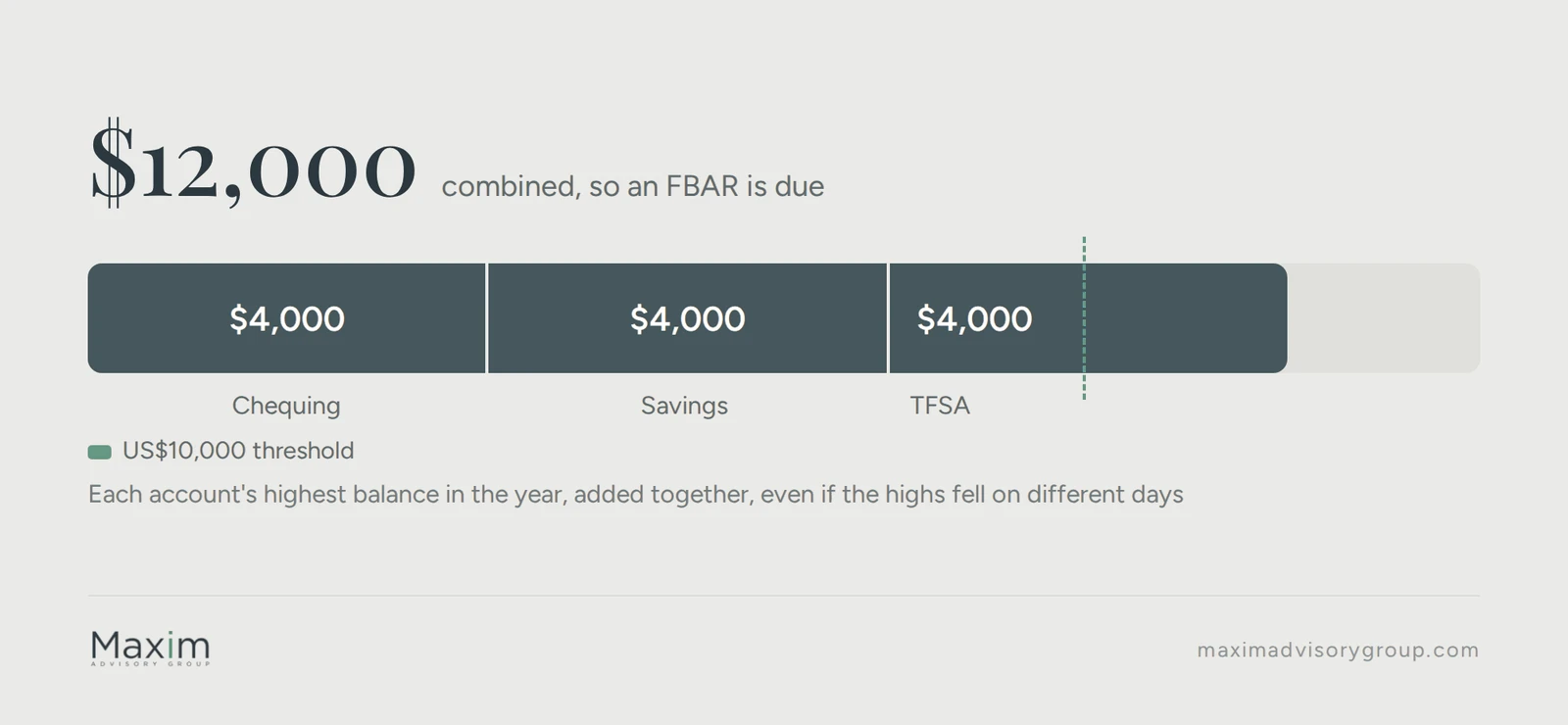
Assuming each account is tested against the $10,000 FBAR threshold on its own. You add up each account’s highest balance in the year, even if those highs fell on different days. Three accounts that each peaked at $4,000 put you over.
Missing the corporation’s Form 5471 when you catch up. The Streamlined procedure needs your returns with every reporting form you should have filed, such as Forms 3520, 5471 and 8938. Leave the corporation’s form out and you can lose the penalty relief.
Treating a joint return as the simple choice. If your spouse is neither a US citizen nor a US resident, you generally can’t file jointly unless you choose to treat them as a US resident. That choice puts their worldwide income on your US return too, this year and every year after until the choice ends.
Assuming you can give up citizenship first and sort out the filings later. When you renounce, Form 8854 asks you to confirm you met your US tax obligations for the previous five years. If you can’t, you’re a covered expatriate in the IRS’s eyes, so the exit tax can apply whatever your income or net worth.
Missing that a client who can pick you by name can turn your fees into investment income. If you own 25% or more of your corporation, watch who can choose you. When anyone other than the corporation, such as a client or an agency, can pick you for the work, or the contract names or describes you, the fees can count as passive investment income. If your corporation is US-controlled, the glass rules then tax them to you each year as the corporation earns them.
What Else Do US Citizens in Canada Ask?
The Questions That Come Up Once the Big Ones Are Settled.
Does the US Tax My US Social Security If I Live in Canada?
No. Under the treaty, only Canada taxes the US social security you receive while living here, and the IRS confirms the exemption for US citizens living here. Canada then lets you deduct 15% of it, or 50% if you’ve lived in Canada and received it without a break since before 1996.
Should I Give Up My US Citizenship?
Only after you’ve checked whether the US exit tax would apply. The State Department fee is $450 since April 13, 2026. The exit tax, if it applies, costs far more. It taxes your gains, above an exclusion, as though you’d sold your property the day before you renounce, with separate rules for retirement accounts.
It applies if you’re a covered expatriate, which means any one of these is true.
- you’re worth $2 million or more
- your average yearly US income tax over the previous five years was above $211,000, the 2026 figure
- you can’t certify five years of filings
Some people who were citizens of both countries from birth are exempt from the first two tests.
Can I Still Contribute to an RRSP and a TFSA?
Yes. You can open a TFSA if you’re resident in Canada, 18 or older, with a valid social insurance number, and the yearly limit is $7,000 for 2025 and 2026. The RRSP dollar limit is $32,490 for 2025 and $33,810 for 2026. On the US side, the RRSP keeps its pause button and the TFSA doesn’t.
What Should You Sort Out Before Next June 15?
Where You Start Depends on Where Your Filings Stand Today.
Filed every year? Check your accounts against the US$10,000 FBAR threshold and the Form 8938 figures. Count your corporation’s accounts too if you own more than half of it or can sign on them.
Filed, but never included your corporation? The missing Form 5471s are the urgent part, because each year of each one carries its own penalty.
Never filed at all? Start the Streamlined procedure before the IRS opens an examination, and put the line about your RRSP in your Form 14653 statement.
Thinking of giving up citizenship? Catch up first. Without five certified years, you leave as a covered expatriate. If you’re leaving Canada as well, the Canadian side has its own bill. Start with departure tax, then how Canada taxes non-residents.
We look at your US return, your Canadian return and any corporation together, because the answer on one usually depends on the others. The first meeting is paid. We charge $500 an hour, with engagements generally 10 to 60 hours ($5,000 to $30,000). By the end of that first meeting, you’ll know which of these forms apply to you and what having them done would cost.
If your situation crosses the border in other ways, our cross-border guidance is the place to start.