

Key Takeaways
RRSP Withdrawals Start at 25% Once You Leave. Your bank takes a quarter off the top and sends it to the CRA before the money leaves Canada.
A RRIF Can Cut That to 15% If You Live in the US. It works up to a yearly allowance, the larger of twice your minimum or 10% of the fund.
Paying Canada Less Isn’t Always a Saving. The US taxes the same money and credits what Canada took, so paying Canada less mostly helps where the full 25% would have been more than your US tax.
June 30 Is the Deadline for a Section 217 Refund. Section 217 lets you file a Canadian return on the income instead of accepting the flat 25%. Miss June 30 and that year’s withholding is final.
Your TFSA Stays Tax-Free in Canada, and the US Rules Are Unsettled. Most contributions made after you leave are taxed 1% a month until you take them out or move back.
What happens to your RRSP once you’ve moved out of Canada? Most people assume it sits there and gets taxed the way it always did, but leaving can change the rules.
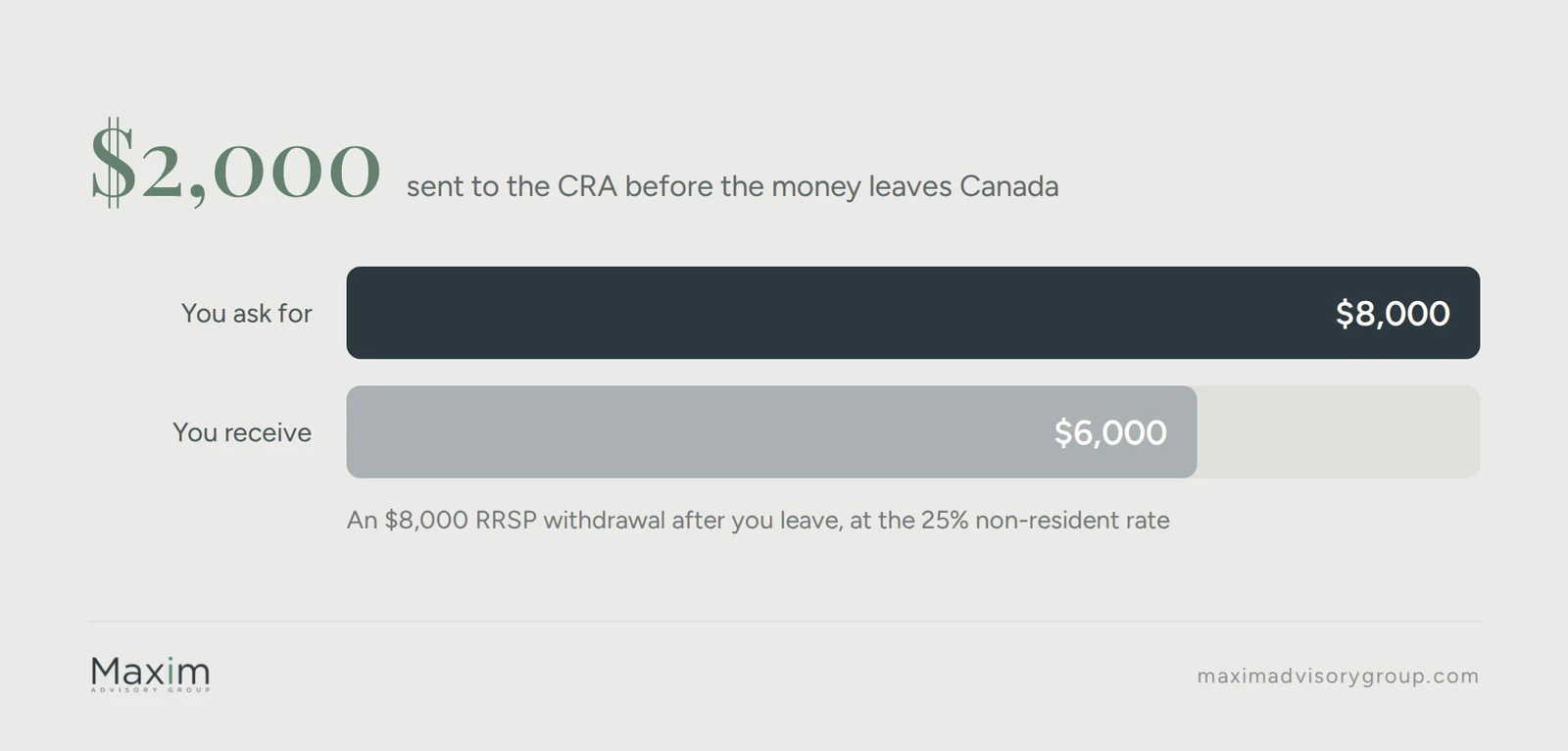
Here’s a good example. Let’s say it’s your first winter living in the US. You ask your Canadian bank to send $8,000 from your RRSP (registered retirement savings plan) to your new account. A few days later, $6,000 gets deposited.
But why did you receive $6,000 when you sent $8,000?
The missing $2,000 went to the Canada Revenue Agency (CRA). Once you’ve left, you’re a non-resident, meaning Canada no longer counts you as living here for tax. Canada’s rule for RRSP money paid to non-residents is a flat 25%, and your bank takes it before the money crosses the border.
Your TFSA (tax-free savings account) has it easier in Canada, which keeps treating it as tax-free after you go. The IRS gives it no special status, and no IRS guidance says how to treat it, so its earnings may be taxed in the US and the reporting can be heavy.
Here’s what people usually miss.
- Living in the US can cut the rate to 15% on payments from a RRIF (registered retirement income fund). That’s the account an RRSP becomes when it starts paying you an income. The Canada–US tax treaty, the agreement that decides which country taxes what, caps tax on regular pension payments. A RRIF counts as regular up to a yearly allowance.
- Paying Canada less won’t always leave you better off. The US taxes the same money and gives you credit for what Canada took, so paying Canada less mostly helps where the full 25% would have been more than your US tax.
- On a RRIF payment, your bank keeps taking the full 25% until you give it a treaty declaration (Form NR301).
- A Canadian tax return can win back part of the 25%, but only if it’s filed by June 30 of the next year.
- Money you borrowed from your RRSP for a home or for school can come due within 60 days of leaving.
We’ll walk through each one.
On This Page
- Can You Keep Your RRSP and TFSA After Leaving Canada?
- What Tax Does Canada Withhold on an RRSP Withdrawal as a Non-Resident?
- How a RRIF Gets You the 15% Treaty Rate, and Where It Stops
- Should You File a Section 217 Election on Your RRSP Withdrawals?
- How the US Taxes Your RRSP Once You Live There
- Is Your TFSA Still Tax-Free Once You Live in the US?
- Common Traps With an RRSP or TFSA When You Leave Canada
- RRSP Non-Resident Withdrawal Questions
- What to Do Before Your First RRSP or RRIF Withdrawal as a Non-Resident
Can You Keep Your RRSP and TFSA After Leaving Canada?
The simple answer is that yes, both accounts come with you. You don’t have to close either one before you go.
Departure Tax Skips Them.
Leaving makes the tax rules count most of your property as sold that day, and the profit is taxed. That’s departure tax, a bill for a sale that never happened. But RRSPs, RRIFs and TFSAs are on the list of things it leaves alone, so your registered accounts stay out of that bill.
The CRA Says So for the TFSA, and the Law Shows It for the RRSP.
The CRA says plainly that you “can keep” a TFSA and “continue to benefit from the exemption from Canadian tax on investment income and withdrawals.” It doesn’t spell out the same thing for an RRSP. But Canadian tax law sets a rate for RRSP payments to people who have left, and that rule only makes sense if the account came with you.
Here’s What That Means in Plain English.
Moving day leaves both accounts where they are. Most of the changes come later, when you take money out or try to put more in.
The rest of what changes when you go is on our cross-border guidance page.
What Tax Does Canada Withhold on an RRSP Withdrawal as a Non-Resident?
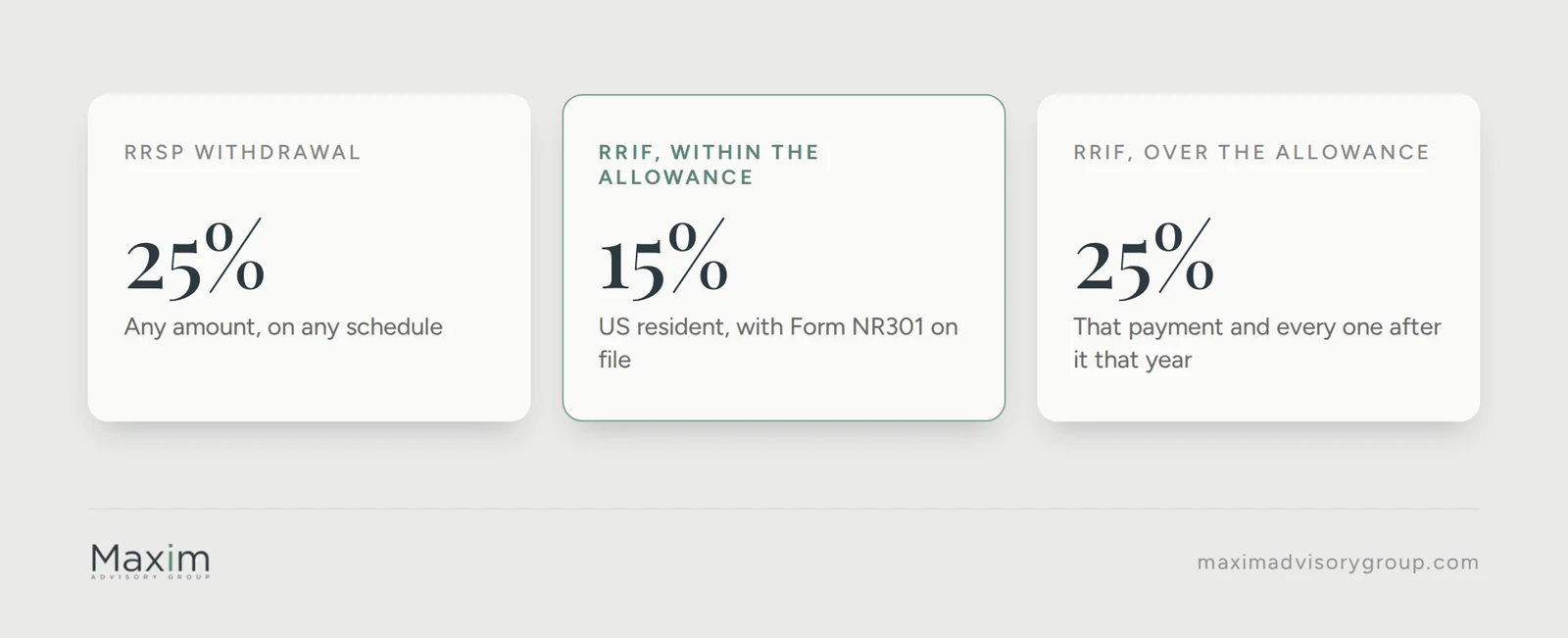
Every RRSP Withdrawal After You Leave Starts at 25%, Taken at Source.
Why does the bank take a quarter, and can you get that down? Three rules decide it.
1. The Default Is 25% of the Gross Payment
The bank takes 25% of everything you withdraw, whatever your US income is that year. Take out $48,000 and $12,000 is sent to the CRA before you even see a dollar.
The rule is section 212(1) of the Income Tax Act. It sets a 25% tax on many kinds of payments from Canada to people living abroad, and RRSP and RRIF payments are on its list. Accountants call it Part XIII tax, the part of the Act it comes from. Our non-resident page shows how it applies to other Canadian income.
2. The Treaty Lowers the Rate to 15% for One Kind of Payment
If you live in the US, the Canada–US tax treaty cuts Canada’s rate to 15% on what it calls a “periodic pension payment”. The treaty’s idea of a pension is wide enough to cover an RRSP. Its pension article never says which payments count as periodic, so Canadian law decides. Our treaty page has the rest of that article.
Living in the US doesn’t get you 15% on its own. Your payment also has to count as periodic under Canadian law, and an RRSP withdrawal never does.
3. Money Taken Straight Out of an RRSP Never Qualifies
For example, setting up $2,000 a month out of the RRSP, same day every month, doesn’t help. Each payment still loses $500.
The reason is a short law called the Income Tax Conventions Interpretation Act. It tells Canada how to read its tax treaties, including what their words mean. It says an RRSP payment made before maturity, meaning before the plan has been turned into retirement income, isn’t periodic. Neither is a payment that cashes out all or part of that income.
As long as the money comes straight out of an RRSP, it pays 25%, however regular or small the withdrawals are. Turning it into retirement income first, usually a RRIF, is what opens the door to 15%.
How a RRIF Gets You the 15% Treaty Rate, and Where It Stops
A RRIF Payment Keeps the 15% Rate Up to a Yearly Allowance.
So how do you get to 15%? You move the money into a RRIF before you take it out.
A RRIF holds the same investments as your RRSP. The difference is that it pays you. From its second year, it has to pay out at least a minimum each year, set by your age.
You can still set one up after you leave, as far as Canadian tax goes. Whether your bank will open a RRIF for someone living in the US is another question, so ask before you count on it. The Income Tax Act lets an RRSP transfer straight into a RRIF in your own name, with no residency condition. The CRA confirms nothing is withheld on the way in if the money moves directly. You first complete Form NRTA1, the form that exempts the transfer from non-resident tax.
The forced minimum is the cost, because both countries tax what the RRIF pays. If you were going to draw the money anyway, it costs you little. In return, RRIF payments can count as periodic, and that gets them the 15% rate up to a yearly allowance.
1. The Allowance Is the Greater of Two Tests
Twice Your Minimum or 10% of the Fund, Whichever Is Higher.
Think of the allowance as the amount you can take out each year at 15%. It resets every January.
Your payments keep the 15% rate until their total for the year passes the larger of two amounts. One is twice your minimum for the year. The other is 10% of what the fund was worth when the year began. Your minimum is that starting value times an age factor.
On a $500,000 fund, that works out like this.
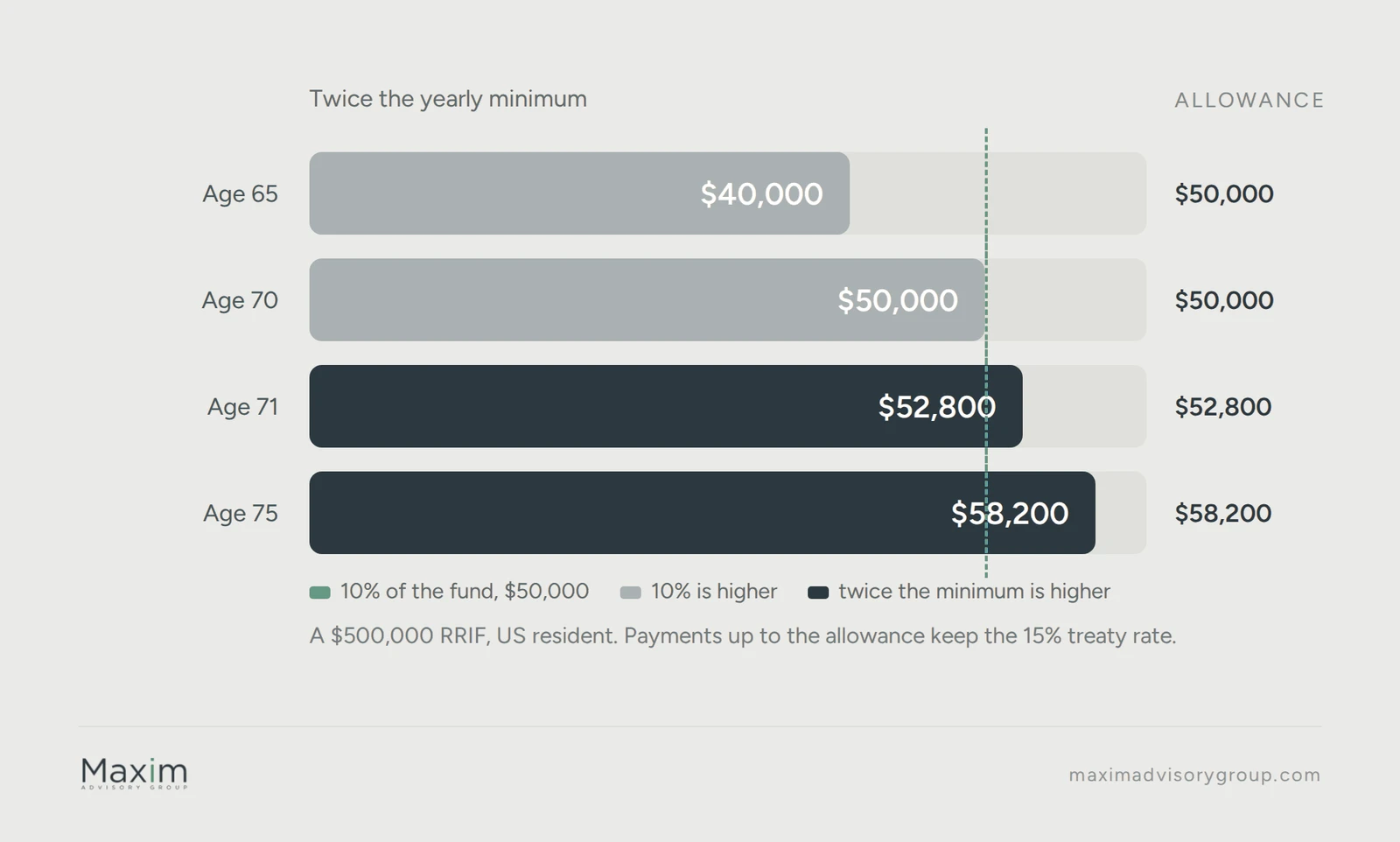
A $500,000 RRIF holding ordinary investments such as funds, shares or deposits, valued at the start of each year, for a resident of the United States. Age factors from the CRA’s chart, checked September 2026. They work out to 1 divided by (90 minus your age) up to 70, and the chart’s own figures from 71 on. Allowance rule from the Income Tax Conventions Interpretation Act, section 5, paragraph (c).
Until 70, your allowance is 10% of the fund, so only the fund’s size moves it. From 71, twice your minimum is bigger, and your allowance grows a little each year as a share of the fund.
In the year you open the RRIF, the Income Tax Act sets the minimum at zero, so your allowance is 10% of the fund. For the allowance, money you move in during that year counts as if it had been there when the year began.
2. The Payment That Goes Over the Allowance Pays 25%
Every Later Payment That Year Pays 25% Too.
The allowance is a running total for the calendar year. Once a payment pushes the year’s total past it, that whole payment is taxed at 25%, and so is every payment after it that year.
One big withdrawal can cost you the lower rate on all of it, but smaller payments that stay inside the allowance keep it.
Here are three ways to take out the same $100,000, for a 65-year-old in the US with $500,000 saved.
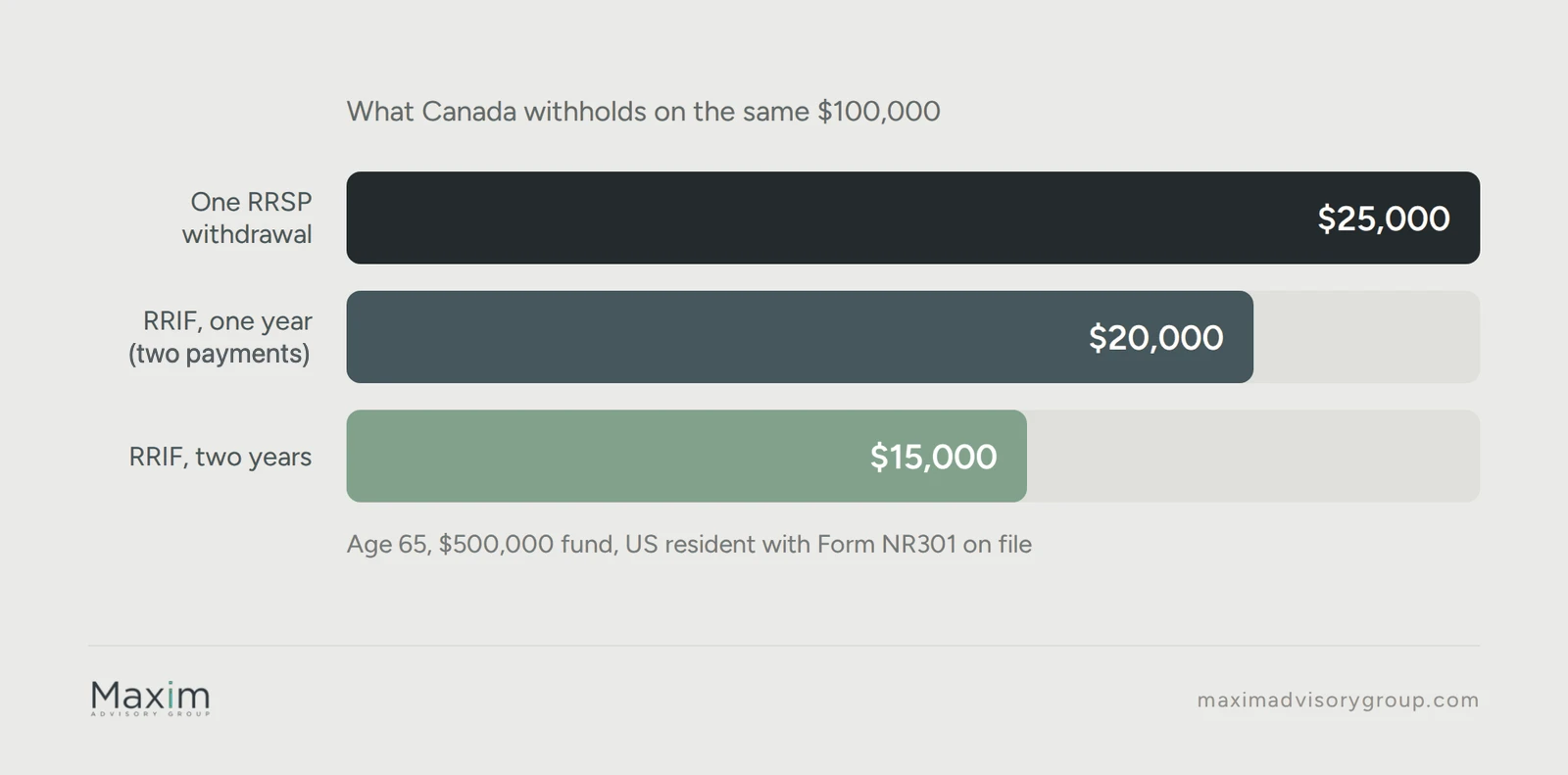
Assumes the RRIF is past its first year, the fund stays near $500,000 at the start of each year, and the bank has your treaty declaration (Form NR301) on file. Treaty rate for a resident of the United States. This assumes the $100,000 comes out in at least two payments, with the first $50,000 inside the allowance. Taken as one $100,000 payment, it’s all withheld at 25%, the same $25,000 as the RRSP.
The two-year route has $10,000 less withheld by Canada than the single RRSP withdrawal. That isn’t automatically $10,000 saved, because the US taxes the same money and gives you credit for what Canada took. Paying Canada less saves you money only where the full 25% would have been more than your US tax on that payment. Otherwise your US credit shrinks by the same amount, and the Internal Revenue Service (IRS) collects the difference.
Should You File a Section 217 Election on Your RRSP Withdrawals?
Only by June 30, and Only After You Have Run the Numbers.
You might be wondering, “Can you get some of that 25% back?” Sure, sometimes… if you file the right Canadian return in time.
Let’s say you mail your section 217 return on July 5 and hope for part of last year’s withholding back… and it’s five days late. The CRA “cannot accept your section 217 election if you file after June 30th,” so whatever was withheld becomes your final tax on that income.
Section 217 is an option, one that tax law calls an election, that lets a non-resident swap the flat 25% for a Canadian tax return on the income. It covers RRSP and RRIF payments, among other income. On that return, the income is taxed at federal rates set by your whole income, including what you earn in the US, plus an extra 48% of that federal tax that non-residents pay in place of provincial tax.
The CRA works out your tax at normal federal rates, with your US income counted in setting the rate, and a federal top-up instead of a provincial one. If that comes to less than the bank took, the CRA sends you the difference. If you owe more, it’s due April 30, two months before the return.
Whether it pays turns mostly on how much of your income is Canadian. Your US income pushes the rate up, and your personal credits, the amounts everyone can claim to lower their tax, are cut back unless at least 90% of your income for the year is Canadian. So a large RRSP withdrawal with little else can get a good part of the 25% back. If you live in the US, though, every dollar Canada refunds is usually a dollar less of US foreign tax credit, so look at both returns before you file. A modest withdrawal next to a US salary often gets little or nothing back. The test behind that is on our non-resident page.
If you already know the election will help, Form NR5 asks the CRA to cut the withholding up front instead of refunding it later. An approved NR5 runs for up to five tax years. The catch is that you file a section 217 return for every one of them.
How the US Taxes Your RRSP Once You Live There
The IRS Leaves the Growth Alone and Taxes What Comes Out.
Does the US tax your RRSP too? Yes, but mostly when money comes out, and it credits what Canada took, up to a limit.
1. Growth Inside the Plan Is Deferred Without an Election
The Treaty Election Is Treated as Made for You.
Under US law on its own, a US resident would pay US tax every year on the dividends and gains inside an RRSP, even with nothing taken out. The IRS says so itself in Revenue Procedure 2014-55, a published IRS guidance document that applies to everyone in the same position.
The Canada–US tax treaty lets you put that tax off until money comes out. The same IRS document treats you as having chosen to, which the IRS calls making an election, so you don’t file anything to get it. Roughly, you qualify if you’ve filed your US returns, haven’t already reported the plan’s growth as income, and have reported any past withdrawals as if the election were in place. The same document also dropped Form 3520, the IRS’s return for foreign trusts, for Canadian retirement plans.
Your RRSP can keep growing while you live in the US without a yearly federal tax bill, and that happens without your asking.
The IRS says the relief does not affect any obligation you may have to file two other reports. One is Form 8938, its annual list of foreign financial assets. The other is the FBAR, the Treasury’s annual report of foreign accounts. Whether either applies depends on what your accounts are worth, and your US preparer should settle it in your first year.
That deferral is federal, and a state can take its own view. California’s publication says the treaty deferral “does not apply for California income tax purposes”, and California residents “must include their RRSP earnings in their taxable income in the year earned.” Ask how your new state treats the plan before you count on the federal answer.
2. The US Taxes the Withdrawal and Credits Canada’s Share
The Credit Stops at the Treaty Rate.
When money comes out, the US taxes it on your return. The tax Canada already took counts toward that US bill, up to a limit.
IRS Publication 514 caps that credit at the treaty rate. Anything Canada withheld above it “is refundable”, so it can’t count toward your US bill.
If your bank takes 25% on a RRIF payment that qualified for 15%, the extra 10 points do nothing for you in the US. That happens when the bank has no NR301, the form that tells a payer you qualify for the treaty rate. Here’s how that plays out on a $40,000 payment.
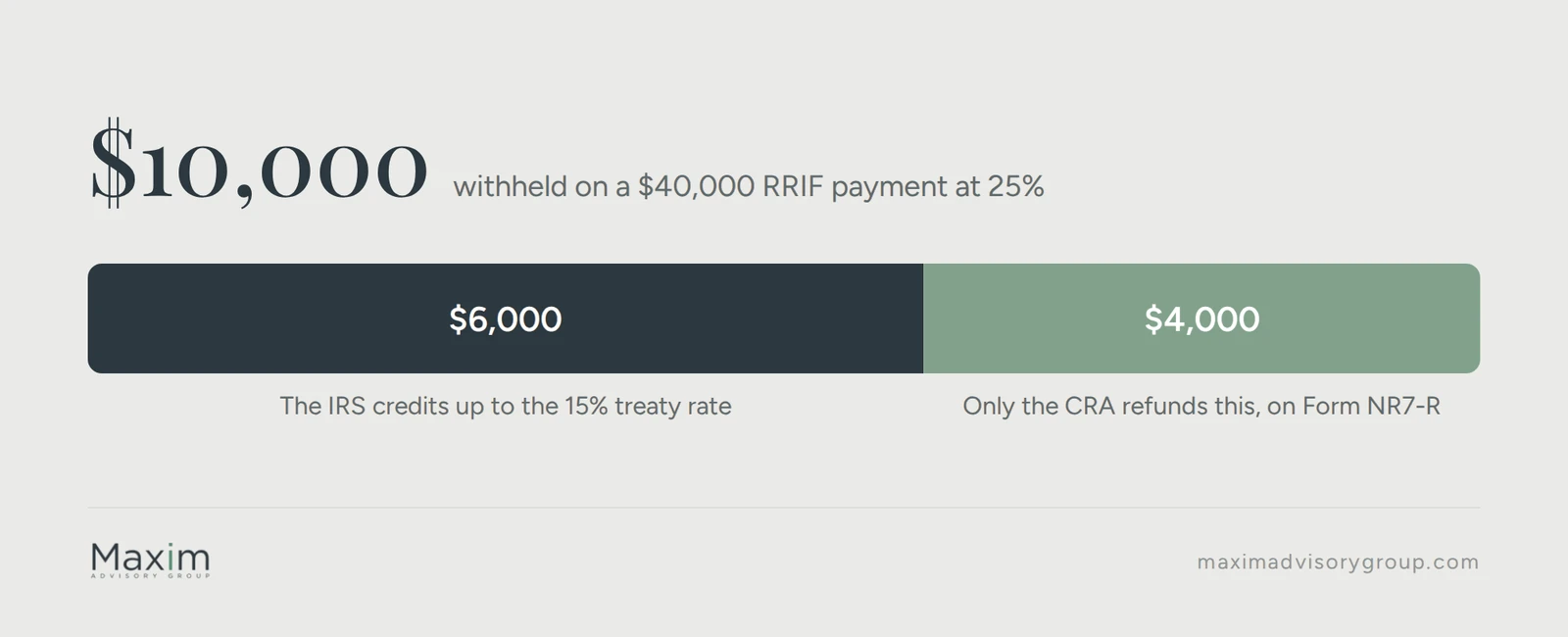
The credit also has its own yearly limit, so the $6,000 can come out lower. The IRS won’t credit the $4,000 at all. The CRA refunds it when you file Form NR7-R, its refund claim for non-resident tax withheld above the right rate. The CRA must have that claim within two years after December 31 of the year your bank sent the tax.
Is Your TFSA Still Tax-Free Once You Live in the US?
Canada Still Treats It as Tax-Free, and the US Has Rules of Its Own.
Is your TFSA still tax-free once you live in the US? Canada still treats it that way. Nothing in US law or the treaty says it does the same, and that’s the key to plan around.
An automatic transfer is where this costs people money. Say $500 a month goes from chequing into the TFSA, set up long before the move and never switched off. Each of those deposits is now a non-resident contribution.
1. Canada Keeps the Shelter and Stops the Contributions
New Money Costs 1% a Month. Withdrawals Stay Tax-Free.
Income and withdrawals stay free of Canadian tax after you leave.
Putting money in now costs you. Only residents can contribute tax-free. A contribution you make as a non-resident, with two narrow exceptions, is taxed 1% for every month it stays in the account. So the January deposit of $500 is taxed 12 times by year end, February’s 11 times, and December’s once. That adds up to about $390 on the $6,000 you put in, and the tax keeps running until the money comes out or you move back. The tax isn’t taken automatically. You report and pay it yourself on Form RC243 with Schedule B by June 30 of the next year. It only stops once the whole contribution is back out, so a partial withdrawal won’t do it.
Contribution room, the amount you’re allowed to put in, works against you too. You earn no new room for any year you’re a non-resident all year. A withdrawal made while you’re away comes back as room only once you’re a resident again. So $20,000 pulled out after you move leaves $20,000 of room waiting in Canada for a return you may never make.
Switch off any automatic transfer before you go. A contribution made while you’re still resident is sheltered in Canada. If you’re heading to the US, talk to your US preparer before you add to the account.
2. The Treaty Gives Your TFSA No US Shelter
The TFSA Fits Neither the Treaty Deferral nor the IRS Trust Exemptions.
No IRS publication, form instruction or ruling names the TFSA. Nothing we can point you to shelters the income inside it from US tax.
The RRSP’s US deferral comes from a treaty rule that covers only a plan “operated exclusively to provide pension or employee benefits.” A TFSA pays out for anything you like, so it falls outside that rule and outside the IRS document built on it.
The IRS also spares two kinds of tax-favoured foreign trust, its term for a trust set up outside the US, from Form 3520, in Revenue Procedure 2020-17. One is retirement trusts. The other is savings trusts that exist “to provide, or to earn income for the provision of, medical, disability, or educational benefits.” A TFSA is not a retirement plan and isn’t limited to medical, disability or education spending, so neither exemption fits.
Whether the account itself counts as a foreign trust, which carries reporting of its own, is a judgement your US preparer has to make and then defend. There is no settled answer yet, and we won’t pretend there is.
One US trap is more certain. Canadian mutual funds and ETFs inside a TFSA are generally PFICs for a US resident, with a Form 8621 for each fund and a harsh tax on gains. The RRSP is protected from this and the TFSA isn’t, so a lot of people simplify or close the TFSA before they move.
Common Traps With an RRSP or TFSA When You Leave Canada
Most of These Are Cheap to Avoid If You See Them Coming.
Missing the Home Buyers’ Plan or Lifelong Learning Plan payback. If you borrowed from your RRSP under the Home Buyers’ Plan or the Lifelong Learning Plan and still owe some of it, the rest is due when you file your return for the year you leave or 60 days after you become a non-resident, whichever comes first. Miss it and a $15,000 balance counts as income for that year.
Treating the RRIF minimum as your 15% limit. Your yearly allowance is always at least twice your minimum, so taking only the minimum can leave some of it unused.
Assuming you can skip the NR301 because it’s optional. If your bank asks for that information and you don’t give it, the CRA’s guidance is that “the full statutory rate should be withheld”, meaning the whole 25%.
Assuming one section 217 return covers later years. You make the election one year at a time, by filing a return for each year you want it. Miss June 30 and that year’s withholding is final.
RRSP Non-Resident Withdrawal Questions
Short Answers on Age 71, the Province You Left and Other Countries.
Do I Still Have to Convert My RRSP at 71 If I Live in the US?
Yes. An RRSP can’t stay an RRSP past the end of the year you turn 71, wherever you live. By then it has to become a RRIF, be paid out, or go to another option the CRA lists. Cashing it out in one go means 25% off the whole balance, so for most people in the US the RRIF is the one to price first.
Does the Province I Left Change the 25%?
No. The 25% in section 212 is one federal rate, whichever province you left from. A section 217 return doesn’t bring the province back either, because non-residents pay an extra 48% of federal tax instead of provincial tax. Our non-resident page has the rest of that return.
What If I Move Somewhere Other Than the US?
The treaty with your new country decides. Canada’s 25% is the starting point everywhere, and each treaty sets its own rules for pensions. If your new country’s treaty also gives the lower rate only to “periodic pension payments”, Canada defines that phrase the same way as for the US, so RRSP withdrawals still pay 25%. A treaty worded differently can give a different answer, for RRSP and RRIF payments alike.
What to Do Before Your First RRSP or RRIF Withdrawal as a Non-Resident
The Cheapest Fixes All Happen Before the Money Moves.
So what should you do with your RRSP after you leave? The real decision is how the money comes out.
It can come all at once from the RRSP, from a RRIF that stays inside its yearly allowance, or spread over several years. Each route sends a different amount to Canada. Once the US credit is counted, the gap in your pocket can be smaller, or nothing.
The NR7-R refund and the section 217 return both work after the money has gone out. Both come with paperwork and a deadline.
Everything else has to happen first. Before you go, repay any Home Buyers’ Plan or Lifelong Learning Plan balance, and stop any automatic transfer into the TFSA. Before the first payment, get the NR301 to your bank and price the RRIF against what you plan to draw each year.
If you’re already drawing from the RRSP, the next payment is still yours to change.
We charge hourly, with engagements generally 10 to 60 hours. You will know what any further work would cost before you agree to it.