

Key Takeaways
The Buyer Can Hold Back a Quarter of the Price. If you’ve left Canada, the buyer’s lawyer holds 25% of the price as a deposit until the CRA signs off. With no sign-off by 30 days after the end of the closing month, the deposit goes to the CRA.
Form T2062 Swaps That for 25% of Your Profit on a Home. File it as soon as you’ve accepted an offer. Even then, the certificate usually arrives after closing because CRA can take several months, so expect your lawyer to hold back part of the price for a while.
A Rental Building Is Held Back at 50%. The land stays at 25%, so one sale carries two rates.
Your Home Exemption Stops Growing When You Leave. Only the years you lived in Canada count, plus one if you bought while living here.
If You Still Owe a Notice, Ten Days After Closing Is a Hard Deadline. That applies if you haven’t filed, or if the buyer, price or cost changed. Late notice costs $25 a day, with a $100 minimum and a $2,500 cap.
The buyer’s lawyer has one big question for you before closing. Where do you live now?
Say you moved abroad some time back and still own your house in Canada. Now you’ve accepted an offer on it.
Your answer changes how closing goes. Because you’ve left Canada for tax purposes, the buyer’s lawyer can hold back a quarter of the price and set it aside for the Canada Revenue Agency (CRA). Under the Income Tax Act you’re a non-resident, and that status triggers the holdback.
That quarter is a deposit against tax you may or may not owe. It isn’t the buyer’s to keep, and it waits with the lawyer until the CRA signs off.
The sign-off is called a clearance certificate, or a section 116 certificate, after the part of the tax law it comes from. You ask for it on Form T2062. Two things make it go faster. Tell your lawyer on day one that you’re a non-resident, and dig out the deeds and purchase agreement from when you bought before you list.
Get it before closing, and the lawyer releases the deposit on the day. If it isn’t there by closing, the lawyer keeps holding the deposit, and a certificate that arrives within 30 days after the end of the closing month still frees it. After that, the lawyer sends it to the CRA, and anything you overpaid comes back only after your next Canadian tax return is processed.
Here’s what people usually miss.
- You can apply before closing, which is the only way the money might be released on the day.
- If you’ve moved to the US, the tax treaty between the two countries still leaves a Canadian house taxable in Canada.
- On a rental, the buyer holds back half of the building’s share of the price.
- A home you lived in isn’t automatically tax-free once you’ve left, because the years abroad count against the exemption.
- Some of the money can wait on a tax return you can’t file until the following year.
Let’s dive into the details.
On This Page
- What the certificate is
- Who needs one
- How much the buyer holds back
- The key dates
- Your home exemption after leaving
- Filling in Form T2062
- The tax you end up paying
- Common traps
- Quick answers
- Before you list
What Is a Section 116 Clearance Certificate?
The Certificate Trades a Deposit on the Whole Price for a Payment on Your Profit.
Why bother with a certificate? Because it shrinks the deposit.
Without one, the lawyer holds a quarter of everything the buyer pays. With one, you pay the CRA a quarter of your profit instead, and the buyer pays you the rest. A rental building also pays tax on recaptured depreciation.
Its formal name is a certificate of compliance. To get one, you pay the CRA 25% of your gain. Your gain is your profit, meaning the sale price minus your adjusted cost base, which is the tax figure for what the property cost you.
If you’d rather not pay cash up front, you can give the CRA security instead, such as a bank guarantee.
Before closing, you apply for the sale you’ve agreed to. You tell the CRA who is buying, what the property is, the price you expect and your cost. The Act calls this a proposed disposition.
The certificate is set at the price you estimated. If the sale closes with the same buyer, at no more than that price, and you didn’t overstate your cost, you don’t notify the CRA again.
After closing, you report the finished sale. Same details and same payment. The certificate comes back once it’s paid.
What the certificate won’t do. It’s the buyer’s protection. The CRA’s circular says it protects the buyer from further tax liability for the sale it covers, up to the price in your notice. It won’t settle your own tax. That’s done on your tax return, where the 25% you paid counts as tax already paid.
Who Needs a Section 116 Certificate, and What Counts as Taxable Canadian Property?
Anyone Who Has Left Canada and Sells Canadian Real Estate Needs One.
Does this apply to you?
What counts is where you live for tax purposes on the day the sale closes. If you still live in Canada that day, none of this applies. But if you’ve left, it does.
The date your residency ended isn’t always the one you might think. The departure tax page explains how to pin it down.
The kind of property matters too. Its name in the tax law is taxable Canadian property, meaning Canadian assets that Canada keeps the right to tax after you leave. The two groups that matter here are…
- Real estate in Canada, like a house or property lot
- Shares of a private company that got more than half its value from Canadian real estate or natural resources at any point in the five years before the sale. Think of a holding company whose main assets are rental buildings.
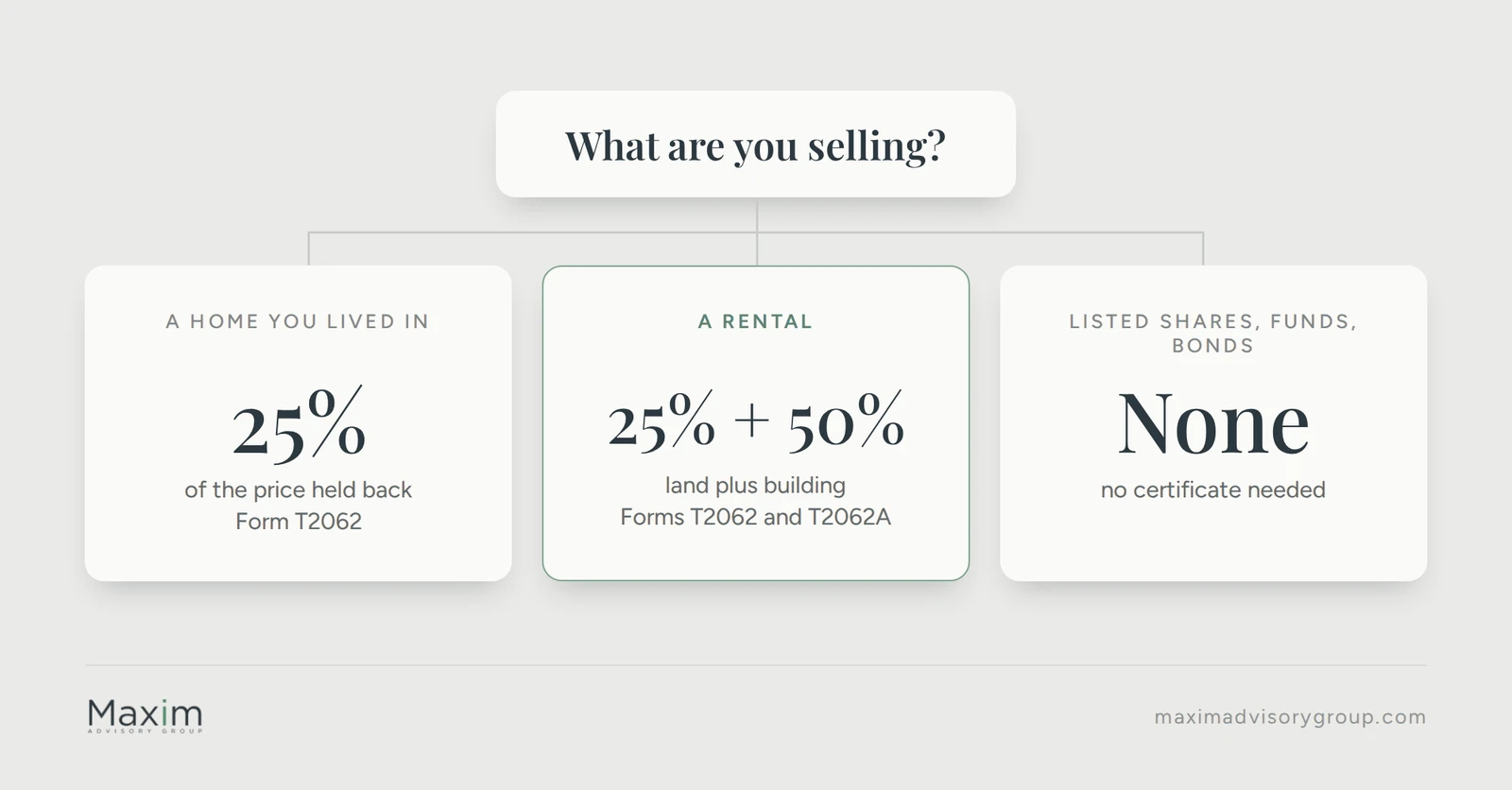
Some property is excluded from section 116 altogether, so there’s nothing to apply for. These include…
- shares listed on a stock exchange
- units of a mutual fund trust, a common legal form for Canadian funds
- a bond, or a mortgage you hold on someone else’s property
Listed shares and funds in a Canadian brokerage account you kept are on that list, but the house never is.
Moved to the US? The treaty leaves this as it is. The Canada–US treaty says gains on real property situated in Canada “may be taxed” in Canada. Section 116’s treaty exception covers only property a treaty takes out of Canadian tax, and a Canadian house stays taxable here.
The rest of a move out of Canada is covered in our cross-border guidance. And if you still live in Canada and spend winters in the US, a different set of rules applies, on the Form 8840 page.
How Much Does the Buyer Hold Back Under Section 116?
The Rate Depends on What You Sell, and a Rental Carries Two Rates on One Sale.
How big is the deposit? For a house you lived in, a quarter of the price. For a rental it’s more, because the tax law treats the building differently from the land.
Let’s say, for example, your house sells for $800,000 and cost you $500,000. Set the home exemption aside for this example. Here’s the deposit with and without a certificate…
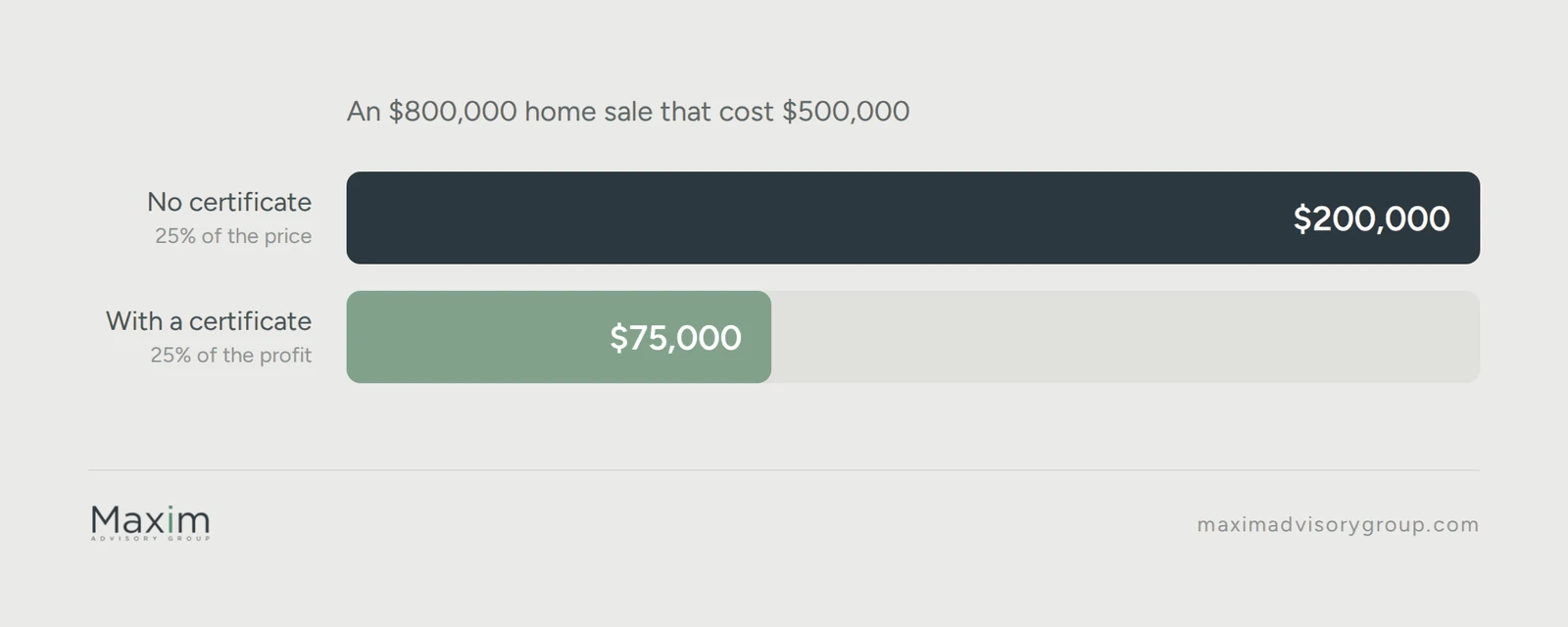
Your own figures depend on your cost base and your exemption.
On this sale the certificate cuts the deposit from $200,000 to $75,000, because it’s worked out on your profit instead of the whole price.
Here is what the buyer holds back without a certificate, and what you pay instead to get one.
| What you’re selling | Held back without a certificate | What you pay for the certificate | Forms |
|---|---|---|---|
| A home or cottage you never rented | 25% of the price | 25% of the gain, less any part the principal residence exemption covers | T2062, plus T2091(IND) and its worksheet if you claim the exemption |
| A rental, the land | 25% of the land’s share of the price | 25% of the gain on the land | T2062 |
| A rental, the building | 50% of the building’s share of the price | 25% of the gain on the building, plus federal tax on recaptured depreciation | T2062 and T2062A, filed together |
| Real estate you bought to resell | 50% of the price | An amount the CRA accepts | T2062A |
| Private company shares worth mainly Canadian real estate | 25% of the price | 25% of the gain | T2062 |
| Listed shares, mutual fund trust units, bonds | Nothing | No certificate needed | None |
Federal rules as of October 2026, per Income Tax Act s. 116, CRA Information Circular IC72-17R6, and the Form T2062 instructions.
Recaptured depreciation, in the building row, is the depreciation you deducted against the rent over the years. It comes back into income when you sell for more than the building’s depreciated value.
1. A Rental Splits Into Land at 25% and Building at 50%
The Building Is Depreciable, So It Takes the Higher Rate.
Why two rates? The tax law treats a building as something that wears out, so you can deduct depreciation on it each year. Land doesn’t wear out, so you can’t.
Property you’re allowed to deduct depreciation on, whether or not you ever claimed it, is called depreciable property, and the Act sets the holdback on depreciable property at 50%. The land stays at 25%.
Now say your house had been a rental, with the land worth $300,000 of the $800,000 and the building $500,000.
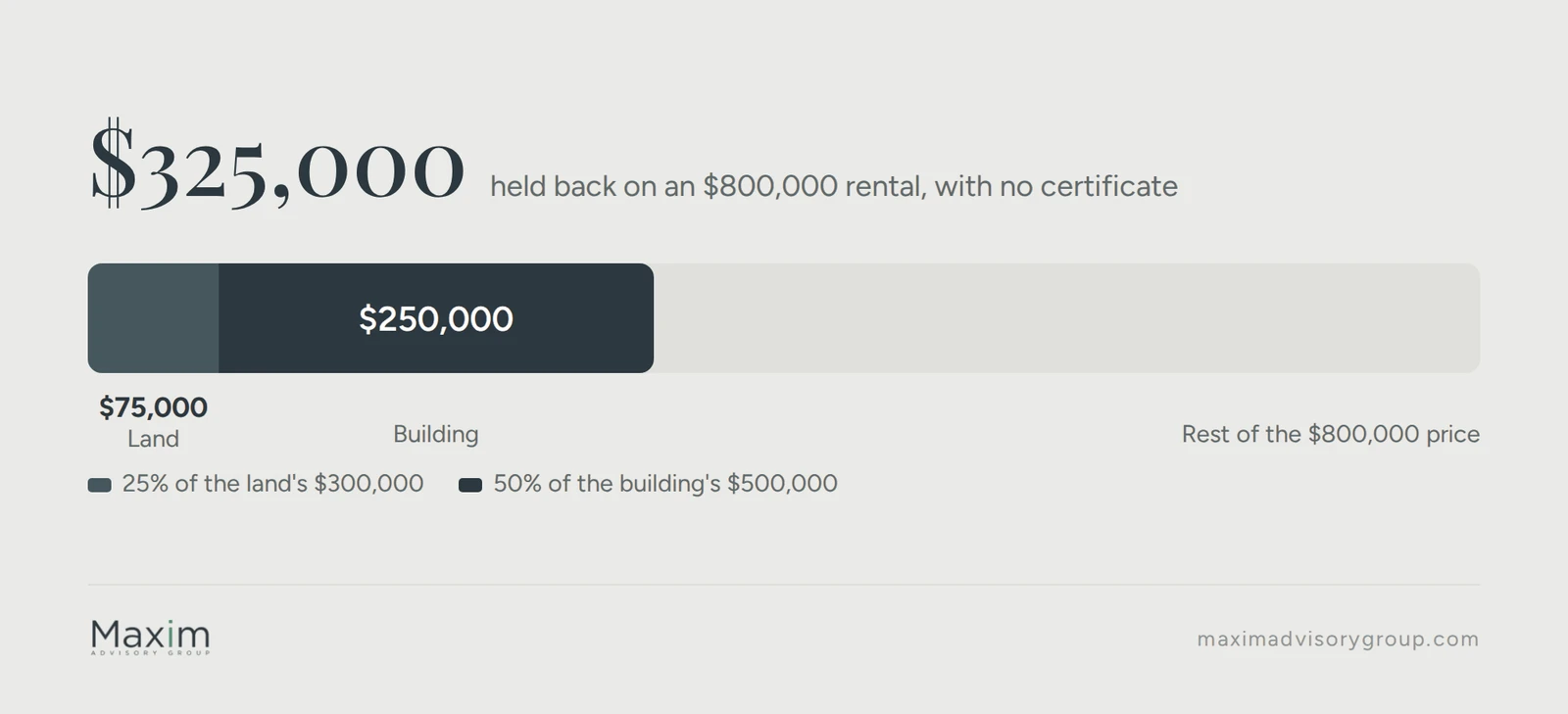
Recaptured depreciation affects what you pay for a certificate and leaves this holdback unchanged.
That’s roughly two-fifths of the price sitting with the buyer’s lawyer, on a property that may have made $300,000.
To get the certificate, the CRA wants documents supporting how you divided the price between land and building, plus your depreciation schedules for every year.
If the house became a rental at any point, before or after you left, there’s an earlier event to account for. Starting to rent a home counts as selling it at that day’s value and buying it back. The exception is if you chose, on your return for that year, to have that ignored, which the Act calls an election. Whether you made it sets your cost base for this sale. If you didn’t make that election, the switch to renting may have created a gain that belonged on that year’s return. And your rental filings from while you were away should be up to date before you apply, or the certificate can stall.
Without the election, the T2062 asks what the house was worth the day renting started. With it, check whether the 50% building rate still applies before you rely on it.
2. Company Shares Can Count as Taxable Canadian Property
Private Shares Are Caught When a Company’s Value Comes Mainly From Real Estate.
Own the house through a company? Then selling the company’s shares can be treated like selling the house, because the shares count as taxable Canadian property. The treaty also leaves shares of a Canadian company taxable in Canada when their value comes principally from Canadian real estate. It doesn’t say over what period that’s measured, unlike the tax law’s own five-year test.
Selling shares like these still takes a T2062, and the CRA asks for the company’s most recent financial statements along with it.
What Are the Section 116 Deadlines?
The Date That Matters Most Is the Day You Accept an Offer.
Four dates are important to know because they decide how long your deposit is tied up.
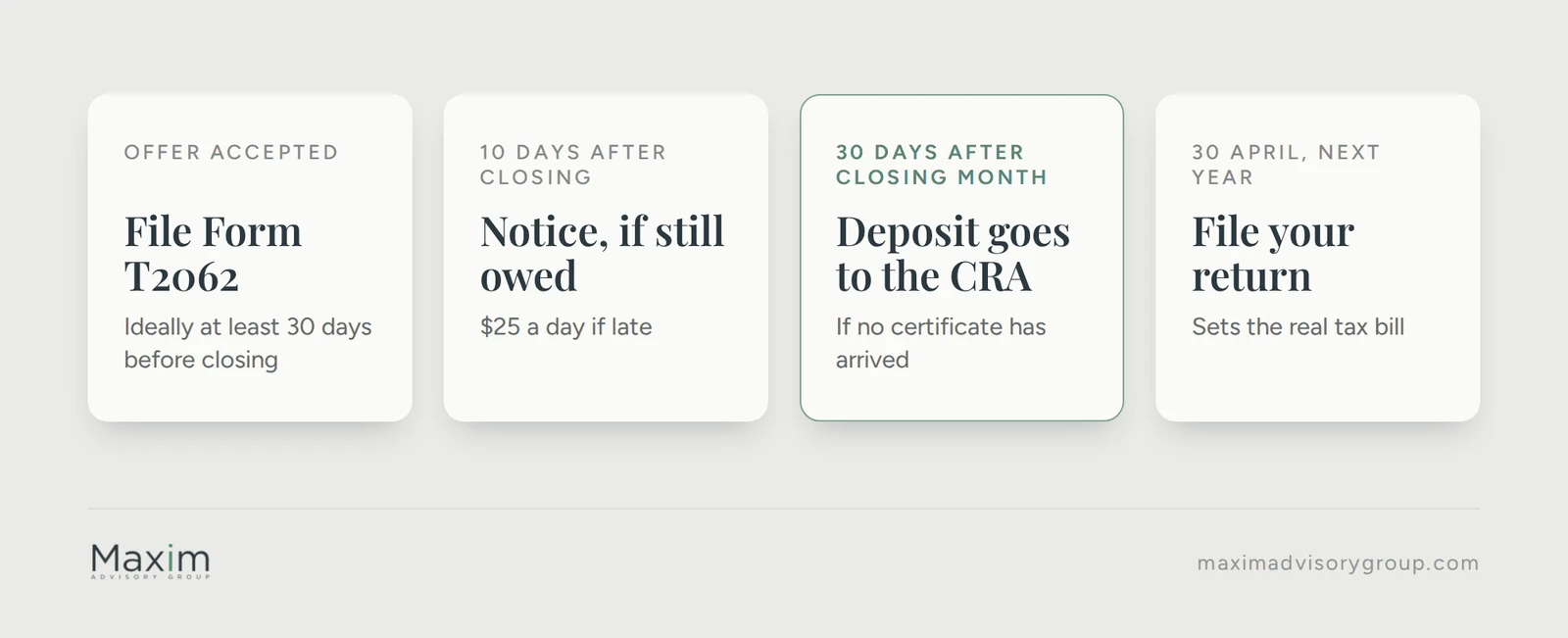
First, once you accept an offer, file the T2062. You can file any time before the sale closes, and the CRA’s circular asks for it at least 30 days before closing. That’s a request rather than a legal deadline.
Filing early gives the CRA weeks to work on it before closing. The CRA promises no processing time, only to issue the certificate at the earliest possible date once it has checked your documents and payment.
Second, within ten days after closing, notify the CRA if you still need to. You need to if you haven’t filed yet. You also need to if you filed early and something changed. That could be a different buyer, a higher price than you estimated, or a cost you gave that turned out higher than your real cost.
This one is required. Miss it and the penalty is $25 a day, at least $100 and at most $2,500. You can apply to have it waived if the delay was beyond your control.
The Act still asks for the notice by registered mail, a phrase with some vintage to it. The CRA also takes the form online, through “Submit documents” in My Account, or through Represent a Client, its portal for accountants and other representatives.
Third, 30 days after the end of the closing month, the buyer pays the CRA. If no certificate has arrived by then, the buyer’s lawyer sends your deposit to the CRA. Close on March 3 and that day is April 30. From then on the money sits on your CRA account as tax already paid.
Your tax return decides how much of it you get back.
Fourth, by April 30 of the following year, file your tax return. It’s the Income Tax and Benefit Return for Non-Residents and Deemed Residents of Canada, and a sale usually means you need one. Any tax still owing is due the same day.
Does the Principal Residence Exemption Still Apply After You Leave?
It Still Applies, for the Years You Lived There as a Canadian Resident.
Does moving away cost you the home exemption? Sure, partly. The principal residence exemption is the rule that makes the profit on your home tax-free. It keeps covering the years you lived there as a Canadian, and the years after you left go uncovered.
If you owned your house for ten years, lived there as a Canadian for seven of them, and sell at a $300,000 profit, the exemption works out the covered share as a fraction.
- The top is one, plus each year the house was your principal residence while you lived in Canada.
- The bottom counts every year you owned it.
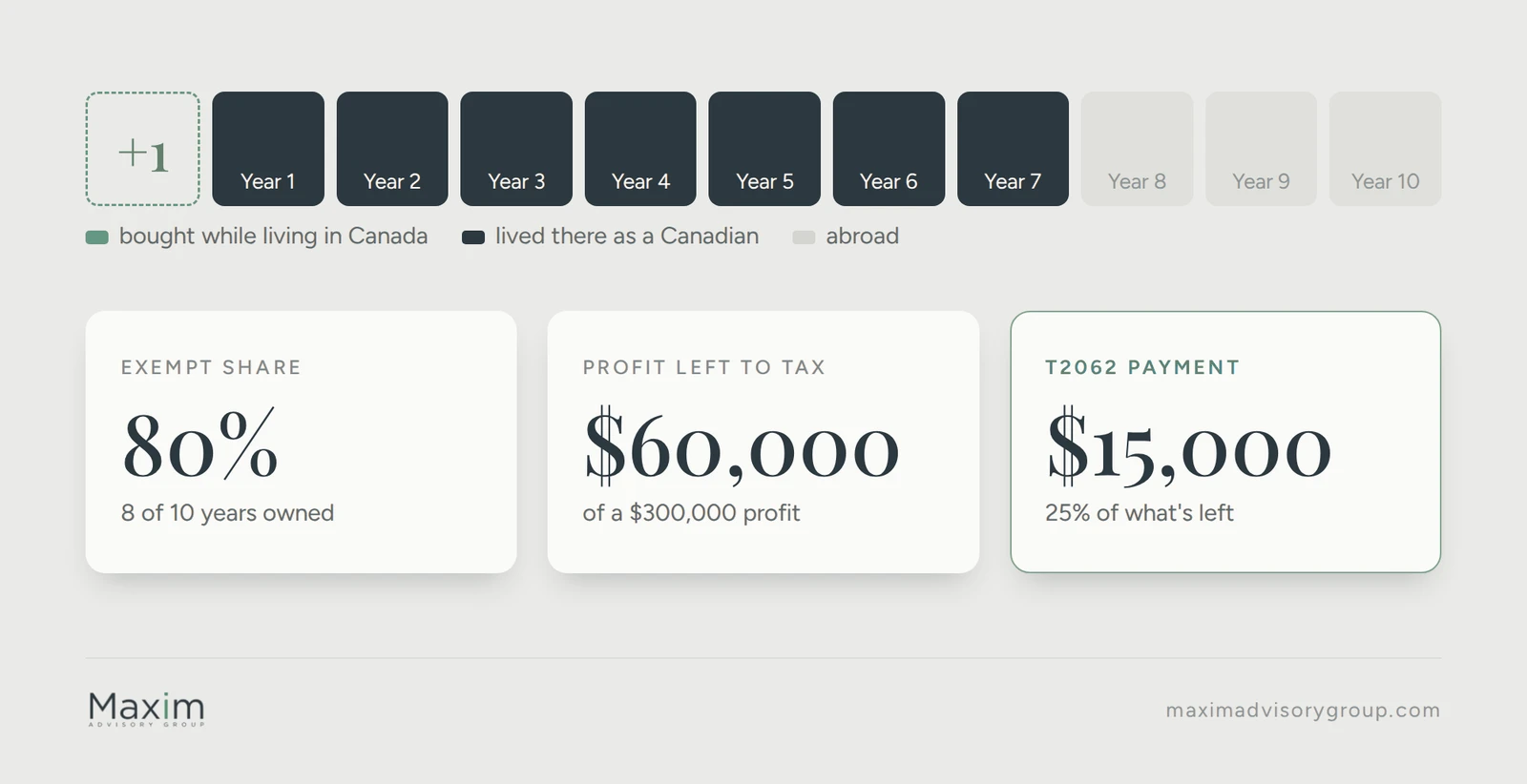
Before selling costs.
In plain terms, 80% of your profit is tax-free. Your T2062 payment drops to $15,000, against the $200,000 the buyer’s lawyer would otherwise hold.
The “one plus” only counts if you were living in Canada the year you bought. The year you left may also count as a Canadian year, so check your own count.
A fully exempt sale still needs the form. The CRA’s circular says a T2062 must be submitted to report the sale of a principal residence. Form T2091(IND) is where you designate the house as your principal residence. It goes with the T2062 and again with your return.
How Do You Fill In Form T2062?
Most of the Form Is Five Numbers.
The form opens with four pages of instructions. The part you fill in starts with identity, meaning you as the seller, with your date of departure from Canada and any representative acting for you, then the buyer. After that come the property details and a row of five numbers, all in Canadian dollars.
Here is that row for your house, with no home exemption claimed…
| Column on the form | Your house |
|---|---|
| 1. Proceeds of disposition, your share of the sale price | $800,000 |
| 2. Adjusted cost base, what the house cost you | $500,000 |
| 3. Gain, column 1 minus column 2 | $300,000 |
| 4. Exempt portion, such as the home exemption | $0 |
| 5. Net gain, column 3 minus column 4 | $300,000 |
| Payment, 25% of the net gain | $75,000 |
If you claim the home exemption in column 4, attach a note showing how you worked it out.
Selling costs wait for the return. The instructions say selling costs such as commissions and legal fees can’t be claimed on the T2062.
Say the commission was $30,000. It stays in the gain on the form, so your payment includes $7,500 (25% of $30,000) on money you never kept. On your return the commission comes off the gain, which lowers your tax, and any payment left over after that is refunded. With an 80% home exemption, the extra paid on the commission is $1,500.
The documents set the pace. For a house, the CRA wants the purchase agreement from when you bought it, the sale agreement, and the registered deeds on both. If you’re claiming the exemption, add Form T2091(IND) and its worksheet. A rental adds depreciation schedules for every year, the land and building split, and Form T2062A for the recaptured depreciation, filed with the T2062.
Two non-residents on title means two forms. Each non-resident co-owner files a separate T2062 for their own share, with a list of every owner and their percentage.
You’ll need a Canadian tax number. Your old social insurance number works if you had one. If you never did, apply on Form T1261 for an Individual Tax Number, the number the CRA gives non-residents without a social insurance number. The form’s instructions ask you to send the T1261 ahead of the sale if you can, to avoid delays.
Payment goes with the form, like a certified cheque, bank draft, money order or your lawyer’s trust cheque. Or you can post security, such as a bank guarantee.
What Does the Sale Finally Cost in Tax?
The Holdback Is a Deposit. The April 30 Return Sets the Bill.
So what’s the real tax on the sale? Your tax return decides that, and the deposit is only an advance on it.
Whatever the buyer sent the CRA, or you paid for the certificate, counts as tax already paid. The return works out the real bill and squares the two.
Tax applies to half the profit. On the return, the taxable part is half your profit. For your house, half of the $60,000 the exemption left uncovered, $30,000, goes into your income.
Living abroad adds a federal top-up. If you lived abroad all through the year you sold, that profit doesn’t count as income earned in a province. You pay a federal surtax equal to 48% of the federal tax on that profit. Normally that surtax replaces provincial tax on this gain. Quebec is the exception, with its own certificate and tax.
The federal tax on that gain gets a top-up of nearly half again. If you sold in the year you left, you were a resident for part of that year and the math is different.
When you don’t need to file. In narrow cases you skip the return altogether. The CRA’s circular lets you skip the return only if all four hold.
- you were non-resident when you sold
- you owe no tax for the year
- you owe nothing from earlier years
- everything you sold was either excluded or covered by a certificate
A sale with profit left after the exemption will usually fail the second. A fully exempt one still needs a return to designate the house as your principal residence.
Any overpayment is refunded once the CRA assesses that return, meaning once it has processed it. Sell in May and the refund waits on a return you can’t file until the year is over. File as early in the new year as you can.
If the US is home now, the sale generally goes on your US return too. The Canadian tax usually counts as a credit against the US tax, and if it was your main home for two of the last five years, the US home sale exclusion may shelter part of the gain. Work through both returns before closing. For how the two countries split the tax, see the Canada–US tax treaty page.
Common Section 116 Traps
All Three Are Decided Before Closing.
Treating the residency question as small talk. The buyer may become liable if the CRA believes they should have known you’d left, so their lawyer will ask where you live. Answer plainly, and early.
Treating the filing as your lawyer’s job. The Act puts the notice on you as the seller, so a late one is your penalty, even if someone else was meant to send it.
Assuming the full price is there for your next home. Money still with the buyer’s lawyer or the CRA can’t go into your next down payment. Budget on the price less the deposit until the lawyer releases it, or, if it has gone to the CRA, until your return is assessed.
Which Section 116 Questions Come Up Most?
A Loss or a Family Sale Still Needs a Certificate, and Rent Is Taxed Separately.
Do I Need a Certificate If I Sold at a Loss?
Yes. The notice covers any sale of taxable Canadian property outside the excluded list, at a profit or a loss. The payment is 25% of any profit, so on a loss it’s usually zero. A rental can still owe tax on recaptured depreciation. Without a certificate, the buyer still holds a quarter of the price as a deposit, or half of the building’s share on a rental.
What If I Sell to Family for Less Than It’s Worth?
The CRA uses the market value instead of the price. That applies to a gift, or to a sale below market value to someone the tax law treats as connected to you. That means anyone the tax law puts outside an arm’s-length relationship with you, which is how two independent strangers deal. The group includes your children, grandchildren, parents, siblings, your spouse and their family, and a company you control, and it can include others.
The deposit and your payment are both worked out on that value, and the form asks for an appraisal or an appraiser’s letter.
What About the Rent I Collected While I Was Away?
It’s taxed separately. Section 116 only deals with the sale. Rent a non-resident receives has its own withholding rules, covered on the non-resident tax page.
What Needs Doing Before You Sell?
Have the Answer Ready Before the Buyer’s Lawyer Asks Where You Live.
That question comes near closing. The earlier you’ve filed, the better your chance the deposit is released on the day.
Before you list, gather the purchase agreement and the deeds from when you bought, and count your years in Canada for the home exemption. Check that every owner on title has a Canadian tax number. If the house was ever rented, find the depreciation schedules and the land and building split.
When you accept an offer, file the T2062 that week, with the payment. Tell your lawyer on day one that you’re a non-resident.
Already under contract? If nothing is filed, file now. The before-closing route stays open until the sale closes.
It’s a paid consultation. By the end you’ll know what your T2062 will ask for and whether anything before the listing would change it.