

What Happens To Your Canadian Income When You Leave?
You can stop being a Canadian tax resident and still owe Canada money.
For example, let’s say you move abroad but keep the rental condo, your shares in the company you helped start, or a loan you made to a business back home. Canada still taxes that income. This is called non-resident tax and it applies to any Canadian-source income you receive after you’ve left, no matter how small.
Each spring, an NR4 slip arrives for every payment you got the year before. It shows the amount, the tax already withheld, and a code for what kind of income it was. What it doesn’t tell you is whether that withholding was correct or not. That’s a big miss… and something we need to catch.
It’s very common for people to have continuing interests when they leave Canada. For example, this year you had three kinds of income: rent from the condo, a dividend from the company, and interest on a loan. Each one gets taxed by a different rule, and each one can go wrong in its own way.
In the end, you might have three payments, and three different answers on how they’re taxed.
Non-Resident Tax In a Nutshell
Canada keeps taxing you on Canadian income, whether or not you’re still here. That includes the rent, the dividend, and the interest from our example, plus pensions, royalties, and any pay for work you still do in Canada.
Here’s the part that trips people up. Canada collects this tax in two completely different ways, and which one applies depends on the type of income, not how much you earned.
The first method… your payer takes a cut before you see the money. This is how rent, dividends, pensions, and royalties work. Whoever pays you withholds 25% and sends it straight to the CRA. You don’t file anything. You just get 75% of the amount, minus whatever the treaty changes (more on that below).
The second… you file a return, like you did when you lived here. This is how work income, business income, and profit from selling Canadian property work. Graduated rates, deductions, the whole normal process.
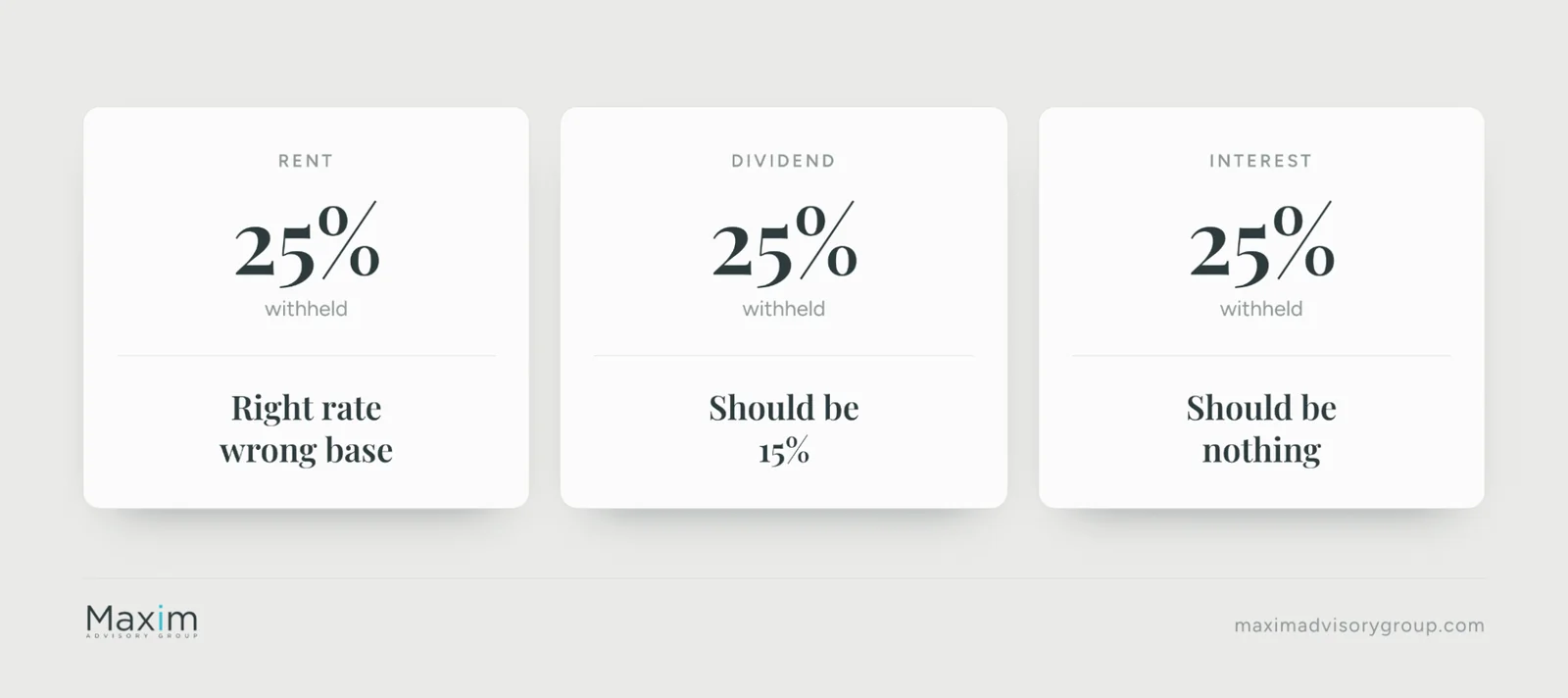
Our three examples all fall under the first method, the automatic 25% cut. But 25% isn’t always the final answer:
- Rent: the 25% doesn’t move, but it’s charged on your full rent collected, not what’s left after expenses. A section 216 election lets you pay tax on the smaller number instead. It usually saves you money.
- Dividends: the US-Canada treaty caps this at 15%. If your bank withheld the full 25%, you overpaid by 10 points.
- Interest: on a normal loan to someone with no other tie to you, the treaty usually drops this to 0%. If anything was withheld, it shouldn’t have been.
Also, filing a tax return to fix these issues isn’t free. You lose most personal tax credits, and a 48% federal surtax replaces the provincial tax you’d normally pay. For rent, it’s still almost always worth it. For pensions, often not.
And the deadlines are strict. Miss the window for your section 216 return on rental income and you don’t get a late option, you lose the election entirely. It sounds tricky but it’s not. We see a lot of people shy away from holding Canadian assets as non-residents…or worse, delay their departure plans. If you do your homework and have a great team, this stuff becomes manageable.
Let’s dive in deeper.
On This Page
- Non-Resident Status Comes First
- The Two Systems Canada Taxes Non-Residents Under
- Withholding Tax On Interest, Dividends And Royalties
- Part XIII Or Part I: Sorting Every Canadian Payment You Receive
- Section 216: Moving Rent From Gross To Net
- What A Return Costs You: The Surtax And The 90% Rule
- Section 217: The Election That Might Not Help You
- When You Have To File, And What You Need To Do It
- 8 Common Non-Resident Tax Traps
- Non-Resident Tax Canada Frequently Asked Questions (FAQs)
- Start With A List Of What Canada Pays You
Non-Resident Status Comes First
Everything above only applies once you’ve actually become a non-resident. That’s not about your passport, and it’s not about where your mail goes.
The CRA looks at your ties to Canada, all together. Three matter almost always:
- a home here,
- a spouse or common-law partner, and
- dependants
Got smaller ties, like a bank account, health coverage, or a driver’s licence? These usually don’t count alone, but add enough of them together and they can. The departure tax page walks through the full test.
Here’s the big trap.
Spend 183 days or more in Canada in a year, and if you don’t have significant ties here and no other country claims you as a tax resident under a treaty, Canada can still tax you as a full-year resident. Not just on what you earned in Canada. On everything, worldwide. It’s called deemed residency, and it’s something to understand before you spend long stretches in Canada.
“183 days” sounds like it’s about where you live, but it isn’t. It’s just a day count, and work days count too. Someone flying to a Canadian job site and going home only once, seven months later, can still hit 183 without ever meaning to live here. Weekends spent in the hotel between shifts count. So does every day you’re simply in the country, whatever you’re doing.
If you’re close to that number, count actual days in Canada. Not workdays, and not trips home you meant to take.
The Two Systems Canada Taxes Non-Residents Under
Every dollar Canada pays you falls under one of two rules. Which rule applies depends only on what kind of income it is, not how much.
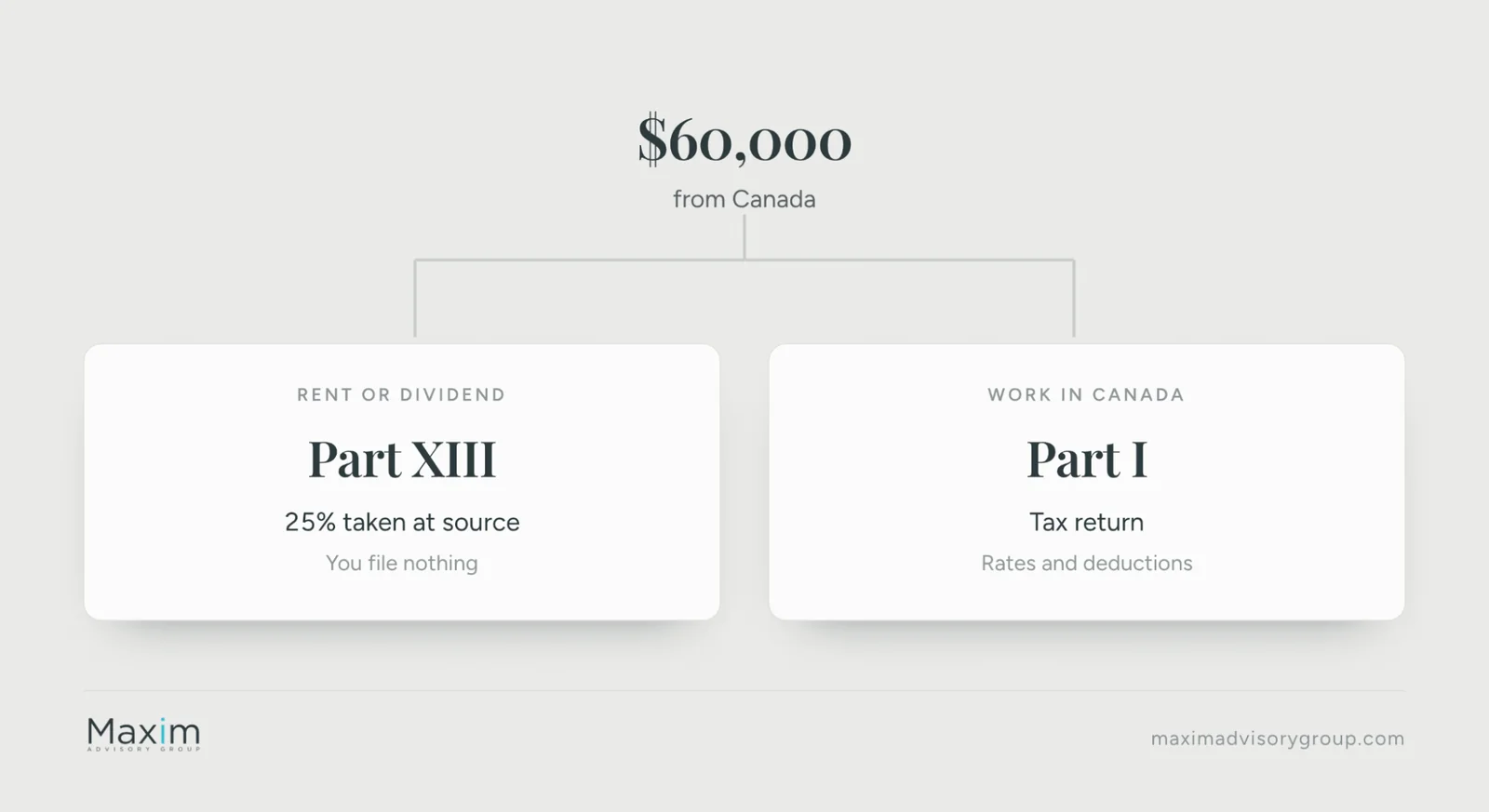
Take $60,000 and change nothing but the label:
- As rent from a Canadian property, Canada takes 25% off the top before you see it. Done.
- As a dividend, same thing. 25% off the top. Done.
- As consulting fees for work you did in Canada, you file a return, like you did when you lived here.
Same $60,000, two completely different processes. That split has a name: Part XIII and Part I of the Income Tax Act.
Part XIII: a flat 25% cut, and usually that’s the end of it
The law says a non-resident pays 25% tax on income a Canadian resident pays them. The list of income this covers: rent, royalties, pensions, RRSP and RRIF payments, annuities, management fees, and payouts from an estate or trust.
Your Canadian payer does the work here, not you. They hold back 25%, send it to the CRA, and pay you what’s left. You file nothing, not even a return in April. If 25% was the correct amount, you’re done and nothing more is owed.
Here’s the catch, and it’s the same one from our rent, dividend, and interest example: a correct 25% and a wrong 25% look identical on the slip. There’s nothing on the paper telling you which one you got. That’s why people leave it uninvestigated for years.
The consulting fee trap
Consulting fees paid to a non-resident for work done in Canada get 15% withheld too, and it looks exactly like the Part XIII cut above, but it isn’t.
Regulation 105 requires a Canadian client to withhold 15% from payments for services performed in Canada. But that 15% is a deposit, not a final tax. You still file a return and the 15% already withheld comes off whatever you owe.
Miss that, and you either skip a return you owed, or assume you’re square when you’re not.
Part I: work, business, and selling Canadian property
Three things push you into the return system instead of flat withholding:
- Working a job in Canada
- Running a business in Canada
- Selling “taxable Canadian property”
The law spells out the first two plainly. The third is where people get surprised.
“Taxable Canadian property” isn’t just real estate, though real estate is in it. It also includes:
- Business property in Canada, even with no real estate involved
- Shares, or partnership and trust interests, where more than half the value came from Canadian real estate, resources, or timber at any point in the last 60 months, not just on the day you sold
That five-year look-back catches people who think they’re clear because today’s balance sheet doesn’t look like real estate.
Landing in the Part I system means filing a return with deductions and graduated rates, instead of a flat 25%. On a modest amount, that usually works in your favor. On a large one, it can stop being a benefit at all, for reasons covered under what filing a return costs you.
Selling property has a deadline before any of this even applies
If you’re selling Canadian property, you have to notify the CRA within 10 days of the sale and get a certificate of compliance.
Miss it, and the buyer is required to hold back 25% of the entire sale price, 50% on some property types. Not 25% of your profit. 25% of the total price, before subtracting what you originally paid for it.
If you’re selling Canadian property, start the certificate paperwork before you have a closing date, not after.
Withholding Tax On Interest, Dividends And Royalties
On interest, Canada often withholds tax it never had the right to collect. And the money to get back is usually easy to spot once you know where to look.
Most ordinary loans owe Canada nothing
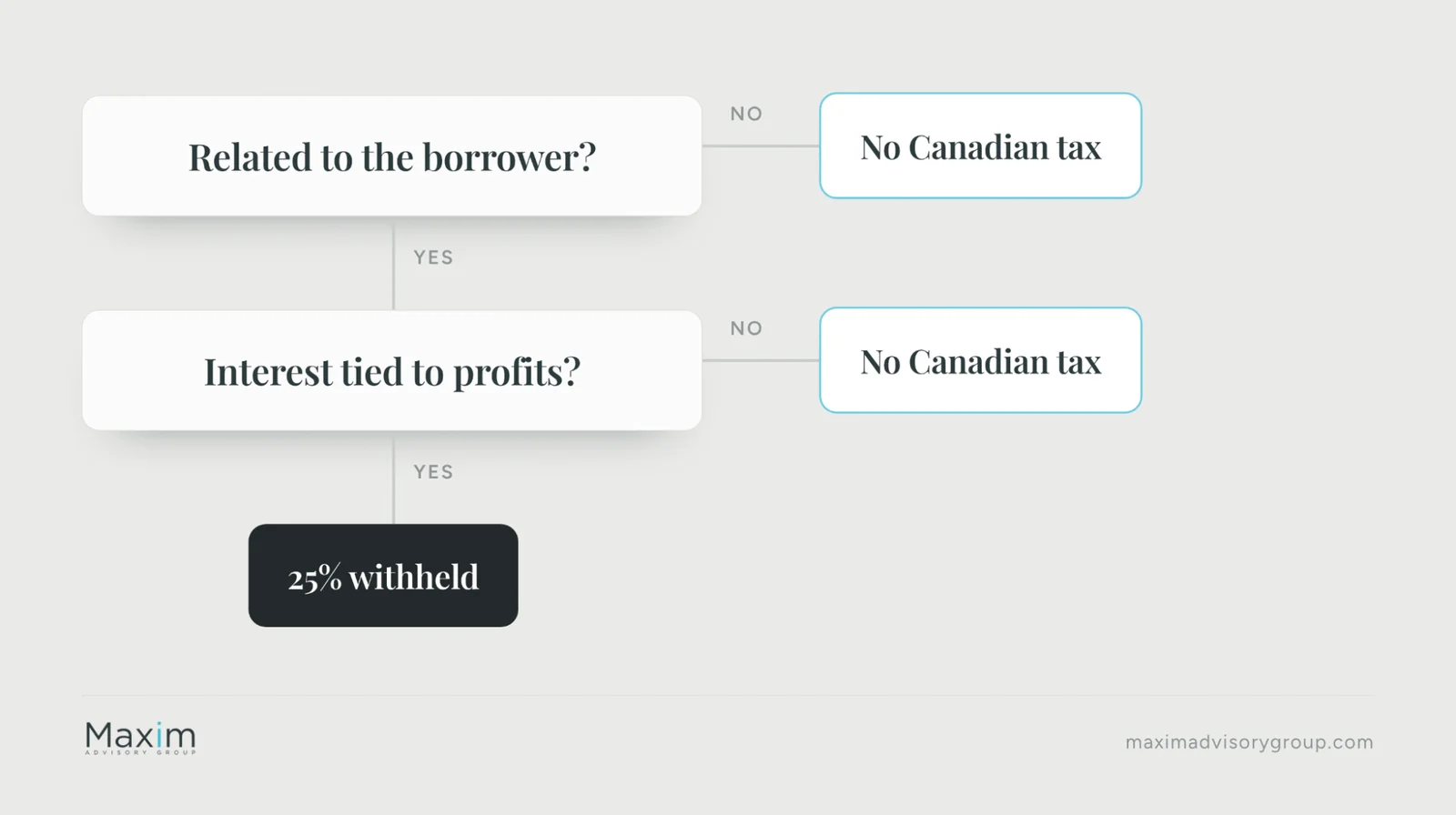
Canada only taxes interest in two situations: when you and the borrower aren’t at arm’s length (think: you control the company, or you’re related to the owner), or when your interest rate earned moves with the borrower’s profits, no matter who they are.
For almost all other loans and interest income, there’s no withholding and no Canadian tax at all.
Here’s the difference in practice. Say you lend a Canadian company $200,000 at 5%. That’s $10,000 a year in interest.
- If you have no other tie to the company, no shares, no board seat, Canada takes none of it.
- If you control that company, the exact same loan gets taxed. $2,500 comes off before you see a dime.
There’s a second trap: if your interest payment moves with the borrower’s revenue or profit (sometimes called “participating debt interest”), Canada taxes it either way. The arm’s-length test doesn’t save you here.
If you live in the US, there’s a second layer of protection. The treaty says interest earned by a US resident can only be taxed by the US. So on an arm’s-length loan, both the law and the treaty point the same way: Canada shouldn’t be taking anything.
Treaty rates don’t apply automatically
Lower treaty rates exist on dividends and royalties too. But nobody applies them for you.
Here’s the part that surprises people: your payer starts by assuming the full Canadian rate applies. They only use the treaty rate once you’ve told them you qualify, which means filing Form NR301 with them directly.
Skip that step, and you’ll get the full rate withheld correctly, by the letter of the process, even though you were entitled to less. Send Form NR301 to each payer before the next payment goes out. It’s a five-minute form, and it’s cheaper than finding the shortfall on next year’s slip and fighting to get it back.
One more thing: the rates in the table below are Canada-US numbers. Live somewhere else, and the same ideas apply, but the actual percentages won’t match. Check your own country’s treaty before relying on these.
Part XIII Or Part I: Sorting Every Canadian Payment You Receive
Here is every common Canadian income stream, sorted:
| Income type | System | Statutory rate | Canada–US treaty ceiling | Election |
|---|---|---|---|---|
| Employment performed in Canada | Part I | Graduated, plus provincial tax where the duties were done ※ | No ceiling, though Article XV(2) can exempt it outright | None |
| Business carried on in Canada | Part I | Graduated, plus provincial tax where the business is earned ※ | Canada may tax only through a permanent establishment, VII(1) ⌂ | None |
| Gain on taxable Canadian property | Part I | Graduated, plus the surtax | No ceiling on real property gains, XIII(1) | None |
| Rent from Canadian real property | Part XIII | 25% of gross | No ceiling, VI(1) | Section 216 |
| Timber royalties | Part XIII | 25% of gross | No ceiling, VI(1) | Section 216 |
| Dividends | Part XIII | 25% | 15%, or 5% for a company owning at least 10% of the voting stock, X(2) | None |
| Interest, arm’s length and not participating | Outside Part XIII | Nil | Nil, XI(1) | Not needed |
| Interest, non-arm’s-length | Part XIII | 25% | Nil under XI(1), except any excess over a commercial rate, XI(5) | None |
| Interest, participating | Part XIII | 25% | 15% where XI(6)(b) reaches it, otherwise nil under XI(1) | None |
| Royalties, general | Part XIII | 25% | 10%, XII(2) | None |
| Royalties for copyright, software, patent, know-how, broadcasting | Part XIII | 25% | Nil, XII(3), with carve-outs | None |
| Periodic pension payments | Part XIII | 25% | 15%, XVIII(2) | Section 217 † |
| RRSP and RRIF payments | Part XIII | 25% | 15% where it is a periodic pension payment | Section 217 † |
| Annuity payments | Part XIII | 25% | 15% of the portion Canada can tax, XVIII(2) | Section 217 † |
| OAS, CPP and QPP benefits | Part XIII | 25% | Taxable only where you live, XVIII(5) | Section 217 † |
| OAS, recovery tax on top | Separate | Additional ◊ | None | |
| Management or administration fees | Part XIII | 25%, with a wide carve-out in 212(4) | Not stated here ◊◊ | None |
Base: Canadian-source income paid to a non-resident individual, for the 2026 tax year. Statutory rates are from sections 115(1), 212(1) and 212(2) of the Income Tax Act, with the carve-outs in 212(4) and the provincial allocation in Regulation 2602. Treaty references are to the Canada–US convention consolidated to include the protocol signed 21 September 2007, and apply only to a resident of the United States. Verified 14 September 2026.
Every treaty ceiling above carries conditions this page does not set out. Articles XI(6), XII(3) and XV(2) in particular each run to a list of carve-outs, and the treaty page works through them.
※ Regulation 2602 counts a non-resident’s employment income attributable to duties performed in a province, and business income earned in a province, as earned in that province. Those carry that province’s own tax and fall outside the 48% surtax. A business carried on in Canada without a permanent establishment in any province stays outside the regulation and does carry it, as does income that is neither employment nor business income.
⌂ A permanent establishment is a fixed place of business in Canada. A customer here is not one, and neither is a contract signed here. If you sell services, watch the rule the 2007 protocol added: it can deem you to have one without any premises at all.
† Section 217 covers a defined list of qualifying income. Check your own income type against Guide T4058 before relying on it.
◊ OAS carries a second, separate charge. The recovery tax reaches non-residents, who file Form T1136, and it stacks on the withholding, capped so that the two together never exceed the OAS received in the year.
◊◊ Management fees are not given their own article in the treaty, and whether they fall under business profits in Article VII turns on facts, and on sources this page leaves unverified. The cell is left unstated rather than guessed.
Section 216: Moving Rent From Gross To Net
If you’re a landlord, 25% withholding has one inherent flaw: it’s charged on your gross rent, not what you actually earned. A property carrying a mortgage, property tax, insurance, and a management fee might barely break even while Canada takes a quarter of every rent check that comes in.
A section 216 election fixes that. It lets you pay tax on your net rental income, or what’s left after expenses, instead of the gross amount collected. It’s a separate return, covering only that rental income. Where withholding took more than you owed, the CRA refunds the difference.
For most rental properties, this isn’t close. Expenses would have to be tiny, and rent enormous, before 25% of gross beats graduated tax on net. If you own a Canadian rental and haven’t filed one of these, there’s likely money owed to you.
Form NR6: Fix The Withholding Before It Happens, Not After
Section 216 gets your money back. Eventually. It does nothing about the year in between, while you wait on a refund for tax that shouldn’t have been taken in the first place.
Form NR6 fixes that upfront. Get it approved before rent starts coming in, and your Canadian agent withholds 25% of your net income all year, not your gross. You never overpay to begin with.
That fix has a cost for your agent, too. Once NR6 is approved, your agent is responsible for remitting that tax to the CRA by the 15th of the month after they pay you. That’s a real obligation you’re handing your property manager. Talk to them before you file the form, not after.
Miss The Deadline, And The Election Is Gone
You generally have two years from the end of the year the rent was paid to file your section 216 return. File under an approved NR6, and that window shrinks to June 30 of the following year.
Miss it, and the CRA doesn’t grant an extension or charge a penalty. It just makes the election invalid.
That puts you back to 25% of gross rent for that year, with no way to fix it after the fact. It happens every year, usually because nobody flagged the date until it had already passed.
Confirm the actual due date for the year you’re filing, since NR6 changes it. Don’t rely on “two years” as the final answer.
What A Return Costs You: The Surtax And The 90% Rule
Filing a return isn’t free. Two costs catch people off guard, and both matter when you’re deciding if an election is worth it.
The 48% surtax replaces provincial tax, and non-residents usually pay it in full
Here’s the assumption people make: “I don’t live in a province, so provincial tax doesn’t apply to me. I only pay the federal rate. I come out ahead.”
That logic sounds airtight, but it’s wrong because of one rule: the federal surtax.
Every Canadian resident pays provincial tax on top of federal tax. Non-residents don’t live in a province, so instead they pay a federal surtax that stands in for it. That surtax is 48% of your federal tax, and how much of it applies depends on one thing: how much of your income counts as “earned in a province.”
For most non-resident income, none of it does. Rent, a pension, a gain on Canadian real estate, none of that is tied to a specific province. For income like that, the full 48% surtax applies. You don’t skip provincial-level tax. You just pay it under a different name, calculated a different way, usually landing higher than what a resident in a low-tax province would pay.
There’s one real exception: income from a job or business you actively worked in a specific province. That income is treated as “earned in a province,” and gets that province’s tax rate instead of the surtax.
So the assumption “no province, no provincial-style tax” is only true for employment and business income tied to a specific province. On rent, pensions, and property gains, it’s backwards: you almost always pay the surtax in full.
Here is the condo, run both ways. $30,000 of rent, $18,000 of costs:
| Leave it alone | Elect under section 216 | |
|---|---|---|
| What Canada taxes | $30,000 of gross rent | $12,000 of net rent |
| Rate | 25%, flat | 14%, the bottom federal bracket |
| Federal tax | $7,500 | $1,680 |
| Surtax, 48% of the federal tax | none, there is no return | $806 |
| Canadian tax for the year | $7,500 | about $2,500 |
| When you pay it | As each rent cheque is paid | On a return, with the over-withholding refunded |
Illustrative figures for the 2026 tax year, to show the mechanism rather than predict a bill. Rent and expenses are round numbers chosen for the example, and every tax figure is computed from the rates cited on this page. The election column claims no personal credit against the net rent. Whether any is available to you turns on the 90% test below, so treat this as a comparison rather than a quote.
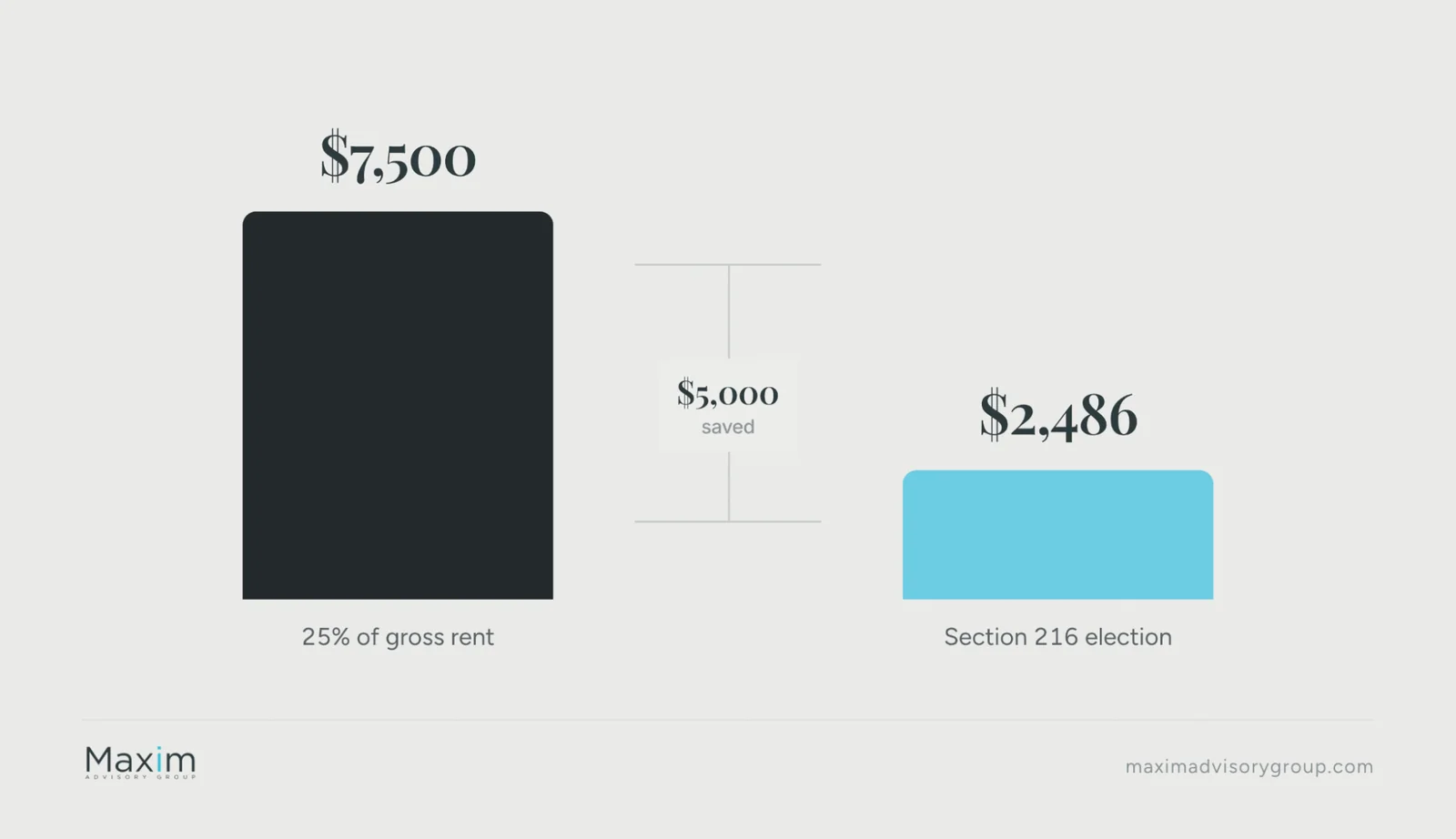
The election wins by about $5,000. The surtax took roughly a third of the smaller bill and came nowhere near reversing the decision. That’s how it goes on rental income, because the expenses are large. Pension income behaves differently: nothing to deduct, and the surtax applies to graduated tax on the whole payment.
The 90% Rule Decides Whether You Keep Your Credits
Filing a Canadian return gets you access to non-refundable credits, the basic personal amount, the age amount, tuition. These come off your tax bill directly, not your income, and on a small Canadian income they can wipe out most of what you owe.
But as a non-resident, you don’t get them automatically. You have to pass a test first.
The test is simple: what share of your total income for the year came from Canada? Work that out on Form T1234, Schedule B. Hit 90% or more, and you keep every credit a resident would get. Fall under that, and most of them disappear.
What survives below 90% is a short, specific list: CPP or QPP contributions, EI premiums, student loan interest, tuition, and the disability amount, all things you actually paid into or qualify for directly.
Here’s the one that stings. The basic personal amount, the credit doing most of the work on a typical return, isn’t on that list. Miss the 90% threshold, and that’s the first thing you lose.
So before filing a return to fix a withholding problem, it’s worth checking where you land on that 90% line. If most of your income last year came from outside Canada, the credits you were counting on to shrink the bill might not be there.
Section 217: The Election That Might Not Help You
The same swap you saw for rent, trading flat withholding for a regular return, exists for pension income too: old age security, CPP, QPP, superannuation, RRSP payments, and a defined list of others. File a Canadian return, and you might get some of the withholding back.
The CRA treats this election with visibly more caution than the rental one. Its own guidance flags “should you elect” as a question worth asking, and describes the outcome as a possible refund of all or part of the tax withheld. Not “you’ll get it back.” Might, and maybe only part.
Here’s why the caution is warranted. Section 216 works for rent because rental properties have real expenses (mortgage interest, repairs, management fees) that shrink your taxable income well below the gross amount Canada withheld on. Pensions don’t have expenses to deduct. There’s nothing to shrink.
So the trade you’re actually making is: a flat 25% (or 15%, if a treaty caps your pension rate), against graduated tax on the full pension amount, plus the surtax, minus whatever credits you still qualify for after the 90% test.
Here’s where that goes wrong. Say your only Canadian income is a modest pension, and most of your actual income comes from where you live now. Your Canadian income is nowhere near 90% of your total. You lose most of your credits. You pay graduated rates. You pay the surtax. And you have almost nothing left to offset any of it.
There’s no shortcut here. No rule of thumb tells you in advance whether section 217 helps or hurts. The only way to know is to run the numbers both ways, and since income changes, you’d need to check again every year. That’s real work, and it’s worth knowing that going in, before you file, not after.
When You Have To File, And What You Need To Do It
Getting the rate right is only half the job. The other half is paperwork, and it’s where people trip up after they’ve done everything else correctly.
Some things force a return, whether you want one or not. The elections in this guide (section 216, section 217) are optional. Filing isn’t always. If you sold Canadian property this year, or earned employment or business income in Canada, you have to file a return. Owing zero doesn’t excuse you. Selling the condo puts you in the filing system automatically.
Every deadline on this page is different:
- 10 days to notify the CRA after selling Canadian property
- 2 years to file a section 216 return, or June 30 of the following year if an NR6 was approved
- The 15th of the month for your agent to remit withheld tax
- April 30 for a standard return, or June 15 if you carried on a business
None of these line up. That’s why people who track everything else correctly still miss one.
You can’t file anything without a tax number, and it takes weeks to get one. No Canadian social insurance number means no tax number, and no tax number means you can’t file a return, make an election, reduce withholding, or report a property sale. You need Form T1261 to get one, and the CRA’s own estimate is 6 to 8 weeks.
That timeline ruins more deadlines than anything else here. If your section 216 return is due June 30 and you start the tax number process in May, you’re already too late.
Over-withheld tax is refundable, but only for two years. Say a payer withheld 25% when the treaty capped it at 15%. You can claim that difference back on Form NR7-R. The catch: the CRA has to receive it within two years of the end of the year the tax was sent in. Miss the window, and the money is gone for good.
That means 2026 over-withholding has to be claimed by the end of 2028. Anything from 2023 is already unrecoverable.
If any of this sounds like you, do this first: Pull your last two years of NR4 slips. Check the withholding rate against what you actually owed. The oldest ones on that list are the ones closest to expiring, so start there.
8 Common Non-Resident Tax Traps
These come up over and over. Avoid these mistakes:
- Assuming all your income is taxed the same way. It isn’t. Canada sorts what you earn by type. Pay for work done here goes on a tax return at regular rates. Rent, pensions, and dividends lose a flat 25% off the top, often less under a treaty. Most interest from a bank isn’t taxed at all. Each type has its own rules, so check each one.
- Assuming interest is taxed at 25%. It usually isn’t. Ordinary interest from an unrelated borrower isn’t taxed by Canada at all, and for a US resident the treaty points the same way.
- Treating 183 days as a safe number. Reach it on a long stay, with no significant ties here and no other country claiming you under a treaty, and Canada can tax you as a resident for the whole year, on worldwide income.
- Missing the section 216 deadline. The CRA treats an out-of-time election as invalid, which puts 25% of the gross back as your final Canadian tax for that year.
- Starting the tax number too late. An ITN takes six to eight weeks, and it sits in front of every return and every waiver application on this page.
- Assuming no province means no provincial tax. Instead you pay an extra 48% on top of your federal tax, on income not earned in a province, which is most of what a non-resident receives.
- Waiting on a refund that expires. Form NR7-R has to reach the CRA within two years of the end of the calendar year the tax was sent. After that the money is gone.
- Expecting the treaty rate to apply itself. Your payer starts from the rate in the Act. You only get the lower treaty rate once you’ve given them Form NR301.
Non-Resident Tax Canada Frequently Asked Questions (FAQs)
What is non-resident tax in Canada?
Non-resident tax is the tax Canada charges on Canadian income you receive after you stop being a Canadian tax resident. It covers rent, dividends, pensions, RRSP and RRIF withdrawals, and royalties. It also covers pay for work done in Canada, business income earned here, and gains when you sell Canadian property. Most of it is taken off before you’re paid.
How much tax does Canada withhold from non-residents?
The standard rate is 25% of the gross payment, under Part XIII of the Income Tax Act. A tax treaty can lower it. For US residents, dividends usually drop to 15% and most pensions to 15%. Ordinary interest paid to an unrelated person isn’t taxed at all. To get a treaty rate, you give your payer Form NR301 before they pay you.
What is an NR4 slip?
An NR4 slip is the tax slip a Canadian payer sends you each spring for payments made to you as a non-resident. It shows the gross amount, the tax withheld, and a code for the type of income. It doesn’t tell you whether the right rate was withheld. Check each slip against the rate that should apply to that income.
Do non-residents have to file a Canadian tax return?
Not always. If all your Canadian income had the correct tax withheld at source, you usually don’t file. You do have to file if you sold taxable Canadian property, like real estate, or earned income from work or a business in Canada. You may also choose to file to pay less tax on rent under section 216, or to claim a refund.
How is rental income taxed for non-residents of Canada?
By default, your tenant or property manager withholds 25% of the gross rent. You can file a section 216 return instead and pay tax only on your net rental income after expenses, which usually saves money. To lower the monthly withholding during the year, file Form NR6 before the rent is paid. Your agent then withholds 25% of the net rent.
What is the deadline for a section 216 return?
You normally have two years from the end of the year the rent was paid to file your section 216 return. If you filed an approved Form NR6 that year, the deadline is much shorter: 30 June of the following year. Miss it and the election is invalid, so you’re taxed at 25% of the gross rent with no way to fix it.
How do I get back non-resident tax that was over-withheld?
File Form NR7-R to apply for a refund of Part XIII tax that was withheld at too high a rate. The CRA has to receive it within two years of the end of the calendar year the tax was sent to the CRA. After that, the refund is lost, so check your oldest NR4 slips first.
Do I need a Canadian tax number as a non-resident?
If you don’t have a Canadian social insurance number, you need an individual tax number, or ITN, before you can file a return, make a section 216 election, or apply to reduce withholding. You apply on Form T1261. The CRA says to allow 6 to 8 weeks, so apply well before any deadline.
Start With A List Of What Canada Pays You
Three things in this article are all about timing, not tax rate. Your payer sets the withholding rate the moment they pay you, not later. An NR6 only works if it’s approved before rent goes out, not after. And a section 216 election has a hard deadline, past which it simply stops existing.
None of that can be fixed in April, sitting down to file a return. By then, the year’s already happened.
So work backwards from what’s already true. Write down everything Canada pays you, and what kind of income each one is. Match each against what you’ve read here. For each one, ask three questions:
- Is the withholding rate already correct?
- Does fixing it require a form sitting with your payer (like NR301 or NR6)?
- Does it come with an election and a deadline (like section 216)?
If more than one or two items on your list need action, that’s worth bringing to an actual conversation instead of guessing your way through it alone. An hour now costs a lot less than a correction next spring.